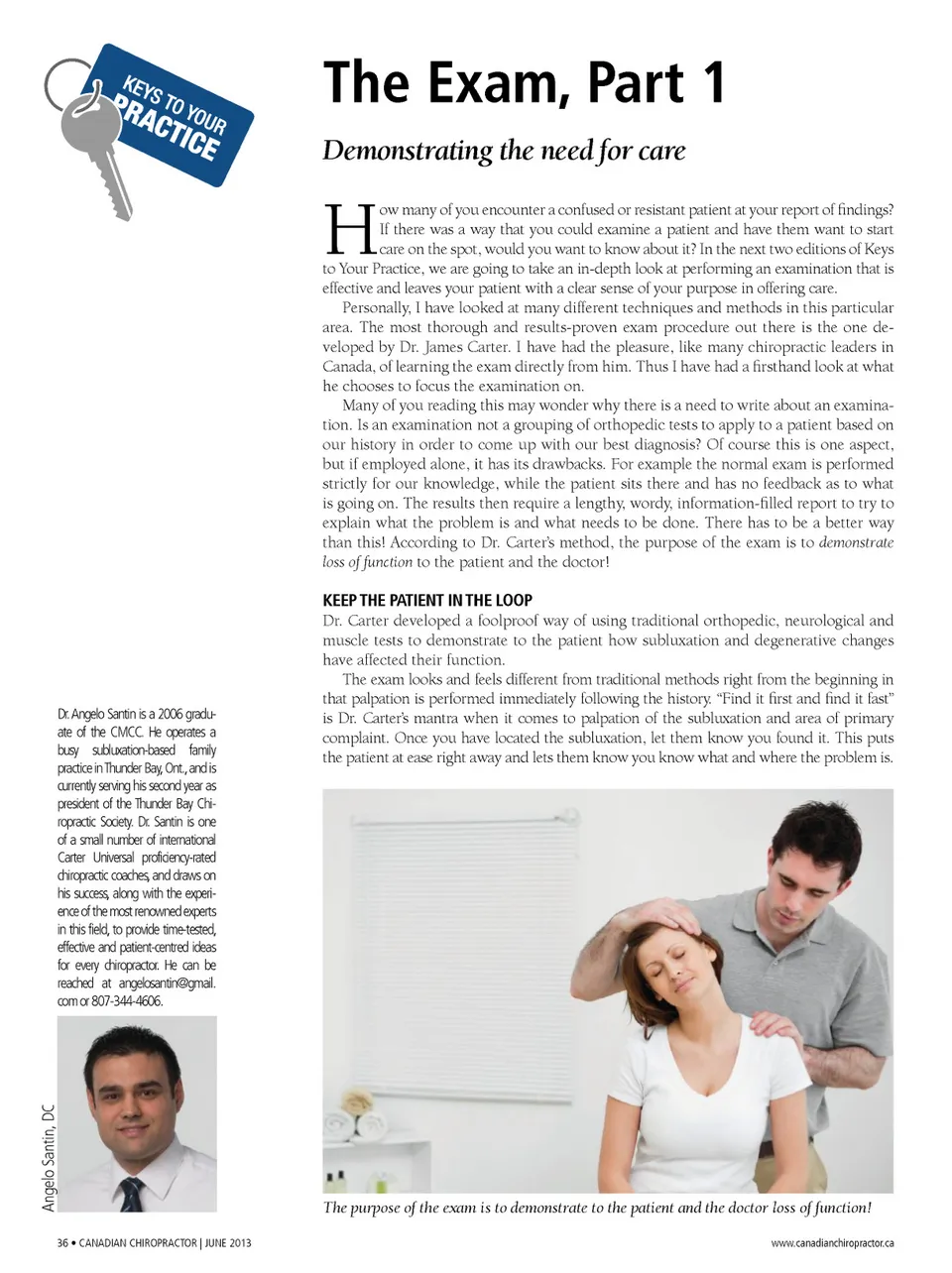
The Exam, Part 1 Demonstrating the need for care H ow many of you encounter a confused or resistant patient at your report of findings? If there was a way that you could examine a patient and have them want to start care on the spot, would you want to know about it? In the next two editions of Keys to Your Practice, we are going to take an in-depth look at performing an examination that is effective and leaves your patient with a clear sense of your purpose in offering care. Personally, I have looked at many different techniques and methods in this particular area. The most thorough and results-proven exam procedure out there is the one de-veloped by Dr. James Carter. I have had the pleasure, like many chiropractic leaders in Canada, of learning the exam directly from him. Thus I have had a firsthand look at what he chooses to focus the examination on. Many of you reading this may wonder why there is a need to write about an examina-tion. Is an examination not a grouping of orthopedic tests to apply to a patient based on our history in order to come up with our best diagnosis? Of course this is one aspect, but if employed alone, it has its drawbacks. For example the normal exam is performed strictly for our knowledge, while the patient sits there and has no feedback as to what is going on. The results then require a lengthy, wordy, information-filled report to try to explain what the problem is and what needs to be done. There has to be a better way than this! According to Dr. Carter’s method, the purpose of the exam is to demonstrate loss of function to the patient and the doctor! Dr. Angelo Santin is a 2006 gradu-ate of the CMCC. He operates a busy subluxation-based family practice in Thunder Bay, Ont., and is currently serving his second year as president of the Thunder Bay Chi-ropractic Society. Dr. Santin is one of a small number of international Carter Universal proficiency-rated chiropractic coaches, and draws on his success, along with the experi-ence of the most renowned experts in this field, to provide time-tested, effective and patient-centred ideas for every chiropractor. He can be reached at angelosantin@gmail. com or 807-344-4606. KEEP THE PATIENT IN THE LOOP Dr. Carter developed a foolproof way of using traditional orthopedic, neurological and muscle tests to demonstrate to the patient how subluxation and degenerative changes have affected their function. The exam looks and feels different from traditional methods right from the beginning in that palpation is performed immediately following the history. “Find it first and find it fast” is Dr. Carter’s mantra when it comes to palpation of the subluxation and area of primary complaint. Once you have located the subluxation, let them know you found it. This puts the patient at ease right away and lets them know you know what and where the problem is. Angelo Santin, DC The purpose of the exam is to demonstrate to the patient and the doctor loss of function! www.canadianchiropractor.ca 36 • CANADIAN CHIROPRACTOR | JUNE 2013
Chiropractic + Naturopathic Doctor June 2013 : Page 36