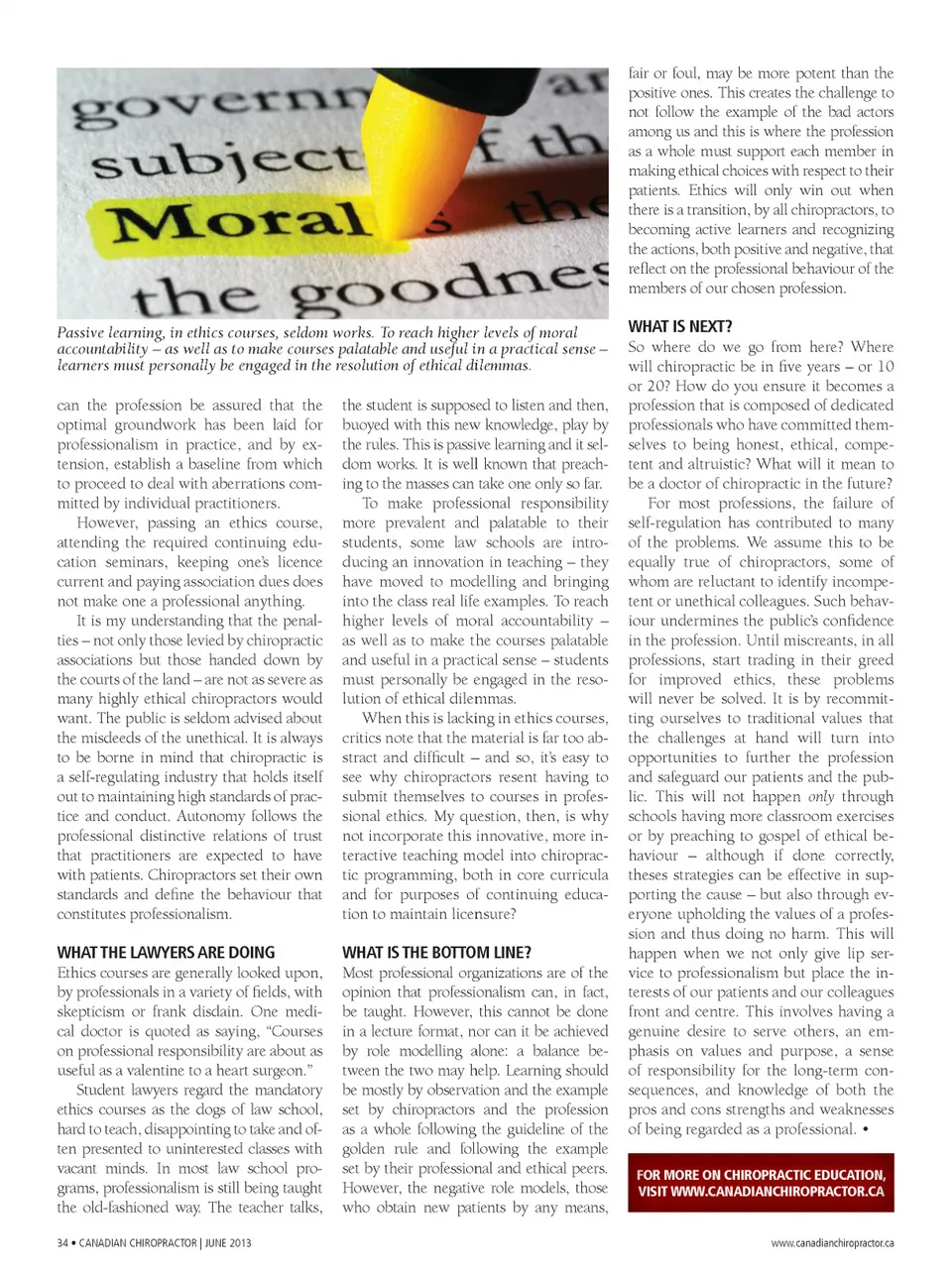
fair or foul, may be more potent than the positive ones. This creates the challenge to not follow the example of the bad actors among us and this is where the profession as a whole must support each member in making ethical choices with respect to their patients. Ethics will only win out when there is a transition, by all chiropractors, to becoming active learners and recognizing the actions, both positive and negative, that reflect on the professional behaviour of the members of our chosen profession. Passive learning, in ethics courses, seldom works. To reach higher levels of moral accountability – as well as to make courses palatable and useful in a practical sense – learners must personally be engaged in the resolution of ethical dilemmas. can the profession be assured that the optimal groundwork has been laid for professionalism in practice, and by ex-tension, establish a baseline from which to proceed to deal with aberrations com-mitted by individual practitioners. However, passing an ethics course, attending the required continuing edu-cation seminars, keeping one’s licence current and paying association dues does not make one a professional anything. It is my understanding that the penal-ties – not only those levied by chiropractic associations but those handed down by the courts of the land – are not as severe as many highly ethical chiropractors would want. The public is seldom advised about the misdeeds of the unethical. It is always to be borne in mind that chiropractic is a self-regulating industry that holds itself out to maintaining high standards of prac-tice and conduct. Autonomy follows the professional distinctive relations of trust that practitioners are expected to have with patients. Chiropractors set their own standards and define the behaviour that constitutes professionalism. the student is supposed to listen and then, buoyed with this new knowledge, play by the rules. This is passive learning and it sel-dom works. It is well known that preach-ing to the masses can take one only so far. To make professional responsibility more prevalent and palatable to their students, some law schools are intro-ducing an innovation in teaching – they have moved to modelling and bringing into the class real life examples. To reach higher levels of moral accountability – as well as to make the courses palatable and useful in a practical sense – students must personally be engaged in the reso-lution of ethical dilemmas. When this is lacking in ethics courses, critics note that the material is far too ab-stract and difficult – and so, it’s easy to see why chiropractors resent having to submit themselves to courses in profes-sional ethics. My question, then, is why not incorporate this innovative, more in-teractive teaching model into chiroprac-tic programming, both in core curricula and for purposes of continuing educa-tion to maintain licensure? WHAT THE LAWYERS ARE DOING Ethics courses are generally looked upon, by professionals in a variety of fields, with skepticism or frank disdain. One medi-cal doctor is quoted as saying, “Courses on professional responsibility are about as useful as a valentine to a heart surgeon.” Student lawyers regard the mandatory ethics courses as the dogs of law school, hard to teach, disappointing to take and of-ten presented to uninterested classes with vacant minds. In most law school pro-grams, professionalism is still being taught the old-fashioned way. The teacher talks, s CANADIAN CHIROPRACTOR | JUNE 2013 WHAT IS THE BOTTOM LINE? Most professional organizations are of the opinion that professionalism can, in fact, be taught. However, this cannot be done in a lecture format, nor can it be achieved by role modelling alone: a balance be-tween the two may help. Learning should be mostly by observation and the example set by chiropractors and the profession as a whole following the guideline of the golden rule and following the example set by their professional and ethical peers. However, the negative role models, those who obtain new patients by any means, WHAT IS NEXT? So where do we go from here? Where will chiropractic be in five years – or 10 or 20? How do you ensure it becomes a profession that is composed of dedicated professionals who have committed them-selves to being honest, ethical, compe-tent and altruistic? What will it mean to be a doctor of chiropractic in the future? For most professions, the failure of self-regulation has contributed to many of the problems. We assume this to be equally true of chiropractors, some of whom are reluctant to identify incompe-tent or unethical colleagues. Such behav-iour undermines the public’s confidence in the profession. Until miscreants, in all professions, start trading in their greed for improved ethics, these problems will never be solved. It is by recommit-ting ourselves to traditional values that the challenges at hand will turn into opportunities to further the profession and safeguard our patients and the pub-lic. This will not happen only through schools having more classroom exercises or by preaching to gospel of ethical be-haviour – although if done correctly, theses strategies can be effective in sup-porting the cause – but also through ev-eryone upholding the values of a profes-sion and thus doing no harm. This will happen when we not only give lip ser-vice to professionalism but place the in-terests of our patients and our colleagues front and centre. This involves having a genuine desire to serve others, an em-phasis on values and purpose, a sense of responsibility for the long-term con-sequences, and knowledge of both the pros and cons strengths and weaknesses vÊLi}ÊÀi}>À`i`Ê>ÃÊ>Ê«ÀviÃÃ>°ÊU FO F O R MO O RE O N CH C IR OP O RA CT C IC C E DU CA C TI ON O N , VI V ISI S T WW W W.CA C NA DI AN CH C IR OP O RA CT C OR O .C CA www.canadianchiropractor.ca
Chiropractic + Naturopathic Doctor June 2013 : Page 34