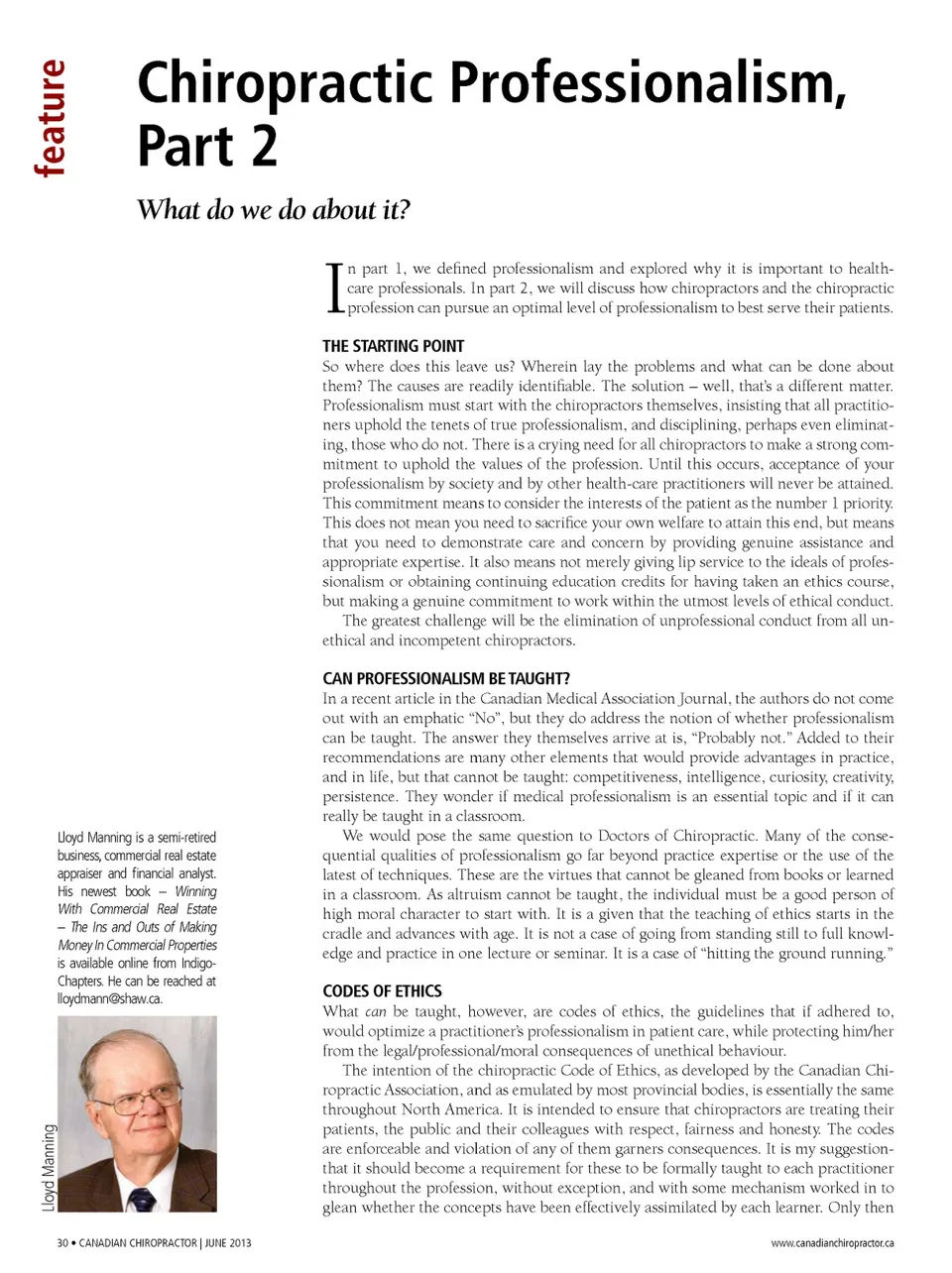
Chiropractic Professionalism, Part 2 What do we do about it? feature I n part 1, we defined professionalism and explored why it is important to health-care professionals. In part 2, we will discuss how chiropractors and the chiropractic profession can pursue an optimal level of professionalism to best serve their patients. THE STARTING POINT So where does this leave us? Wherein lay the problems and what can be done about them? The causes are readily identifiable. The solution – well, that’s a different matter. Professionalism must start with the chiropractors themselves, insisting that all practitio-ners uphold the tenets of true professionalism, and disciplining, perhaps even eliminat-ing, those who do not. There is a crying need for all chiropractors to make a strong com-mitment to uphold the values of the profession. Until this occurs, acceptance of your professionalism by society and by other health-care practitioners will never be attained. This commitment means to consider the interests of the patient as the number 1 priority. This does not mean you need to sacrifice your own welfare to attain this end, but means that you need to demonstrate care and concern by providing genuine assistance and appropriate expertise. It also means not merely giving lip service to the ideals of profes-sionalism or obtaining continuing education credits for having taken an ethics course, but making a genuine commitment to work within the utmost levels of ethical conduct. The greatest challenge will be the elimination of unprofessional conduct from all un-ethical and incompetent chiropractors. CAN PROFESSIONALISM BE TAUGHT? In a recent article in the Canadian Medical Association Journal, the authors do not come out with an emphatic “No”, but they do address the notion of whether professionalism can be taught. The answer they themselves arrive at is, “Probably not.” Added to their recommendations are many other elements that would provide advantages in practice, and in life, but that cannot be taught: competitiveness, intelligence, curiosity, creativity, persistence. They wonder if medical professionalism is an essential topic and if it can really be taught in a classroom. We would pose the same question to Doctors of Chiropractic. Many of the conse-quential qualities of professionalism go far beyond practice expertise or the use of the latest of techniques. These are the virtues that cannot be gleaned from books or learned in a classroom. As altruism cannot be taught, the individual must be a good person of high moral character to start with. It is a given that the teaching of ethics starts in the cradle and advances with age. It is not a case of going from standing still to full knowl-edge and practice in one lecture or seminar. It is a case of “hitting the ground running.” CODES OF ETHICS What can be taught, however, are codes of ethics, the guidelines that if adhered to, would optimize a practitioner’s professionalism in patient care, while protecting him/her from the legal/professional/moral consequences of unethical behaviour. The intention of the chiropractic Code of Ethics, as developed by the Canadian Chi-ropractic Association, and as emulated by most provincial bodies, is essentially the same throughout North America. It is intended to ensure that chiropractors are treating their patients, the public and their colleagues with respect, fairness and honesty. The codes are enforceable and violation of any of them garners consequences. It is my suggestion-that it should become a requirement for these to be formally taught to each practitioner throughout the profession, without exception, and with some mechanism worked in to glean whether the concepts have been effectively assimilated by each learner. Only then www.canadianchiropractor.ca Lloyd Manning is a semi-retired business, commercial real estate appraiser and financial analyst. His newest book – Winning With Commercial Real Estate – The Ins and Outs of Making Money In Commercial Properties is available online from Indigo-Chapters. He can be reached at [email protected]. Lloyd Manning 30 • CANADIAN CHIROPRACTOR | JUNE 2013
Chiropractic + Naturopathic Doctor June 2013 : Page 30