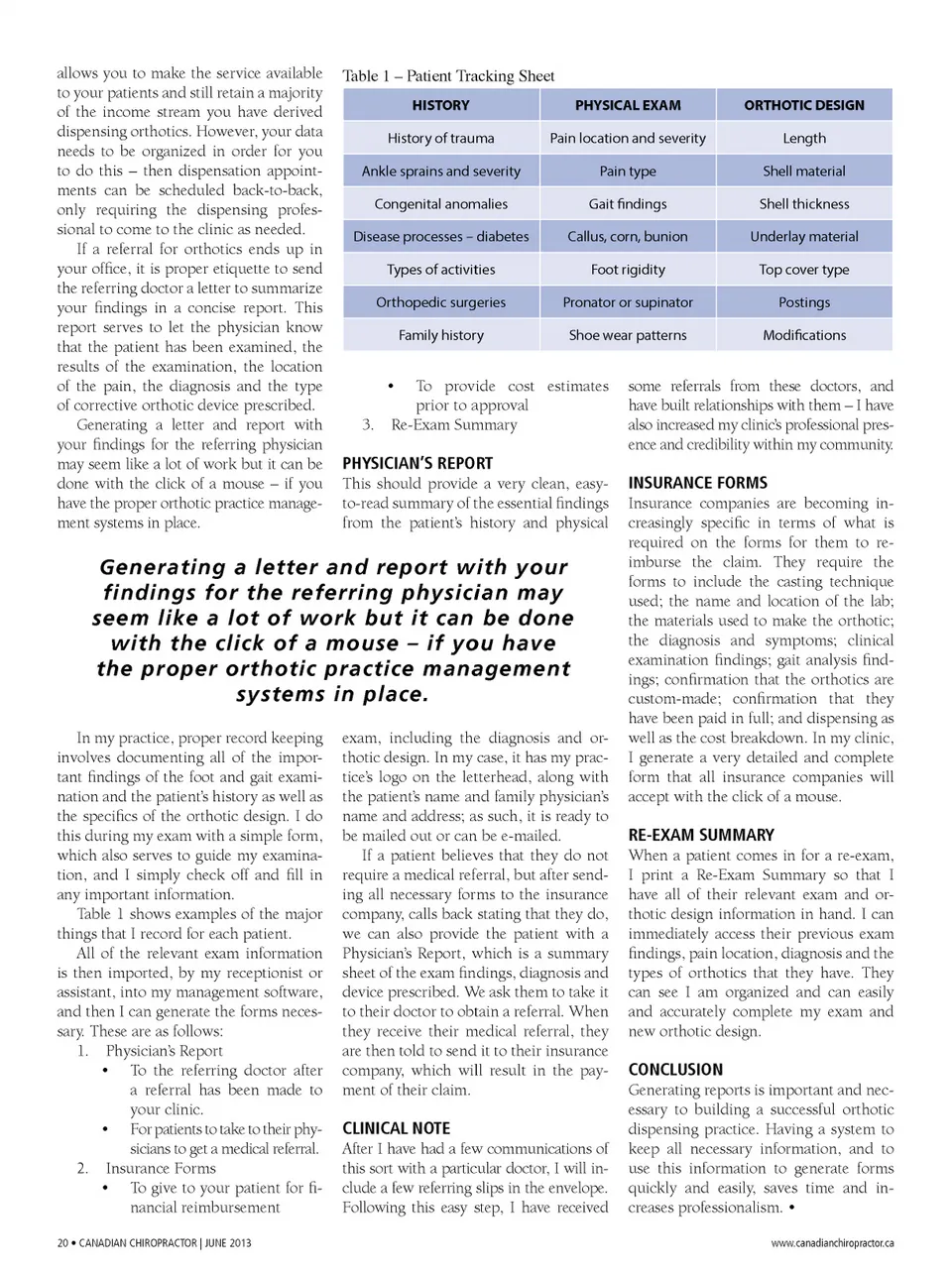
allows you to make the service available to your patients and still retain a majority of the income stream you have derived dispensing orthotics. However, your data needs to be organized in order for you to do this – then dispensation appoint-ments can be scheduled back-to-back, only requiring the dispensing profes-sional to come to the clinic as needed. If a referral for orthotics ends up in your office, it is proper etiquette to send the referring doctor a letter to summarize your findings in a concise report. This report serves to let the physician know that the patient has been examined, the results of the examination, the location of the pain, the diagnosis and the type of corrective orthotic device prescribed. Generating a letter and report with your findings for the referring physician may seem like a lot of work but it can be done with the click of a mouse – if you have the proper orthotic practice manage-ment systems in place. Table 1 – Patient Tracking Sheet HISTORY PHYSICAL EXAM ORTHOTIC DESIGN History of trauma Ankle sprains and severity Congenital anomalies Disease processes – diabetes Types of activities Orthopedic surgeries Family history Pain location and severity Pain type Gait findings Callus, corn, bunion Foot rigidity Pronator or supinator Shoe wear patterns Length Shell material Shell thickness Underlay material Top cover type Postings Modifications • 3. To provide cost estimates prior to approval Re-Exam Summary PHYSICIAN’S REPORT This should provide a very clean, easy-to-read summary of the essential findings from the patient’s history and physical some referrals from these doctors, and have built relationships with them – I have also increased my clinic’s professional pres-ence and credibility within my community. Generating a letter and report with your findings for the referring physician may seem like a lot of work but it can be done with the click of a mouse – if you have the proper orthotic practice management systems in place. In my practice, proper record keeping involves documenting all of the impor-tant findings of the foot and gait exami-nation and the patient’s history as well as the specifics of the orthotic design. I do this during my exam with a simple form, which also serves to guide my examina-tion, and I simply check off and fill in any important information. Table 1 shows examples of the major things that I record for each patient. All of the relevant exam information is then imported, by my receptionist or assistant, into my management software, and then I can generate the forms neces-sary. These are as follows: 1. Physician’s Report • To the referring doctor after a referral has been made to your clinic. • For patients to take to their phy-sicians to get a medical referral. 2. Insurance Forms • To give to your patient for fi-nancial reimbursement 20 • CANADIAN CHIROPRACTOR | JUNE 2013 exam, including the diagnosis and or-thotic design. In my case, it has my prac-tice’s logo on the letterhead, along with the patient’s name and family physician’s name and address; as such, it is ready to be mailed out or can be e-mailed. If a patient believes that they do not require a medical referral, but after send-ing all necessary forms to the insurance company, calls back stating that they do, we can also provide the patient with a Physician’s Report, which is a summary sheet of the exam findings, diagnosis and device prescribed. We ask them to take it to their doctor to obtain a referral. When they receive their medical referral, they are then told to send it to their insurance company, which will result in the pay-ment of their claim. INSURANCE FORMS Insurance companies are becoming in-creasingly specific in terms of what is required on the forms for them to re-imburse the claim. They require the forms to include the casting technique used; the name and location of the lab; the materials used to make the orthotic; the diagnosis and symptoms; clinical examination findings; gait analysis find-ings; confirmation that the orthotics are custom-made; confirmation that they have been paid in full; and dispensing as well as the cost breakdown. In my clinic, I generate a very detailed and complete form that all insurance companies will accept with the click of a mouse. RE-EXAM SUMMARY When a patient comes in for a re-exam, I print a Re-Exam Summary so that I have all of their relevant exam and or-thotic design information in hand. I can immediately access their previous exam findings, pain location, diagnosis and the types of orthotics that they have. They can see I am organized and can easily and accurately complete my exam and new orthotic design. CONCLUSION Generating reports is important and nec-essary to building a successful orthotic dispensing practice. Having a system to keep all necessary information, and to use this information to generate forms quickly and easily, saves time and in-creases professionalism. • www.canadianchiropractor.ca CLINICAL NOTE After I have had a few communications of this sort with a particular doctor, I will in-clude a few referring slips in the envelope. Following this easy step, I have received
Chiropractic + Naturopathic Doctor June 2013 : Page 20