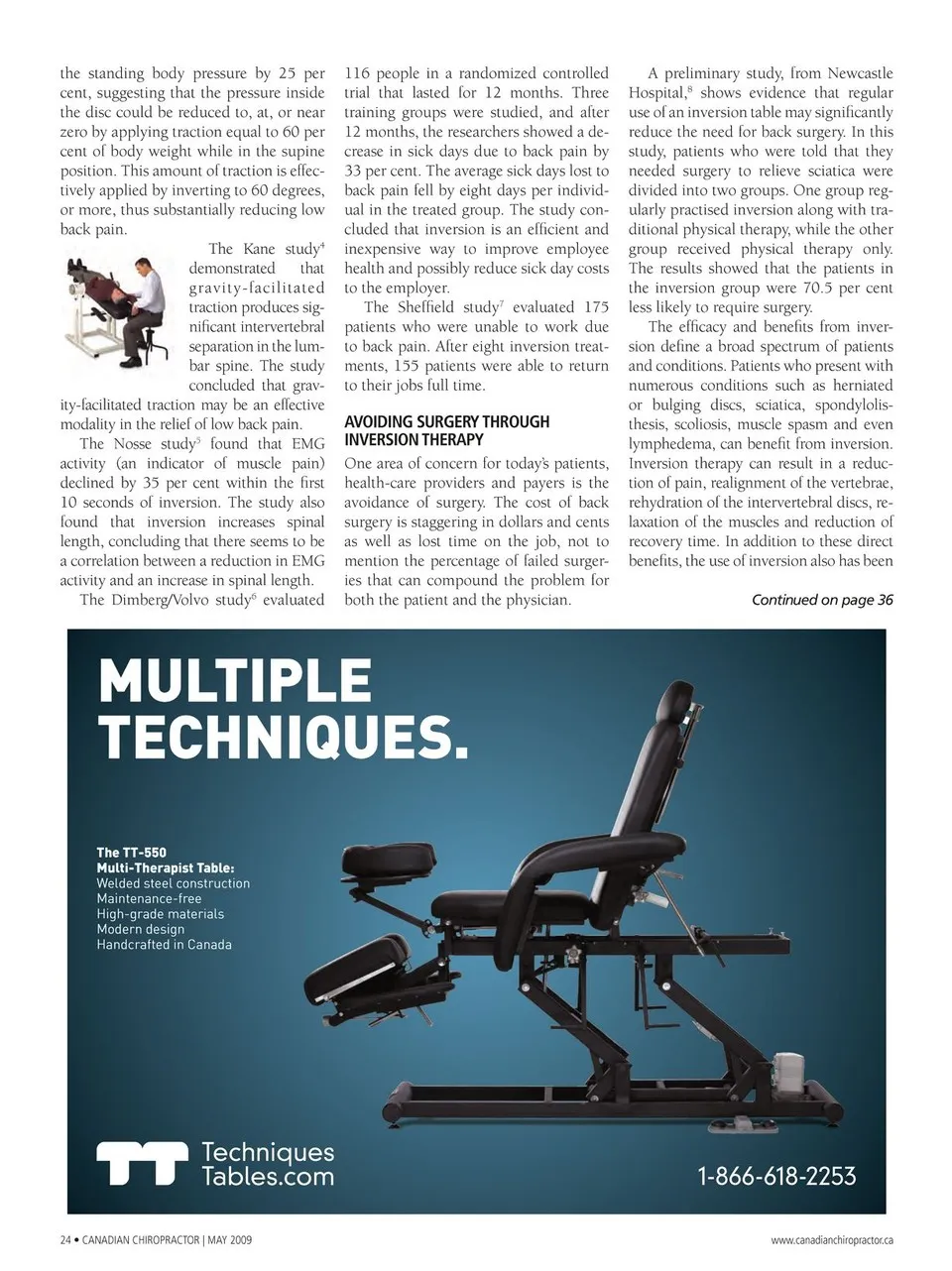
the standing body pressure by 25 per cent, suggesting that the pressure inside the disc could be reduced to, at, or near zero by applying traction equal to 60 per cent of body weight while in the supine position. This amount of traction is effec- tively applied by inverting to 60 degrees, or more, thus substantially reducing low back pain. The Kane study4 demonstrated that gravity-facilitated traction produces sig- nificant intervertebral separation in the lum- bar spine. The study concluded that grav- ity-facilitated traction may be an effective modality in the relief of low back pain. The Nosse study5 found that EMG activity (an indicator of muscle pain) declined by 35 per cent within the first 10 seconds of inversion. The study also found that inversion increases spinal length, concluding that there seems to be a correlation between a reduction in EMG activity and an increase in spinal length. The Dimberg/Volvo study6 evaluated 116 people in a randomized controlled trial that lasted for 12 months. Three training groups were studied, and after 12 months, the researchers showed a de- crease in sick days due to back pain by 33 per cent. The average sick days lost to back pain fell by eight days per individ- ual in the treated group. The study con- cluded that inversion is an efficient and inexpensive way to improve employee health and possibly reduce sick day costs to the employer. The Sheffield study7 evaluated 175 patients who were unable to work due to back pain. After eight inversion treat- ments, 155 patients were able to return to their jobs full time. AVOIDING SURGERY THROUGH INVERSION THERAPY One area of concern for today’s patients, health-care providers and payers is the avoidance of surgery. The cost of back surgery is staggering in dollars and cents as well as lost time on the job, not to mention the percentage of failed surger- ies that can compound the problem for both the patient and the physician. Hospital,8 A preliminary study, from Newcastle shows evidence that regular use of an inversion table may significantly reduce the need for back surgery. In this study, patients who were told that they needed surgery to relieve sciatica were divided into two groups. One group reg- ularly practised inversion along with tra- ditional physical therapy, while the other group received physical therapy only. The results showed that the patients in the inversion group were 70.5 per cent less likely to require surgery. The effi cacy and benefi ts from inver- sion defi ne a broad spectrum of patients and conditions. Patients who present with numerous conditions such as herniated or bulging discs, sciatica, spondylolis- thesis, scoliosis, muscle spasm and even lymphedema, can benefi t from inversion. Inversion therapy can result in a reduc- tion of pain, realignment of the vertebrae, rehydration of the intervertebral discs, re- laxation of the muscles and reduction of recovery time. In addition to these direct benefi ts, the use of inversion also has been Continued on page 36 Techniques Tables.com 24 • CANADIAN CHIROPRACTOR | MAY 2009 1-866-618-2253 www.canadianchiropractor.ca
Chiropractic + Naturopathic Doctor May 2009: Page 24