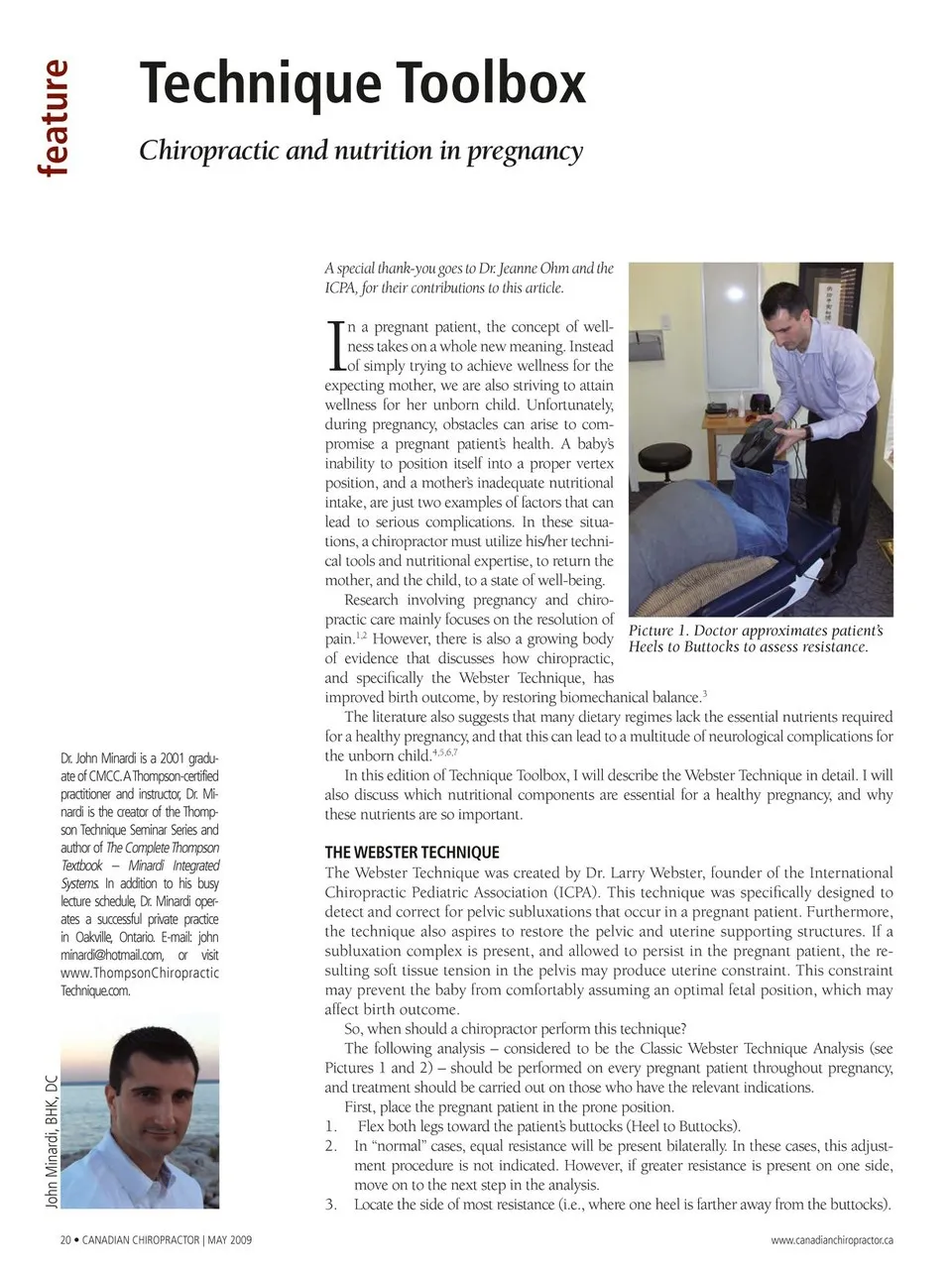
John Minardi, BHK, DC feature Technique Toolbox Chiropractic and nutrition in pregnancy A special thank-you goes to Dr. Jeanne Ohm and the ICPA, for their contributions to this article. n a pregnant patient, the concept of well- ness takes on a whole new meaning. Instead of simply trying to achieve wellness for the expecting mother, we are also striving to attain wellness for her unborn child. Unfortunately, during pregnancy, obstacles can arise to com- promise a pregnant patient’s health. A baby’s inability to position itself into a proper vertex position, and a mother’s inadequate nutritional intake, are just two examples of factors that can lead to serious complications. In these situa- tions, a chiropractor must utilize his/her techni- cal tools and nutritional expertise, to return the mother, and the child, to a state of well-being. Research involving pregnancy and chiro- I practic care mainly focuses on the resolution of pain.1,2 Dr. John Minardi is a 2001 gradu- ate of CMCC. A Thompson-certified practitioner and instructor, Dr. Mi- nardi is the creator of the Thomp- son Technique Seminar Series and author of The Complete Thompson Textbook – Minardi Integrated Systems. In addition to his busy lecture schedule, Dr. Minardi oper- ates a successful private practice in Oakville, Ontario. E-mail: john [email protected], or visit www.ThompsonChiropractic Technique.com. However, there is also a growing body of evidence that discusses how chiropractic, and specifi cally the Webster Technique, has improved birth outcome, by restoring biomechanical balance.3 The literature also suggests that many dietary regimes lack the essential nutrients required for a healthy pregnancy, and that this can lead to a multitude of neurological complications for the unborn child.4,5,6,7 In this edition of Technique Toolbox, I will describe the Webster Technique in detail. I will also discuss which nutritional components are essential for a healthy pregnancy, and why these nutrients are so important. Picture 1. Doctor approximates patient’s Heels to Buttocks to assess resistance. THE WEBSTER TECHNIQUE The Webster Technique was created by Dr. Larry Webster, founder of the International Chiropractic Pediatric Association (ICPA). This technique was specifi cally designed to detect and correct for pelvic subluxations that occur in a pregnant patient. Furthermore, the technique also aspires to restore the pelvic and uterine supporting structures. If a subluxation complex is present, and allowed to persist in the pregnant patient, the re- sulting soft tissue tension in the pelvis may produce uterine constraint. This constraint may prevent the baby from comfortably assuming an optimal fetal position, which may affect birth outcome. So, when should a chiropractor perform this technique? The following analysis – considered to be the Classic Webster Technique Analysis (see Pictures 1 and 2) – should be performed on every pregnant patient throughout pregnancy, and treatment should be carried out on those who have the relevant indications. First, place the pregnant patient in the prone position. Flex both legs toward the patient’s buttocks (Heel to Buttocks). In “normal” cases, equal resistance will be present bilaterally. In these cases, this adjust- ment procedure is not indicated. However, if greater resistance is present on one side, move on to the next step in the analysis. Locate the side of most resistance (i.e., where one heel is farther away from the buttocks). 1. 2. 3. 20 • CANADIAN CHIROPRACTOR | MAY 2009 www.canadianchiropractor.ca
Chiropractic + Naturopathic Doctor May 2009: Page 20