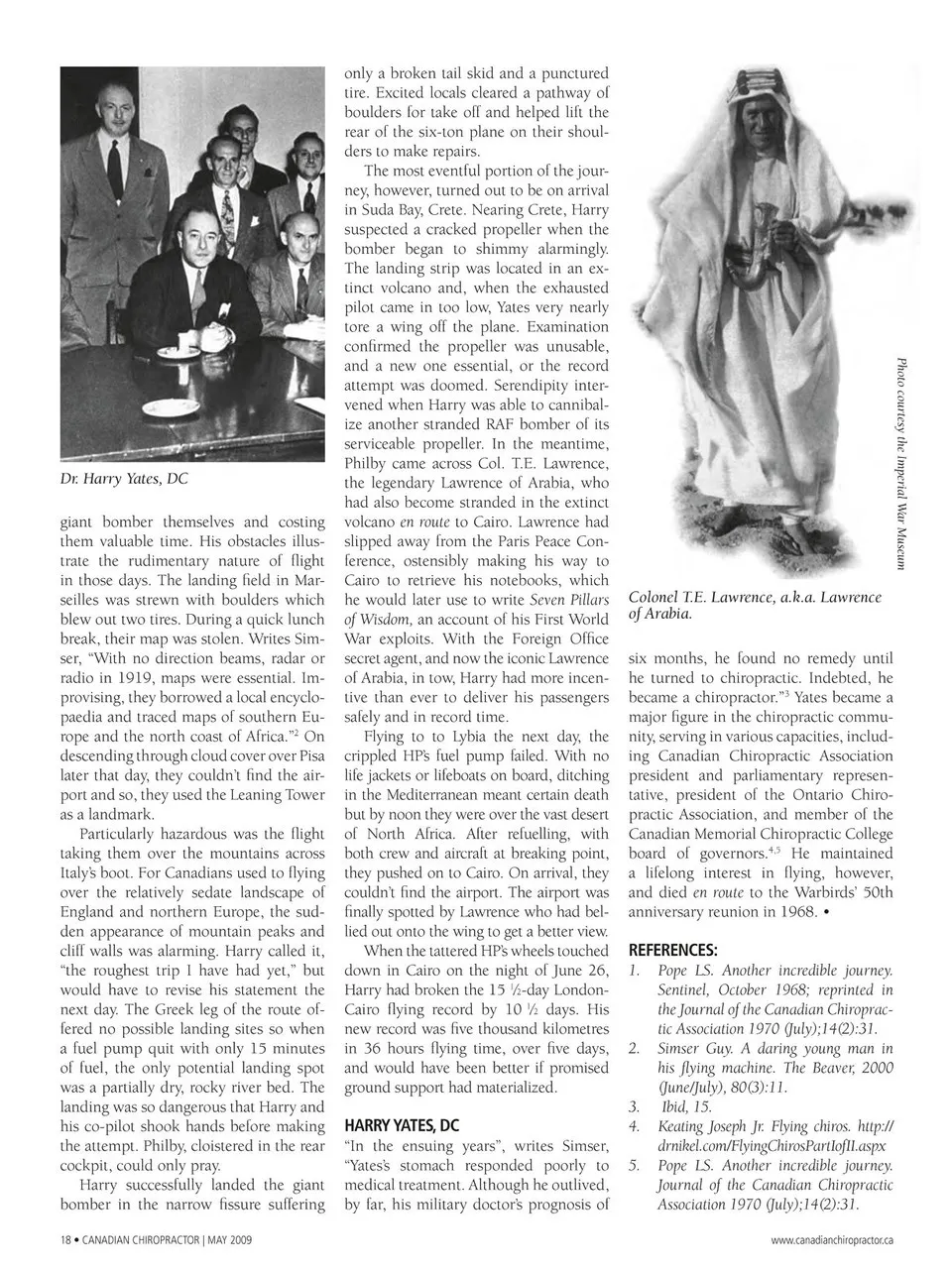
only a broken tail skid and a punctured tire. Excited locals cleared a pathway of boulders for take off and helped lift the rear of the six-ton plane on their shoul- ders to make repairs. The most eventful portion of the jour- Dr. Harry Yates, DC giant bomber themselves and costing them valuable time. His obstacles illus- trate the rudimentary nature of flight in those days. The landing fi eld in Mar- seilles was strewn with boulders which blew out two tires. During a quick lunch break, their map was stolen. Writes Sim- ser, “With no direction beams, radar or radio in 1919, maps were essential. Im- provising, they borrowed a local encyclo- paedia and traced maps of southern Eu- rope and the north coast of Africa.”2 On descending through cloud cover over Pisa later that day, they couldn’t fi nd the air- port and so, they used the Leaning Tower as a landmark. Particularly hazardous was the flight taking them over the mountains across Italy’s boot. For Canadians used to flying over the relatively sedate landscape of England and northern Europe, the sud- den appearance of mountain peaks and cliff walls was alarming. Harry called it, “the roughest trip I have had yet,” but would have to revise his statement the next day. The Greek leg of the route of- fered no possible landing sites so when a fuel pump quit with only 15 minutes of fuel, the only potential landing spot was a partially dry, rocky river bed. The landing was so dangerous that Harry and his co-pilot shook hands before making the attempt. Philby, cloistered in the rear cockpit, could only pray. Harry successfully landed the giant bomber in the narrow fissure suffering 18 • CANADIAN CHIROPRACTOR | MAY 2009 ney, however, turned out to be on arrival in Suda Bay, Crete. Nearing Crete, Harry suspected a cracked propeller when the bomber began to shimmy alarmingly. The landing strip was located in an ex- tinct volcano and, when the exhausted pilot came in too low, Yates very nearly tore a wing off the plane. Examination confi rmed the propeller was unusable, and a new one essential, or the record attempt was doomed. Serendipity inter- vened when Harry was able to cannibal- ize another stranded RAF bomber of its serviceable propeller. In the meantime, Philby came across Col. T.E. Lawrence, the legendary Lawrence of Arabia, who had also become stranded in the extinct volcano en route to Cairo. Lawrence had slipped away from the Paris Peace Con- ference, ostensibly making his way to Cairo to retrieve his notebooks, which he would later use to write Seven Pillars of Wisdom, an account of his First World War exploits. With the Foreign Office secret agent, and now the iconic Lawrence of Arabia, in tow, Harry had more incen- tive than ever to deliver his passengers safely and in record time. Flying to to Lybia the next day, the crippled HP’s fuel pump failed. With no life jackets or lifeboats on board, ditching in the Mediterranean meant certain death but by noon they were over the vast desert of North Africa. After refuelling, with both crew and aircraft at breaking point, they pushed on to Cairo. On arrival, they couldn’t fi nd the airport. The airport was fi nally spotted by Lawrence who had bel- lied out onto the wing to get a better view. When the tattered HP’s wheels touched down in Cairo on the night of June 26, Harry had broken the 15 1 Cairo fl ying record by 10 1 ⁄2 Colonel T.E. Lawrence, a.k.a. Lawrence of Arabia. six months, he found no remedy until he turned to chiropractic. Indebted, he became a chiropractor.”3 Yates became a major fi gure in the chiropractic commu- nity, serving in various capacities, includ- ing Canadian Chiropractic Association president and parliamentary represen- tative, president of the Ontario Chiro- practic Association, and member of the Canadian Memorial Chiropractic College board of governors.4,5 He maintained a lifelong interest in flying, however, and died en route to the Warbirds’ 50th anniversary reunion in 1968. • REFERENCES: 1. -day London- ⁄2 days. His new record was fi ve thousand kilometres in 36 hours fl ying time, over five days, and would have been better if promised ground support had materialized. HARRY YATES, DC “In the ensuing years”, writes Simser, “Yates’s stomach responded poorly to medical treatment. Although he outlived, by far, his military doctor’s prognosis of 2. 3. 4. 5. Pope LS. Another incredible journey. Sentinel, October 1968; reprinted in the Journal of the Canadian Chiroprac- tic Association 1970 (July);14(2):31. Simser Guy. A daring young man in his fl ying machine. The Beaver, 2000 (June/July), 80(3):11. Ibid, 15. Keating Joseph Jr. Flying chiros. http:// drnikel.com/FlyingChirosPartIofII.aspx Pope LS. Another incredible journey. Journal of the Canadian Chiropractic Association 1970 (July);14(2):31. www.canadianchiropractor.ca Photo courtesy the Imperial War Museum
Chiropractic + Naturopathic Doctor May 2009: Page 18