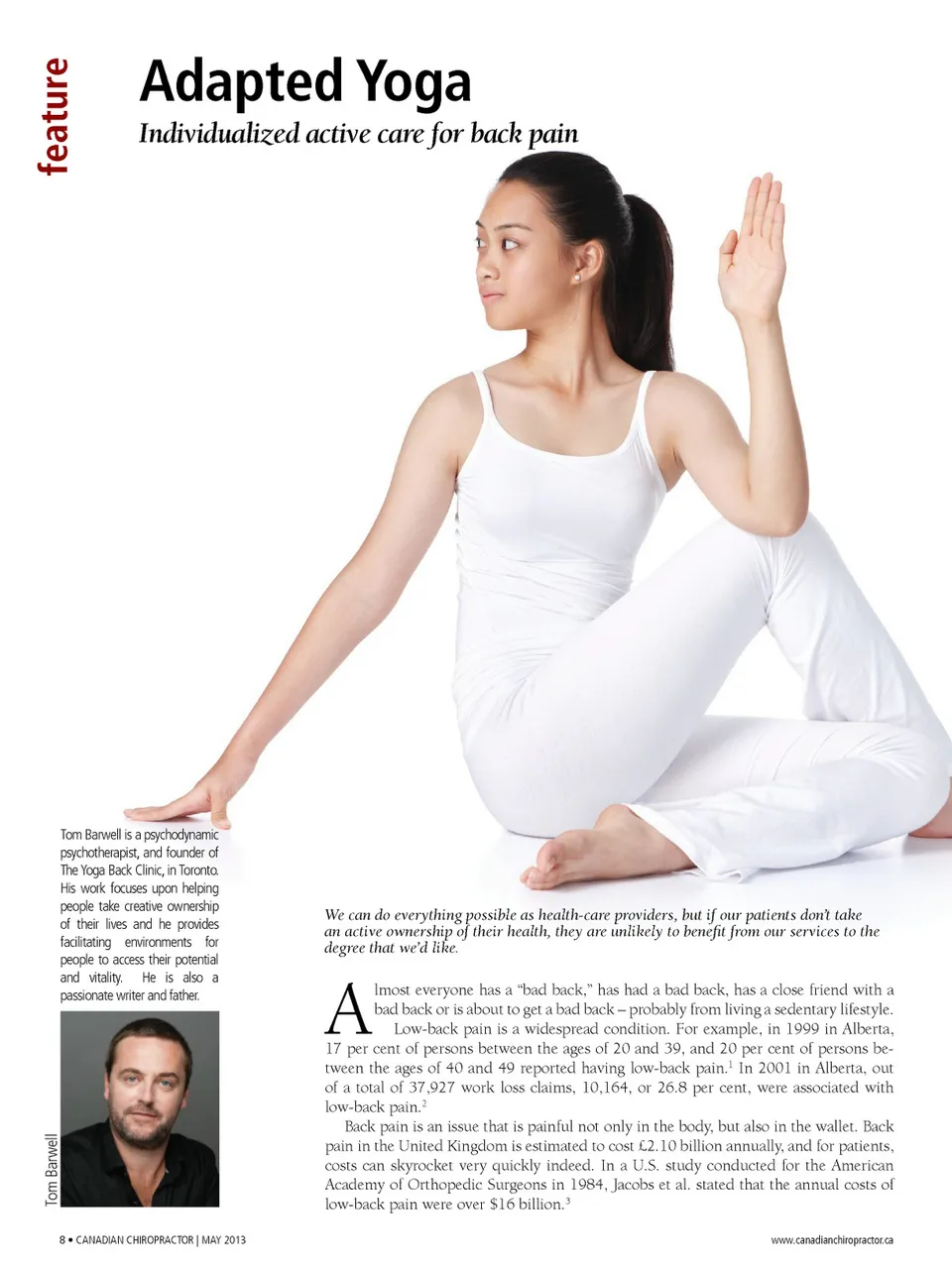
There are a range of health-care professionals out there to help with this epidemic but all too often they face the same challenge: determining how to encourage people to do their home exercises. We can do everything possible as health-care providers, but if our clients don’t take an active ownership of their health, they are unlikely to benefit from our services to the degree that we’d like. The problem is that people fundamentally don’t like doing home exercises! So, how do we promote the kind of active care that we know is valuable to people, without relying upon guilt or heavy instruction, or hoping that the pain someone may be experiencing will drive them to do exercises? What is needed is a modality of active care that people will actually enjoy. One solution that is gaining in exposure and research is the use of adapted forms of yoga. obviously, you will have wasted your time and efforts and the patient will have derived no benefit. Why fight patients and try to force them to do a practice they don’t want to do in environments they don’t want to be in? Perhaps they are the type to need a more structured environment, and/or don’t feel comfortable practising at home all alone? Practice is about having a welcoming environment – even a beautiful one. It is having a regular schedule, and exercise that is clinically sound as well as interesting and deeply satisfying to people. And so, it may, at times, be more effective to prescribe an option, to some patients, that goes beyond a home-based routine and takes them deeper into their own care. WHY YOGA IS AN OPTION Comparatively affordable, yoga is also incredibly popular. It is not usually seen as a chore at all – but rather something that people passionately want to do. Adherents point to positive mental and physical results and attend class with almost reli -gious fervour. Research also supports the case for adapted yoga – particu -larly in smaller classes with the guidance of an experienced instructor. One of the largest studies, to date, was carried out in the United Kingdom, and was intended to test whether or not yoga might be an effective and affordable alternative to in -tegrate within the public health-care system, otherwise known as National Health Services (NHS). 4 The trial was funded by Arthritis Research UK and sponsored by the University of York. The results came back largely positive. Not only did the trial find greater improvements in back function than standard care could offer, but participants also took fewer days off work (four versus 12 for the control group). Results also showed a high probability of the treatment being cost-effective. These are persuasive arguments indeed. The lesson from re -search is shaping up to be that yoga, though it can cause injury if practised without proper care, can, if adapted to back conditions and done with professional su -pervision, be a very positive influence. Yoga is also a way of promoting self-care. It has a strong tradition of helping people develop an awareness of their bodies. When allied with careful instruction, and even some education into simple physiology, it can help a person (particu -larly with recurrent issues) to achieve a far greater awareness of posture, movement (or lack of it) and musculature. A C.A.P. OFF TO YOGA C.A.P. – or Cost, Awareness and Practice – is the trinity of care that I have developed for my clients, based upon research done after my own painful episodes of back trouble. C.A.P. is also a simple way of considering some of the things that can help practitioners decide whether adapted yoga might be a feasi -ble and beneficial option for their patients. “C” is cost. People can’t do a prescribed therapy or exercise regimen if it costs too much. “A” is finding a way to develop a different kind of aware -ness around one’s issue, an element that yoga is well known for. And “P” is for practice. Practice is key because if the patients aren’t actually going to do the exercises you prescribe, then, www.canadianchiropractor.ca A PROGRAM OF CARE Based on the C.A.P. model, I can activate a protocol that takes these concepts a step further to provide different levels of adapted yoga for clients who are referred with various back issues. This protocol usually begins with the client entering a yoga class titled “Gentle,” which is very structured and uses a lot of props and support, and progressing through to an “In -termediate” and then an “Open” class, meant for graduates of the other classes, or for people more interested in healthy back maintenance rather than the rehabilitation work of the other, less strenuous classes. The protocol in this way is designed to be customized for the human nature of each client, and moves clients through a program of care that is attractive to them. As I am a psy -chotherapist by trade and training, providing people with the necessary structure so that they can give themselves over to actually feeling good about themselves, and enjoying what they are doing, is what I strive for in providing care. AN INTERDISCIPLINARY APPROACH Strangely enough, many of the exercises used in adapted yoga are virtually identical to those commonly used by physio -therapists and other “movement” specialists. On the whole, our practice program uses props such as bolsters and straps more than a regular yoga class, but does not use weights or gym equipment. The result is that the yoga “feel” survives in -tact. The yoga practitioner (in this case, the client) uses his or her own body weight under careful instruction and supervi -sion while maintaining the inner awareness that sets yoga apart from other exercise modalities. MIND/BODY/SPIRIT In speaking of this modality, we should not ignore the “mental” or “stress” side that exists with many back – and other – prob -lems. As Statistics Canada puts it: “Contributing factors include poor muscle tone, especially in the back and abdominal mus -cles; sedentary lifestyle; obesity; smoking; poor posture; and in particular, improper or heavy lifting. There is also evidence suggesting that psychosocial factors (e.g., chronic stress and depression) are determinants of back pain.” The stressful, sedentary side of modern life is writ large in this, as it is in much of the literature. Therefore, the culture of adapted yoga – that of movement, de-stressing, taking time and space, posture – is perhaps just as powerful as its elements of specialized movement and is, therefore, an integral part of the practice program that clients can benefit from with this sort CANADIAN CHIROPRACTOR | MAY 2013 • 9
Chiropractic + Naturopathic Doctor May 2013: Page 9