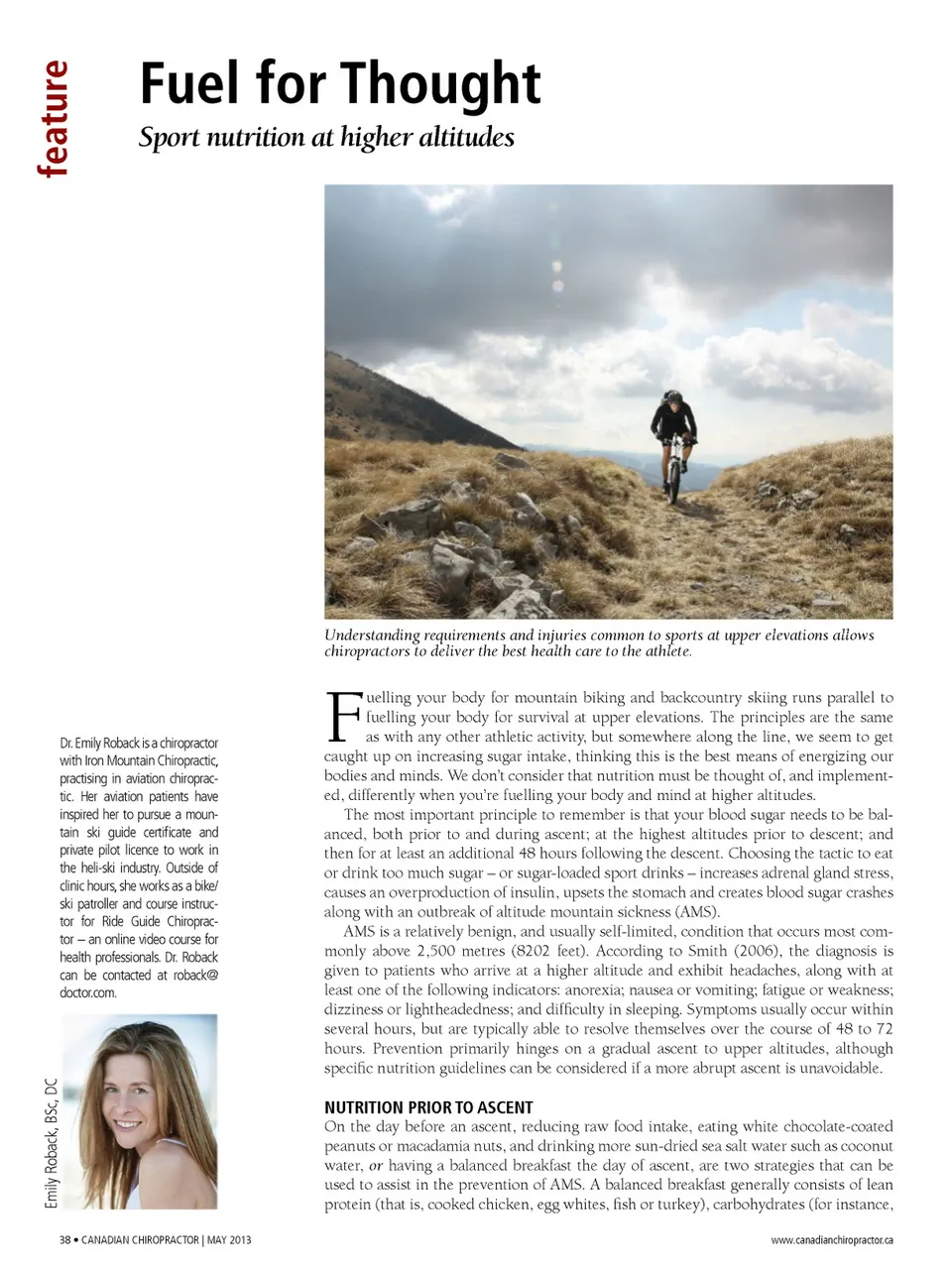
feature Fuel for Thought Sport nutrition at higher altitudes Understanding requirements and injuries common to sports at upper elevations allows chiropractors to deliver the best health care to the athlete. uelling your body for mountain biking and backcountry skiing runs parallel to fuelling your body for survival at upper elevations. The principles are the same as with any other athletic activity, but somewhere along the line, we seem to get caught up on increasing sugar intake, thinking this is the best means of energizing our bodies and minds. We don’t consider that nutrition must be thought of, and implement -ed, differently when you’re fuelling your body and mind at higher altitudes. The most important principle to remember is that your blood sugar needs to be bal -anced, both prior to and during ascent; at the highest altitudes prior to descent; and then for at least an additional 48 hours following the descent. Choosing the tactic to eat or drink too much sugar – or sugar-loaded sport drinks – increases adrenal gland stress, causes an overproduction of insulin, upsets the stomach and creates blood sugar crashes along with an outbreak of altitude mountain sickness (AMS). AMS is a relatively benign, and usually self-limited, condition that occurs most com -monly above 2,500 metres (8202 feet). According to Smith (2006), the diagnosis is given to patients who arrive at a higher altitude and exhibit headaches, along with at least one of the following indicators: anorexia; nausea or vomiting; fatigue or weakness; dizziness or lightheadedness; and difficulty in sleeping. Symptoms usually occur within several hours, but are typically able to resolve themselves over the course of 48 to 72 hours. Prevention primarily hinges on a gradual ascent to upper altitudes, although specific nutrition guidelines can be considered if a more abrupt ascent is unavoidable. Dr. Emily Roback is a chiropractor with Iron Mountain Chiropractic, practising in aviation chiroprac-tic. Her aviation patients have inspired her to pursue a moun-tain ski guide certificate and private pilot licence to work in the heli-ski industry. Outside of clinic hours, she works as a bike/ ski patroller and course instruc-tor for Ride Guide Chiroprac-tor – an online video course for health professionals. Dr. Roback can be contacted at roback@ doctor.com. F Emily Roback, BSc, DC NuTRITION PRIOR TO ASCENT On the day before an ascent, reducing raw food intake, eating white chocolate-coated peanuts or macadamia nuts, and drinking more sun-dried sea salt water such as coconut water, or having a balanced breakfast the day of ascent, are two strategies that can be used to assist in the prevention of AMS. A balanced breakfast generally consists of lean protein (that is, cooked chicken, egg whites, fish or turkey), carbohydrates (for instance, www.canadianchiropractor.ca 38 • CANADIAN CHIROPRACTOR | MAY 2013
Chiropractic + Naturopathic Doctor May 2013: Page 38