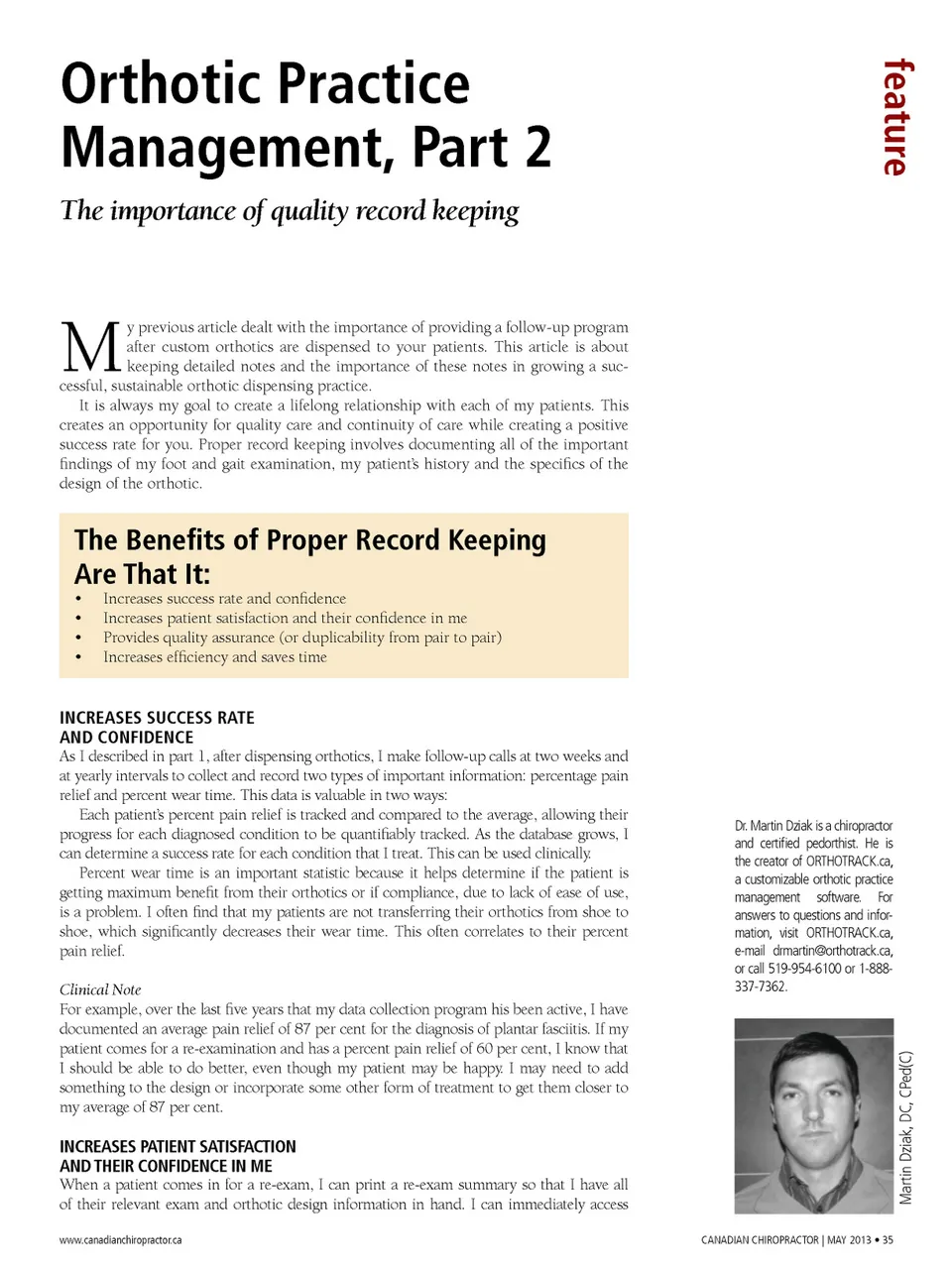
Orthotic Practice Management, Part 2 The importance of quality record keeping feature M y previous article dealt with the importance of providing a follow-up program after custom orthotics are dispensed to your patients. This article is about keeping detailed notes and the importance of these notes in growing a suc -cessful, sustainable orthotic dispensing practice. It is always my goal to create a lifelong relationship with each of my patients. This creates an opportunity for quality care and continuity of care while creating a positive success rate for you. Proper record keeping involves documenting all of the important findings of my foot and gait examination, my patient’s history and the specifics of the design of the orthotic. The Benefits of Proper Record Keeping Are That It: • • • • Increases success rate and confidence Increases patient satisfaction and their confidence in me Provides quality assurance (or duplicability from pair to pair) Increases efficiency and saves time INCREASES SuCCESS RATE AND CONFIDENCE As I described in part 1, after dispensing orthotics, I make follow-up calls at two weeks and at yearly intervals to collect and record two types of important information: percentage pain relief and percent wear time. This data is valuable in two ways: Each patient’s percent pain relief is tracked and compared to the average, allowing their progress for each diagnosed condition to be quantifiably tracked. As the database grows, I can determine a success rate for each condition that I treat. This can be used clinically. Percent wear time is an important statistic because it helps determine if the patient is getting maximum benefit from their orthotics or if compliance, due to lack of ease of use, is a problem. I often find that my patients are not transferring their orthotics from shoe to shoe, which significantly decreases their wear time. This often correlates to their percent pain relief. Clinical Note For example, over the last five years that my data collection program his been active, I have documented an average pain relief of 87 per cent for the diagnosis of plantar fasciitis. If my patient comes for a re-examination and has a percent pain relief of 60 per cent, I know that I should be able to do better, even though my patient may be happy. I may need to add something to the design or incorporate some other form of treatment to get them closer to my average of 87 per cent. Dr. Martin Dziak is a chiropractor and certified pedorthist. He is the creator of ORTHOTRACK.ca, a customizable orthotic practice management software. For answers to questions and infor-mation, visit ORTHOTRACK.ca, e-mail [email protected], or call 519-954-6100 or 1-888-337-7362. INCREASES PATIENT SATISFACTION AND THEIR CONFIDENCE IN ME When a patient comes in for a re-exam, I can print a re-exam summary so that I have all of their relevant exam and orthotic design information in hand. I can immediately access www.canadianchiropractor.ca CANADIAN CHIROPRACTOR | MAY 2013 • 35 Martin Dziak, DC, CPed(C)
Chiropractic + Naturopathic Doctor May 2013: Page 35