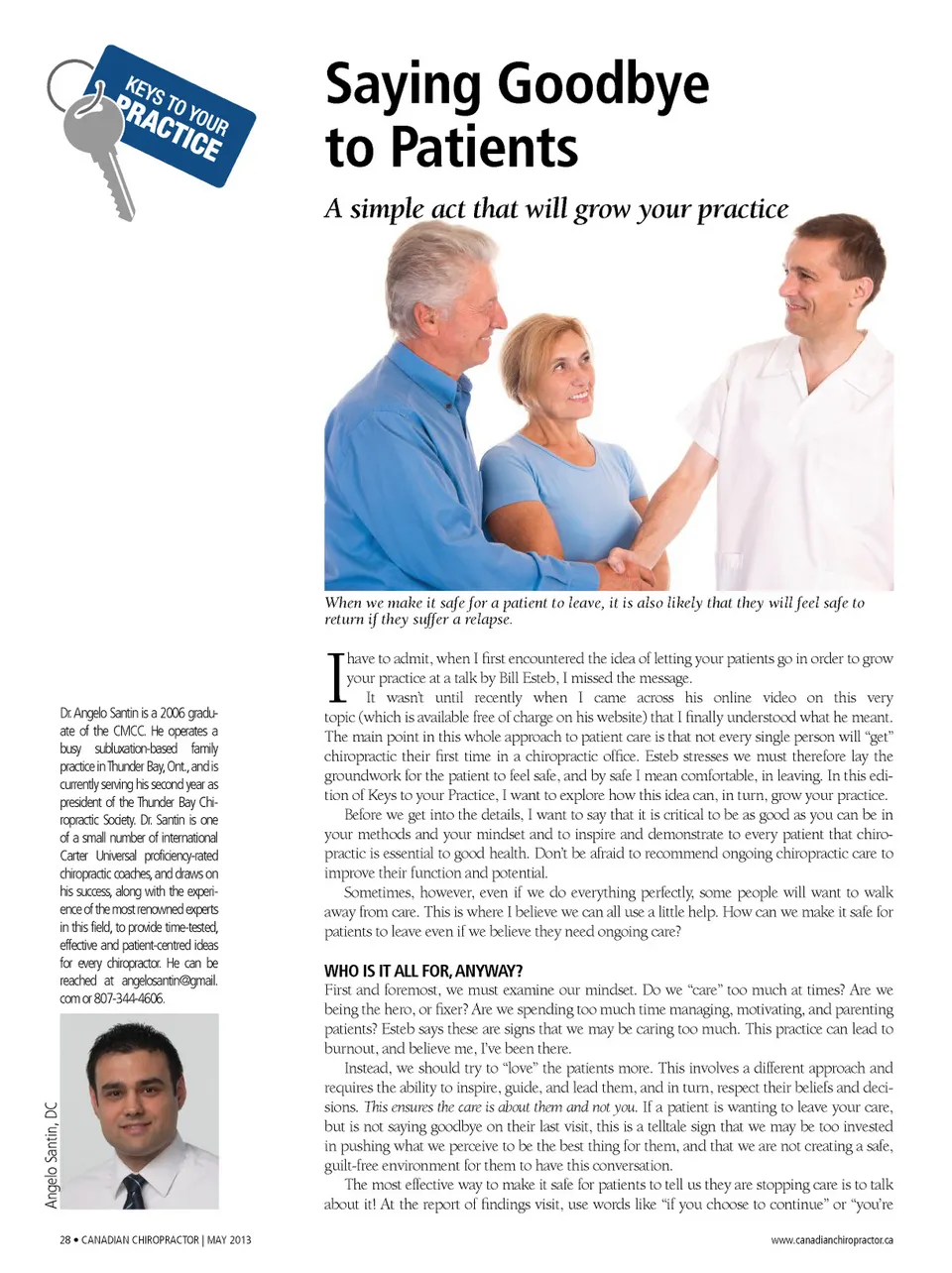
in charge.” I personally like to use these phrases at re-examination reports. I make my recommendations for ongoing supportive care but also let them know it’s their choice as to how much care they receive, and that anytime they choose to discontinue, they need only let us know. This immediately puts the patient in charge. They feel as if they are part of the decision, and the tone in the room changes. Remember, most of the time, a patient will discontinue care be -cause they are feeling better: this is a positive thing that we should celebrate with them! WHAT ABOuT GROWTH? How, then, does this lead back to growth in our practices? Well, when we make it safe for a patient to leave, it is also likely that they will feel safe to return when they suffer a relapse. Unfortu -nately, a patient may go through a few relapses in order to finally learn that they need to be more proactive about their maintain -ing their health. As well, Esteb mentions that even though patients are inactive, they still refer to us as “their chiropractor.” Is this not so true? We get referrals all the time from patients who continue to tell their friends, “you should go see my chiropractor,” even when they are not ac -tively under care. This type of referral also gives us a key opportu -nity to keep in contact with the patient who did the referring. For example, having them remain in contact with you through newslet -ters, e-mails, Facebook, etc, is a great way for them to still feel a part of the practice. I find I like to send a postcard or make a phone call on major special events like a milestone birthday or some other special time. For the record, I am not a big proponent of forcing reactivations. In fact, I would caution against making calls to inac -tive patients for the purpose of getting them back under care. How -ever, if done genuinely, this will keep you on their mind when it’s time for them to return. I am a big believer that a proper mindset and excellent com -munication can go a long way to enable patients to experience chi -ropractic over their lifetime. This idea of allowing them to fail and return in a safe environment can aid to help our public image and change the old saying that “once you go to a chiropractor, they want you to go for the rest of your life.” Why don’t we lead the way in patient -centred care and let it be up to them? Remember, when it comes to your practice work from the inside out. • Key to Saying Goodbye to Patients (for Now) Maintain a safe environment for patients to leave active care, and to return or send others to you if necessary. • ACTION STEP 1: Examine your own practices and ask yourself, are you managing versus leading, that is, are you “caring” too much? • ACTION STEP 2: Keep communication open and talk about the choice of stopping care from the beginning. • ACTION STEP 3: Keep inactive patients involved in the practice through newsletters, social media, etc. BackSwing ‘13 Tuesday, September 10, 2013 DiamondBack Golf Club Registration $300 per player For information visit www.cmcc.ca/BackSwing or contact Katie Pinsent-Oxley at [email protected] or 416 482 2340 ext. 200 Silver Sponsors CFS Corporation ObusForme Bronze Sponsors Aramark Canada Ltd. Ernest H. Wolkin Chartered Accountant Footmaxx North York Rehabilitation Centre Media Sponsor Canadian Chiropractor Magazine Canadian Memorial Chiropractic College CMCC’s 9 th annual www.canadianchiropractor.ca CANADIAN CHIROPRACTOR | MAY 2013 • 29
Chiropractic + Naturopathic Doctor May 2013: Page 29