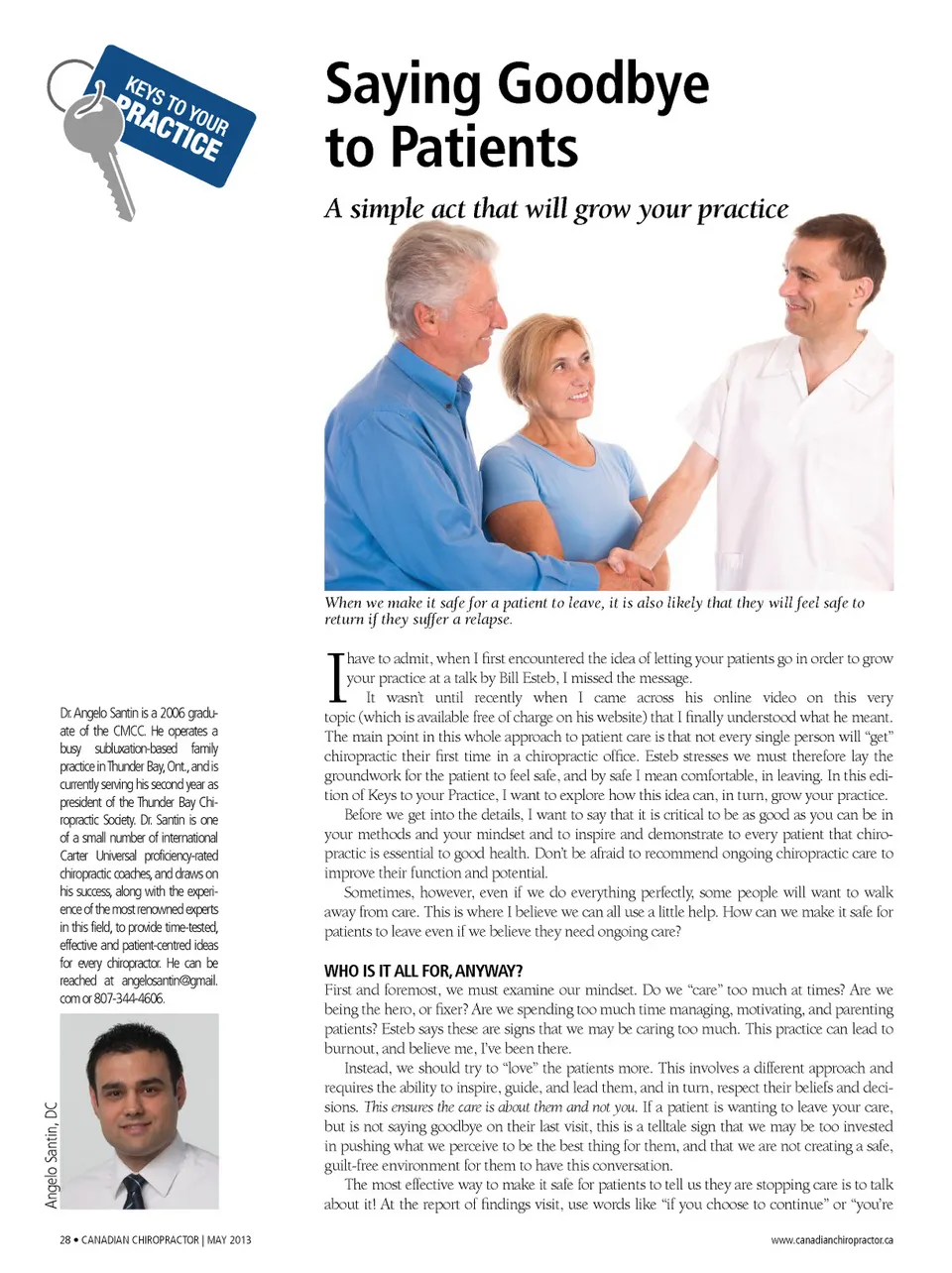
Saying Goodbye to Patients A simple act that will grow your practice When we make it safe for a patient to leave, it is also likely that they will feel safe to return if they suffer a relapse. Dr. Angelo Santin is a 2006 gradu-ate of the CMCC. He operates a busy subluxation-based family practice in Thunder Bay, Ont., and is currently serving his second year as president of the Thunder Bay Chi-ropractic Society. Dr. Santin is one of a small number of international Carter Universal proficiency-rated chiropractic coaches, and draws on his success, along with the experi -ence of the most renowned experts in this field, to provide time-tested, effective and patient-centred ideas for every chiropractor. He can be reached at angelosantin@gmail. com or 807-344-4606. I have to admit, when I first encountered the idea of letting your patients go in order to grow your practice at a talk by Bill Esteb, I missed the message. It wasn’t until recently when I came across his online video on this very topic (which is available free of charge on his website) that I finally understood what he meant. The main point in this whole approach to patient care is that not every single person will “get” chiropractic their first time in a chiropractic office. Esteb stresses we must therefore lay the groundwork for the patient to feel safe, and by safe I mean comfortable, in leaving. In this edi -tion of Keys to your Practice, I want to explore how this idea can, in turn, grow your practice. Before we get into the details, I want to say that it is critical to be as good as you can be in your methods and your mindset and to inspire and demonstrate to every patient that chiro -practic is essential to good health. Don’t be afraid to recommend ongoing chiropractic care to improve their function and potential. Sometimes, however, even if we do everything perfectly, some people will want to walk away from care. This is where I believe we can all use a little help. How can we make it safe for patients to leave even if we believe they need ongoing care? WHO IS IT ALL FOR, ANYWAY? First and foremost, we must examine our mindset. Do we “care” too much at times? Are we being the hero, or fixer? Are we spending too much time managing, motivating, and parenting patients? Esteb says these are signs that we may be caring too much. This practice can lead to burnout, and believe me, I’ve been there. Instead, we should try to “love” the patients more. This involves a different approach and requires the ability to inspire, guide, and lead them, and in turn, respect their beliefs and deci -sions. This ensures the care is about them and not you. If a patient is wanting to leave your care, but is not saying goodbye on their last visit, this is a telltale sign that we may be too invested in pushing what we perceive to be the best thing for them, and that we are not creating a safe, guilt-free environment for them to have this conversation. The most effective way to make it safe for patients to tell us they are stopping care is to talk about it! At the report of findings visit, use words like “if you choose to continue” or “you’re www.canadianchiropractor.ca Angelo Santin, DC 28 • CANADIAN CHIROPRACTOR | MAY 2013
Chiropractic + Naturopathic Doctor May 2013: Page 28