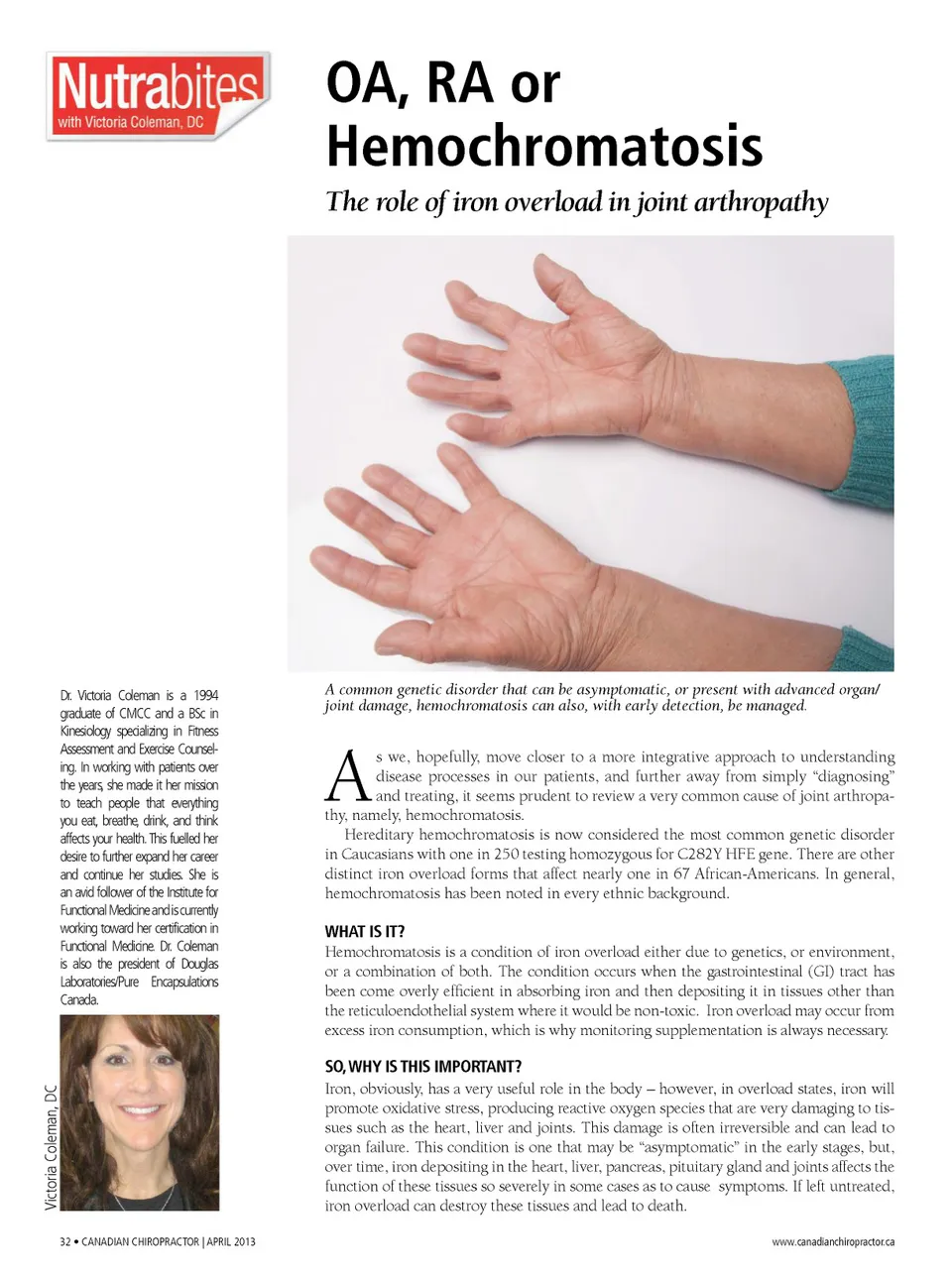
OA, RA or Hemochromatosis The role of iron overload in joint arthropathy Dr. Victoria Coleman is a 1994 graduate of CMCC and a BSc in Kinesiology specializing in Fitness Assessment and Exercise Counsel-ing. in working with patients over the years, she made it her mission to teach people that everything you eat, breathe, drink, and think affects your health. This fuelled her desire to further expand her career and continue her studies. She is an avid follower of the institute for Functional Medicine and is currently working toward her certification in Functional Medicine. Dr. Coleman is also the president of Douglas Laboratories/Pure Encapsulations Canada. A common genetic disorder that can be asymptomatic, or present with advanced organ/ joint damage, hemochromatosis can also, with early detection, be managed. A s we, hopefully, move closer to a more integrative approach to understanding disease processes in our patients, and further away from simply “diagnosing” and treating, it seems prudent to review a very common cause of joint arthropa-thy, namely, hemochromatosis. Hereditary hemochromatosis is now considered the most common genetic disorder in Caucasians with one in 250 testing homozygous for C282Y HFE gene. There are other distinct iron overload forms that affect nearly one in 67 African-Americans. In general, hemochromatosis has been noted in every ethnic background. WHAT IS IT? Hemochromatosis is a condition of iron overload either due to genetics, or environment, or a combination of both. The condition occurs when the gastrointestinal (GI) tract has been come overly efficient in absorbing iron and then depositing it in tissues other than the reticuloendothelial system where it would be non-toxic. Iron overload may occur from excess iron consumption, which is why monitoring supplementation is always necessary. SO, WHY IS THIS IMPORTANT? Iron, obviously, has a very useful role in the body – however, in overload states, iron will promote oxidative stress, producing reactive oxygen species that are very damaging to tis-sues such as the heart, liver and joints. This damage is often irreversible and can lead to organ failure. This condition is one that may be “asymptomatic” in the early stages, but, over time, iron depositing in the heart, liver, pancreas, pituitary gland and joints affects the function of these tissues so severely in some cases as to cause symptoms. If left untreated, iron overload can destroy these tissues and lead to death. www.canadianchiropractor.ca Victoria Coleman, DC 32 • CANADiAN CHiROPRACTOR | APRiL 2013
Chiropractic + Naturopathic Doctor April 2013: Page 32