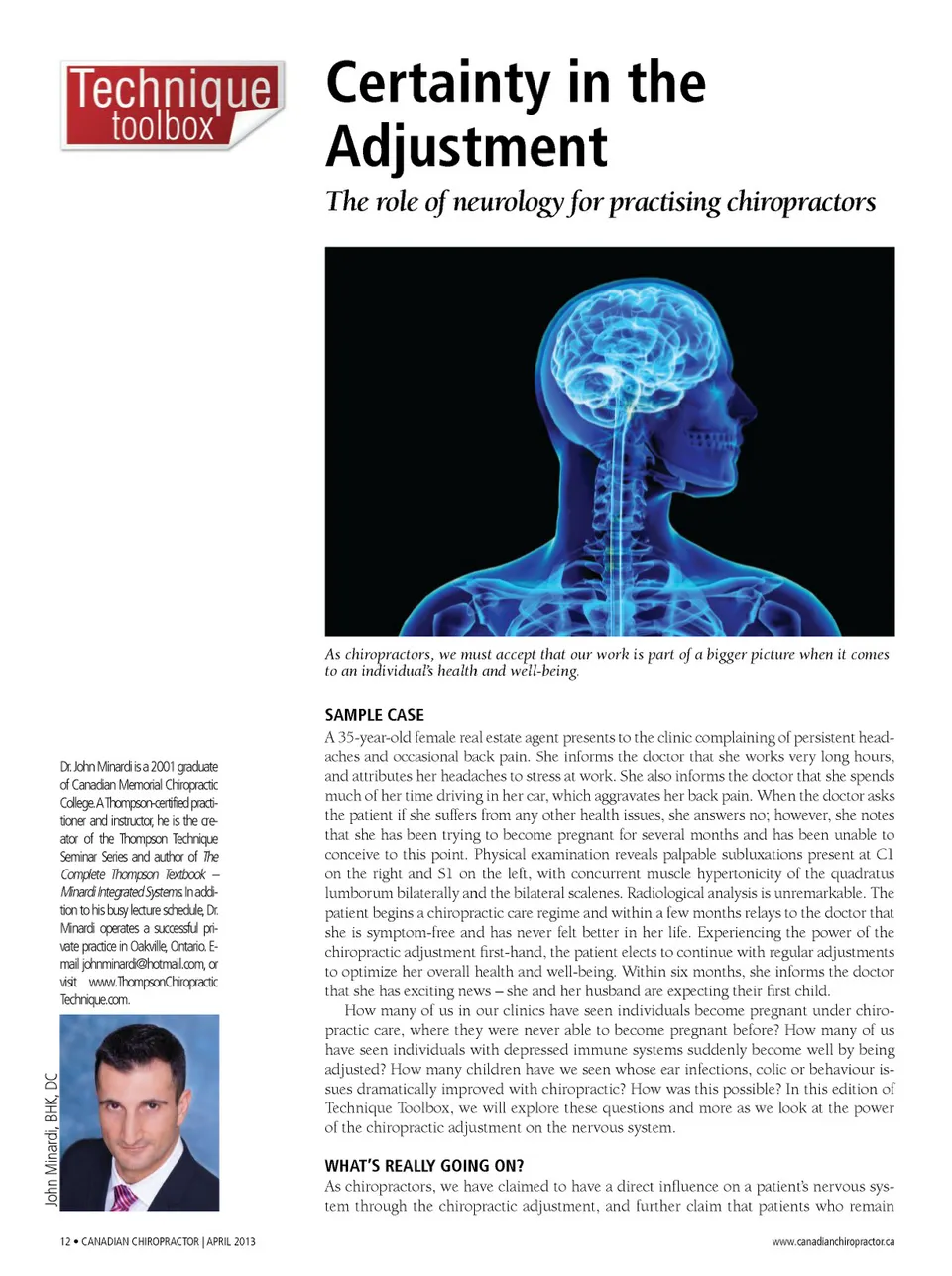
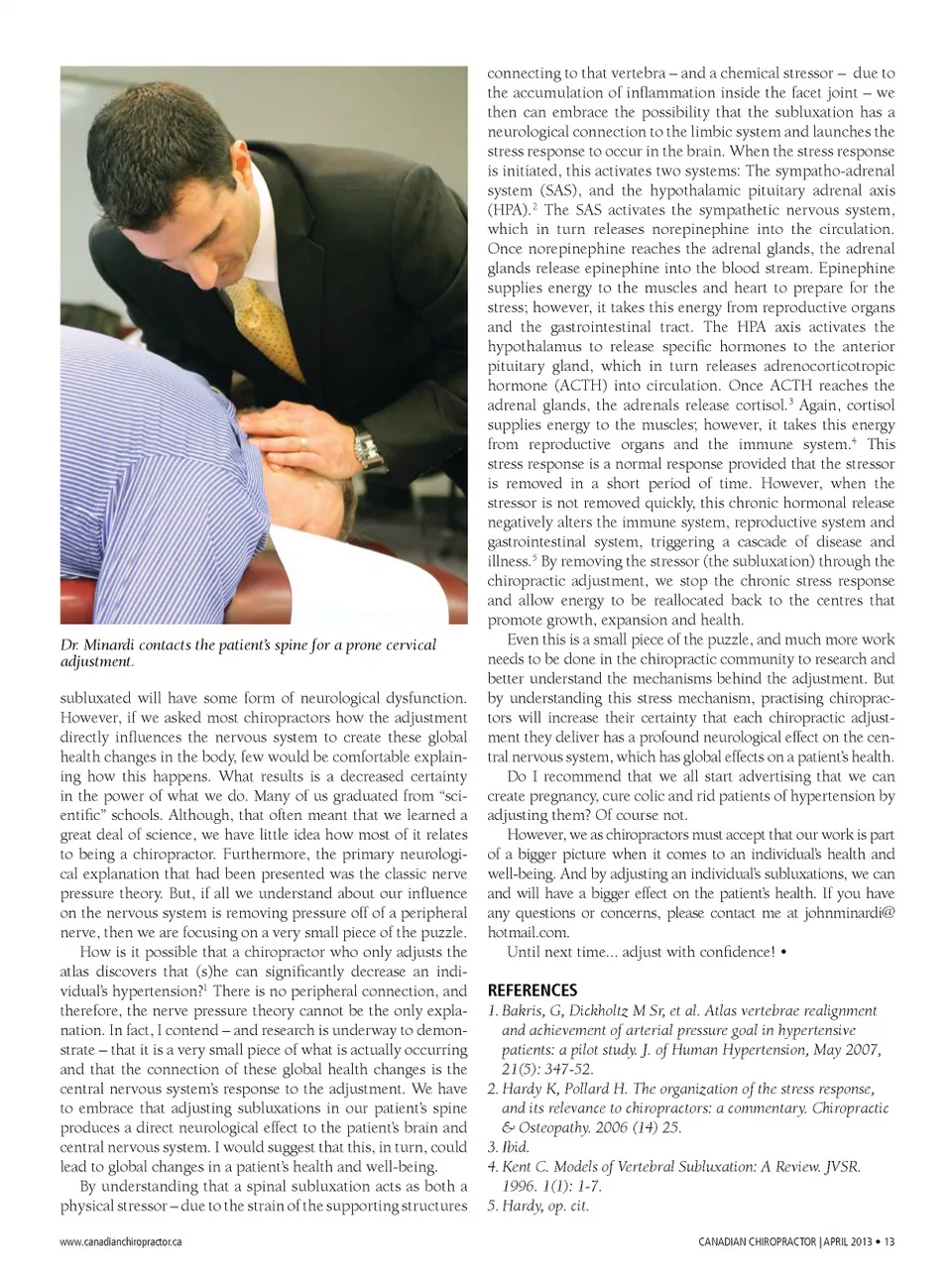
Dr. Minardi contacts the patient’s spine for a prone cervical adjustment. subluxated will have some form of neurological dysfunction. However, if we asked most chiropractors how the adjustment directly influences the nervous system to create these global health changes in the body, few would be comfortable explain-ing how this happens. What results is a decreased certainty in the power of what we do. Many of us graduated from “sci-entific” schools. Although, that often meant that we learned a great deal of science, we have little idea how most of it relates to being a chiropractor. Furthermore, the primary neurologi-cal explanation that had been presented was the classic nerve pressure theory. But, if all we understand about our influence on the nervous system is removing pressure off of a peripheral nerve, then we are focusing on a very small piece of the puzzle. How is it possible that a chiropractor who only adjusts the atlas discovers that (s)he can significantly decrease an indi-vidual’s hypertension? 1 There is no peripheral connection, and therefore, the nerve pressure theory cannot be the only expla-nation. In fact, I contend – and research is underway to demon-strate – that it is a very small piece of what is actually occurring and that the connection of these global health changes is the central nervous system’s response to the adjustment. We have to embrace that adjusting subluxations in our patient’s spine produces a direct neurological effect to the patient’s brain and central nervous system. I would suggest that this, in turn, could lead to global changes in a patient’s health and well-being. By understanding that a spinal subluxation acts as both a physical stressor – due to the strain of the supporting structures www.canadianchiropractor.ca connecting to that vertebra – and a chemical stressor – due to the accumulation of inflammation inside the facet joint – we then can embrace the possibility that the subluxation has a neurological connection to the limbic system and launches the stress response to occur in the brain. When the stress response is initiated, this activates two systems: The sympatho-adrenal system (SAS), and the hypothalamic pituitary adrenal axis (HPA). 2 The SAS activates the sympathetic nervous system, which in turn releases norepinephine into the circulation. Once norepinephine reaches the adrenal glands, the adrenal glands release epinephine into the blood stream. Epinephine supplies energy to the muscles and heart to prepare for the stress; however, it takes this energy from reproductive organs and the gastrointestinal tract. The HPA axis activates the hypothalamus to release specific hormones to the anterior pituitary gland, which in turn releases adrenocorticotropic hormone (ACTH) into circulation. Once ACTH reaches the adrenal glands, the adrenals release cortisol. 3 Again, cortisol supplies energy to the muscles; however, it takes this energy from reproductive organs and the immune system. 4 This stress response is a normal response provided that the stressor is removed in a short period of time. However, when the stressor is not removed quickly, this chronic hormonal release negatively alters the immune system, reproductive system and gastrointestinal system, triggering a cascade of disease and illness. 5 By removing the stressor (the subluxation) through the chiropractic adjustment, we stop the chronic stress response and allow energy to be reallocated back to the centres that promote growth, expansion and health. Even this is a small piece of the puzzle, and much more work needs to be done in the chiropractic community to research and better understand the mechanisms behind the adjustment. But by understanding this stress mechanism, practising chiroprac-tors will increase their certainty that each chiropractic adjust-ment they deliver has a profound neurological effect on the cen-tral nervous system, which has global effects on a patient’s health. Do I recommend that we all start advertising that we can create pregnancy, cure colic and rid patients of hypertension by adjusting them? Of course not. However, we as chiropractors must accept that our work is part of a bigger picture when it comes to an individual’s health and well-being. And by adjusting an individual’s subluxations, we can and will have a bigger effect on the patient’s health. If you have any questions or concerns, please contact me at johnminardi@ hotmail.com. Until next time... adjust with confidence! • REfERENCES 1. Bakris, G, Dickholtz M Sr, et al. Atlas vertebrae realignment and achievement of arterial pressure goal in hypertensive patients: a pilot study. J. of Human Hypertension, May 2007, 21(5): 347-52. 2. Hardy K, Pollard H. The organization of the stress response, and its relevance to chiropractors: a commentary. Chiropractic & Osteopathy. 2006 (14) 25. 3. Ibid. 4. Kent C. Models of Vertebral Subluxation: A Review. JVSR. 1996. 1(1): 1-7. 5. Hardy, op. cit. CANADiAN CHiROPRACTOR | APRIL 2013 • 13
Chiropractic + Naturopathic Doctor April 2013: Page 13