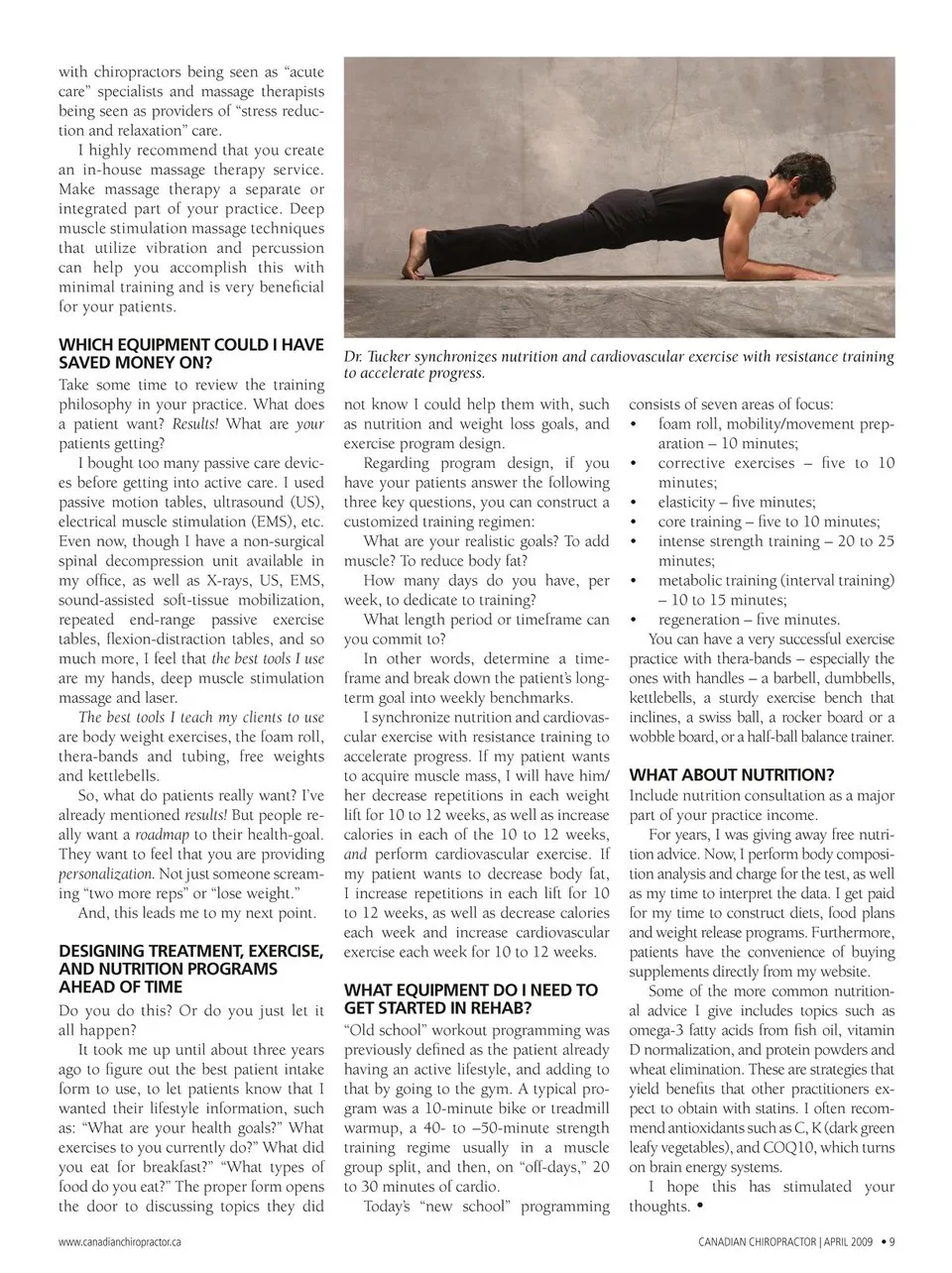
with chiropractors being seen as “acute care” specialists and massage therapists being seen as providers of “stress reduc- tion and relaxation” care. I highly recommend that you create an in-house massage therapy service. Make massage therapy a separate or integrated part of your practice. Deep muscle stimulation massage techniques that utilize vibration and percussion can help you accomplish this with minimal training and is very beneficial for your patients. WHICH EQUIPMENT COULD I HAVE SAVED MONEY ON? Take some time to review the training philosophy in your practice. What does a patient want? Results! What are your patients getting? I bought too many passive care devic- es before getting into active care. I used passive motion tables, ultrasound (US), electrical muscle stimulation (EMS), etc. Even now, though I have a non-surgical spinal decompression unit available in my office, as well as X-rays, US, EMS, sound-assisted soft-tissue mobilization, repeated end-range passive exercise tables, flexion-distraction tables, and so much more, I feel that the best tools I use are my hands, deep muscle stimulation massage and laser. The best tools I teach my clients to use are body weight exercises, the foam roll, thera-bands and tubing, free weights and kettlebells. So, what do patients really want? I’ve already mentioned results! But people re- ally want a roadmap to their health-goal. They want to feel that you are providing personalization. Not just someone scream- ing “two more reps” or “lose weight.” And, this leads me to my next point. DESIGNING TREATMENT, EXERCISE, AND NUTRITION PROGRAMS AHEAD OF TIME Do you do this? Or do you just let it all happen? It took me up until about three years ago to figure out the best patient intake form to use, to let patients know that I wanted their lifestyle information, such as: “What are your health goals?” What exercises to you currently do?” What did you eat for breakfast?” “What types of food do you eat?” The proper form opens the door to discussing topics they did www.canadianchiropractor.ca Dr. Tucker synchronizes nutrition and cardiovascular exercise with resistance training to accelerate progress. not know I could help them with, such as nutrition and weight loss goals, and exercise program design. Regarding program design, if you have your patients answer the following three key questions, you can construct a customized training regimen: What are your realistic goals? To add muscle? To reduce body fat? How many days do you have, per week, to dedicate to training? What length period or timeframe can you commit to? In other words, determine a time- frame and break down the patient’s long- term goal into weekly benchmarks. I synchronize nutrition and cardiovas- cular exercise with resistance training to accelerate progress. If my patient wants to acquire muscle mass, I will have him/ her decrease repetitions in each weight lift for 10 to 12 weeks, as well as increase calories in each of the 10 to 12 weeks, and perform cardiovascular exercise. If my patient wants to decrease body fat, I increase repetitions in each lift for 10 to 12 weeks, as well as decrease calories each week and increase cardiovascular exercise each week for 10 to 12 weeks. WHAT EQUIPMENT DO I NEED TO GET STARTED IN REHAB? “Old school” workout programming was previously defined as the patient already having an active lifestyle, and adding to that by going to the gym. A typical pro- gram was a 10-minute bike or treadmill warmup, a 40- to –50-minute strength training regime usually in a muscle group split, and then, on “off-days,” 20 to 30 minutes of cardio. Today’s “new school” programming consists of seven areas of focus: • foam roll, mobility/movement prep- aration – 10 minutes; • corrective exercises – five to 10 minutes; • elasticity – five minutes; • core training – five to 10 minutes; • intense strength training – 20 to 25 minutes; • metabolic training (interval training) – 10 to 15 minutes; • regeneration – five minutes. You can have a very successful exercise practice with thera-bands – especially the ones with handles – a barbell, dumbbells, kettlebells, a sturdy exercise bench that inclines, a swiss ball, a rocker board or a wobble board, or a half-ball balance trainer. WHAT ABOUT NUTRITION? Include nutrition consultation as a major part of your practice income. For years, I was giving away free nutri- tion advice. Now, I perform body composi- tion analysis and charge for the test, as well as my time to interpret the data. I get paid for my time to construct diets, food plans and weight release programs. Furthermore, patients have the convenience of buying supplements directly from my website. Some of the more common nutrition- al advice I give includes topics such as omega-3 fatty acids from fish oil, vitamin D normalization, and protein powders and wheat elimination. These are strategies that yield benefits that other practitioners ex- pect to obtain with statins. I often recom- mend antioxidants such as C, K (dark green leafy vegetables), and COQ10, which turns on brain energy systems. I hope this has stimulated your thoughts. • CANADIAN CHIROPRACTOR | APRIL 2009 • 9
Chiropractic + Naturopathic Doctor April 2009: Page 9