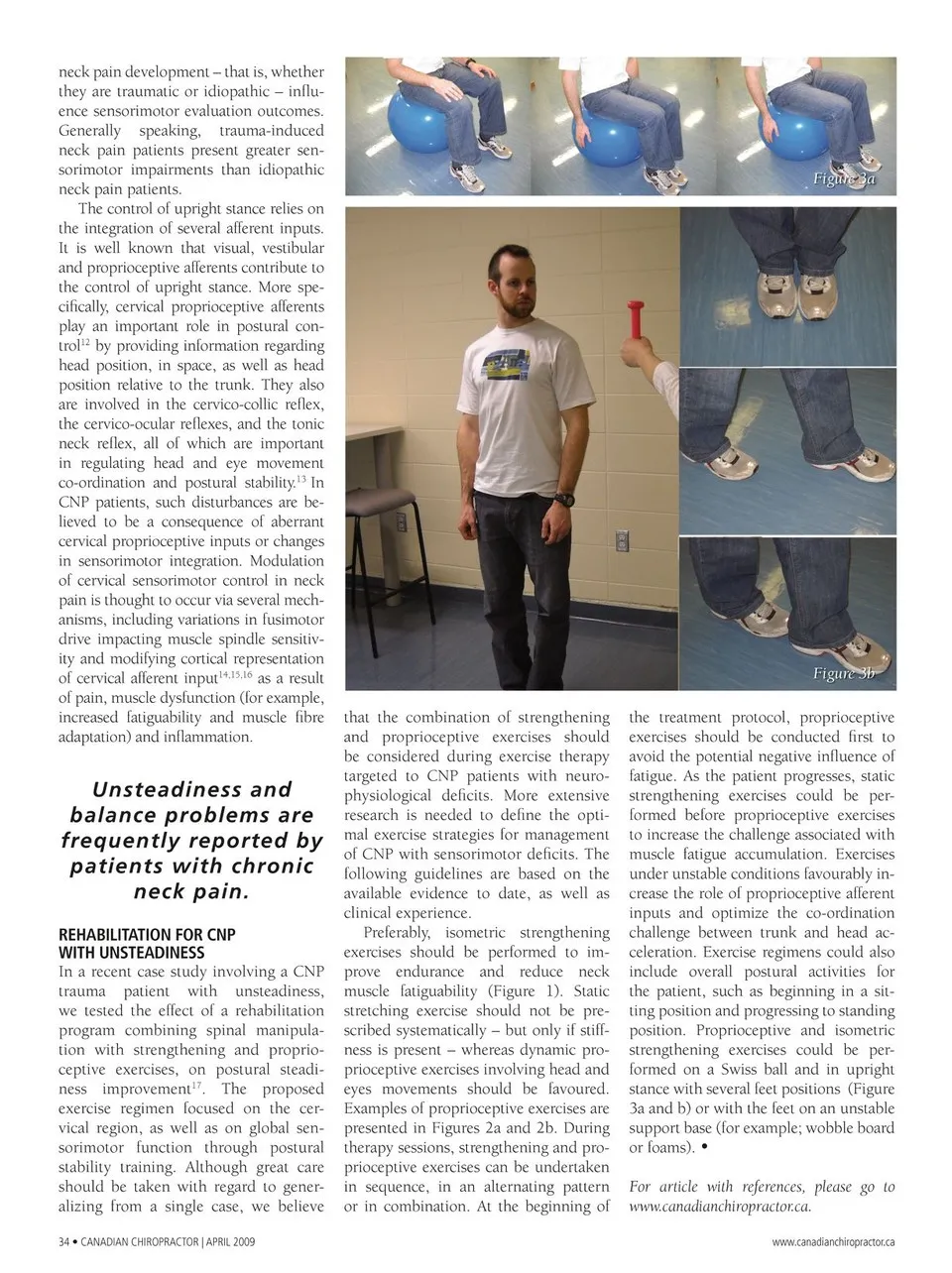
neck pain development – that is, whether they are traumatic or idiopathic – influ- ence sensorimotor evaluation outcomes. Generally speaking, trauma-induced neck pain patients present greater sen- sorimotor impairments than idiopathic neck pain patients. The control of upright stance relies on the integration of several afferent inputs. It is well known that visual, vestibular and proprioceptive afferents contribute to the control of upright stance. More spe- cifically, cervical proprioceptive afferents play an important role in postural con- trol12 by providing information regarding head position, in space, as well as head position relative to the trunk. They also are involved in the cervico-collic reflex, the cervico-ocular reflexes, and the tonic neck reflex, all of which are important in regulating head and eye movement co-ordination and postural stability.13 In CNP patients, such disturbances are be- lieved to be a consequence of aberrant cervical proprioceptive inputs or changes in sensorimotor integration. Modulation of cervical sensorimotor control in neck pain is thought to occur via several mech- anisms, including variations in fusimotor drive impacting muscle spindle sensitiv- ity and modifying cortical representation of cervical afferent input14,15,16 as a result of pain, muscle dysfunction (for example, increased fatiguability and muscle fibre adaptation) and inflammation. Unsteadiness and balance problems are frequently reported by patients with chronic neck pain. rEHABILITATION fOr CNP WITH UNSTEADINESS In a recent case study involving a CNP trauma patient with unsteadiness, we tested the effect of a rehabilitation program combining spinal manipula- tion with strengthening and proprio- ceptive exercises, on postural steadi- ness improvement17 . The proposed exercise regimen focused on the cer- vical region, as well as on global sen- sorimotor function through postural stability training. Although great care should be taken with regard to gener- alizing from a single case, we believe 34 • CANADIAN CHIROPRACTOR | APRIL 2009 that the combination of strengthening and proprioceptive exercises should be considered during exercise therapy targeted to CNP patients with neuro- physiological deficits. More extensive research is needed to define the opti- mal exercise strategies for management of CNP with sensorimotor deficits. The following guidelines are based on the available evidence to date, as well as clinical experience. Preferably, isometric strengthening exercises should be performed to im- prove endurance and reduce neck muscle fatiguability (Figure 1). Static stretching exercise should not be pre- scribed systematically – but only if stiff- ness is present – whereas dynamic pro- prioceptive exercises involving head and eyes movements should be favoured. Examples of proprioceptive exercises are presented in Figures 2a and 2b. During therapy sessions, strengthening and pro- prioceptive exercises can be undertaken in sequence, in an alternating pattern or in combination. At the beginning of Figure 3a Figure 3b the treatment protocol, proprioceptive exercises should be conducted first to avoid the potential negative influence of fatigue. As the patient progresses, static strengthening exercises could be per- formed before proprioceptive exercises to increase the challenge associated with muscle fatigue accumulation. Exercises under unstable conditions favourably in- crease the role of proprioceptive afferent inputs and optimize the co-ordination challenge between trunk and head ac- celeration. Exercise regimens could also include overall postural activities for the patient, such as beginning in a sit- ting position and progressing to standing position. Proprioceptive and isometric strengthening exercises could be per- formed on a Swiss ball and in upright stance with several feet positions (Figure 3a and b) or with the feet on an unstable support base (for example; wobble board or foams). • For article with references, please go to www.canadianchiropractor.ca. www.canadianchiropractor.ca
Chiropractic + Naturopathic Doctor April 2009: Page 34