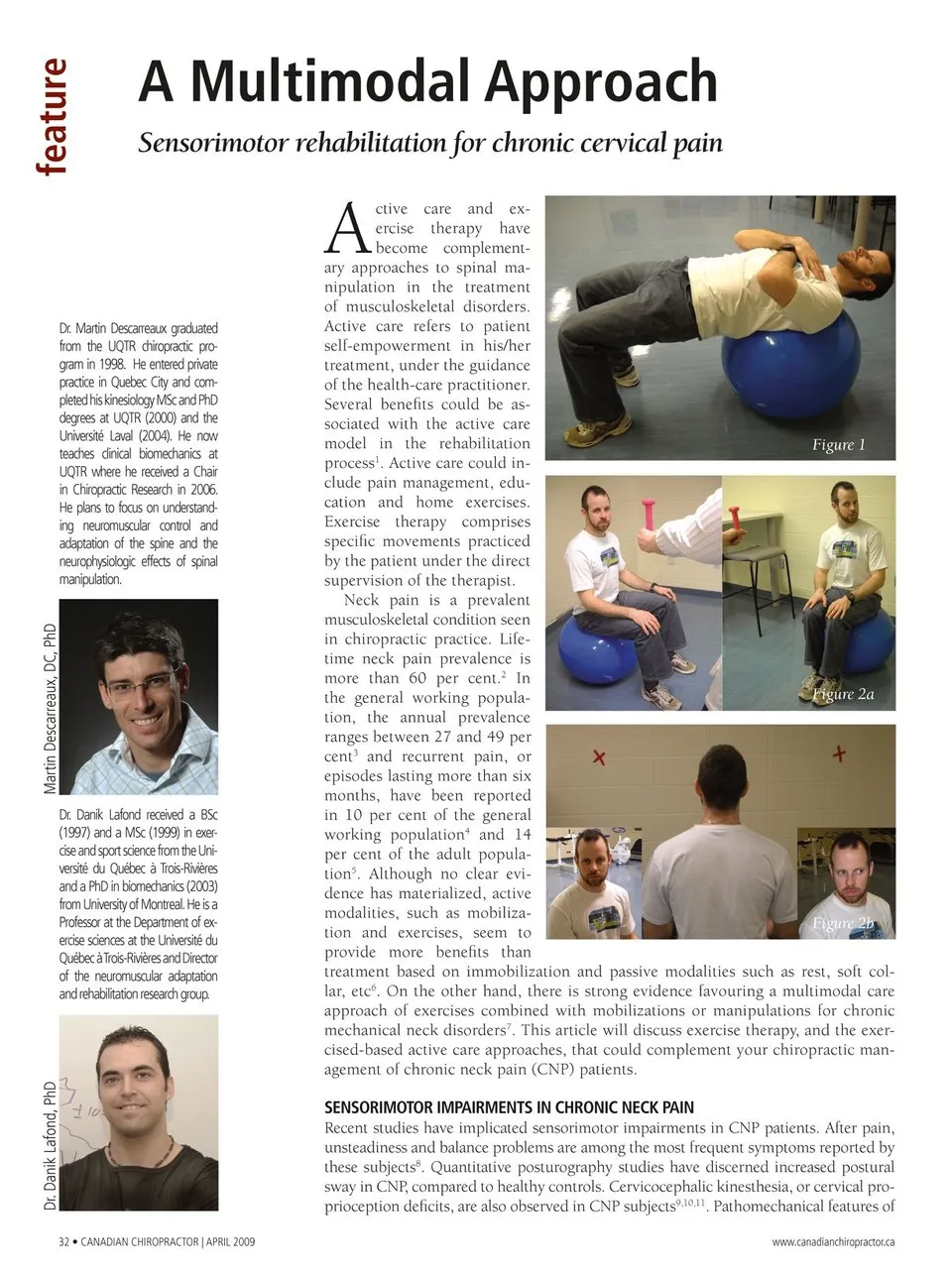
A Multimodal Approach Sensorimotor rehabilitation for chronic cervical pain A Dr. Martin Descarreaux graduated from the UQTR chiropractic pro- gram in 1998. He entered private practice in Quebec City and com- pleted his kinesiology MSc and PhD degrees at UQTR (2000) and the Université Laval (2004). He now teaches clinical biomechanics at UQTR where he received a Chair in Chiropractic Research in 2006. He plans to focus on understand- ing neuromuscular control and adaptation of the spine and the neurophysiologic effects of spinal manipulation. ctive care and ex- ercise therapy have become complement- ary approaches to spinal ma- nipulation in the treatment of musculoskeletal disorders. Active care refers to patient self-empowerment in his/her treatment, under the guidance of the health-care practitioner. Several benefits could be as- sociated with the active care model in the rehabilitation process1 . Active care could in- clude pain management, edu- cation and home exercises. Exercise therapy comprises specific movements practiced by the patient under the direct supervision of the therapist. Neck pain is a prevalent musculoskeletal condition seen in chiropractic practice. Life- time neck pain prevalence is more than 60 per cent.2 In the general working popula- tion, the annual prevalence ranges between 27 and 49 per cent3 Dr. Danik Lafond received a BSc (1997) and a MSc (1999) in exer- cise and sport science from the Uni- versité du Québec à Trois-Rivières and a PhD in biomechanics (2003) from University of Montreal. He is a Professor at the Department of ex- ercise sciences at the Université du Québec à Trois-Rivières and Director of the neuromuscular adaptation and rehabilitation research group. and recurrent pain, or episodes lasting more than six months, have been reported in 10 per cent of the general working population4 and 14 per cent of the adult popula- tion5 . Although no clear evi- dence has materialized, active modalities, such as mobiliza- tion and exercises, seem to provide more benefits than treatment based on immobilization and passive modalities such as rest, soft col- lar, etc6 Figure 2b approach of exercises combined with mobilizations or manipulations for chronic mechanical neck disorders7 . On the other hand, there is strong evidence favouring a multimodal care . This article will discuss exercise therapy, and the exer- cised-based active care approaches, that could complement your chiropractic man- agement of chronic neck pain (CNP) patients. SENSOrIMOTOr IMPAIrMENTS IN CHrONIC NECk PAIN Recent studies have implicated sensorimotor impairments in CNP patients. After pain, unsteadiness and balance problems are among the most frequent symptoms reported by these subjects8 sway in CNP, compared to healthy controls. Cervicocephalic kinesthesia, or cervical pro- prioception deficits, are also observed in CNP subjects9,10,11 32 • CANADIAN CHIROPRACTOR | APRIL 2009 www.canadianchiropractor.ca Figure 1 Figure 2a . Quantitative posturography studies have discerned increased postural . Pathomechanical features of Dr. Danik Lafond, PhD Martin Descarreaux, DC, PhD feature
Chiropractic + Naturopathic Doctor April 2009: Page 32