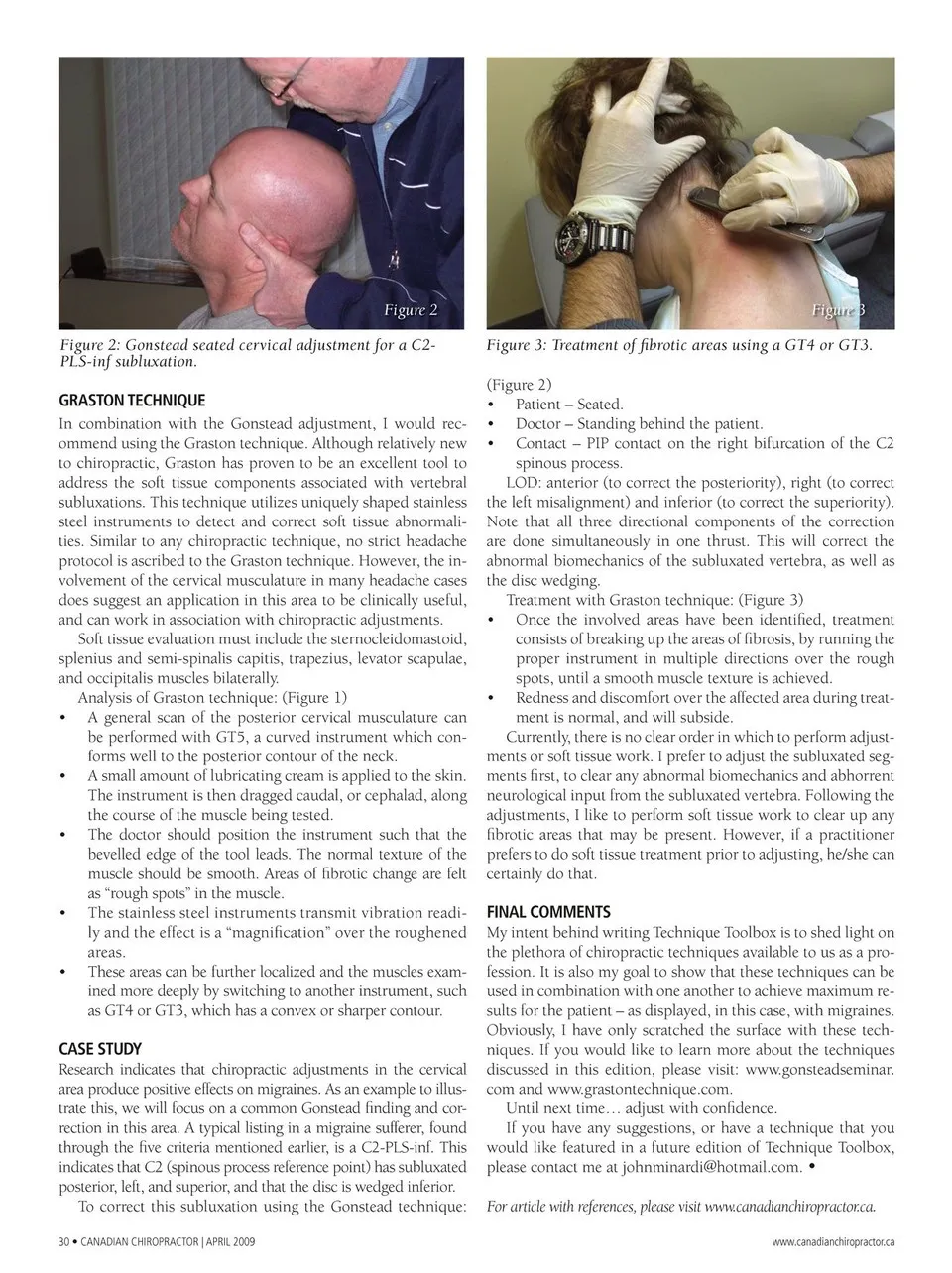
Figure 2: Gonstead seated cervical adjustment for a C2- PLS-inf subluxation. GrASTON TECHNIqUE In combination with the Gonstead adjustment, I would rec- ommend using the Graston technique. Although relatively new to chiropractic, Graston has proven to be an excellent tool to address the soft tissue components associated with vertebral subluxations. This technique utilizes uniquely shaped stainless steel instruments to detect and correct soft tissue abnormali- ties. Similar to any chiropractic technique, no strict headache protocol is ascribed to the Graston technique. However, the in- volvement of the cervical musculature in many headache cases does suggest an application in this area to be clinically useful, and can work in association with chiropractic adjustments. Soft tissue evaluation must include the sternocleidomastoid, splenius and semi-spinalis capitis, trapezius, levator scapulae, and occipitalis muscles bilaterally. Analysis of Graston technique: (Figure 1) • A general scan of the posterior cervical musculature can be performed with GT5, a curved instrument which con- forms well to the posterior contour of the neck. • A small amount of lubricating cream is applied to the skin. The instrument is then dragged caudal, or cephalad, along the course of the muscle being tested. • The doctor should position the instrument such that the bevelled edge of the tool leads. The normal texture of the muscle should be smooth. Areas of fibrotic change are felt as “rough spots” in the muscle. • The stainless steel instruments transmit vibration readi- ly and the effect is a “magnification” over the roughened areas. • These areas can be further localized and the muscles exam- ined more deeply by switching to another instrument, such as GT4 or GT3, which has a convex or sharper contour. CASE STUDy Research indicates that chiropractic adjustments in the cervical area produce positive effects on migraines. As an example to illus- trate this, we will focus on a common Gonstead finding and cor- rection in this area. A typical listing in a migraine sufferer, found through the five criteria mentioned earlier, is a C2-PLS-inf. This indicates that C2 (spinous process reference point) has subluxated posterior, left, and superior, and that the disc is wedged inferior. To correct this subluxation using the Gonstead technique: 30 • CANADIAN CHIROPRACTOR | APRIL 2009 Figure 2 Figure 2 Figure 3 Figure 3: Treatment of fibrotic areas using a GT4 or GT3. (Figure 2) • Patient – Seated. • Doctor – Standing behind the patient. • Contact – PIP contact on the right bifurcation of the C2 spinous process. LOD: anterior (to correct the posteriority), right (to correct the left misalignment) and inferior (to correct the superiority). Note that all three directional components of the correction are done simultaneously in one thrust. This will correct the abnormal biomechanics of the subluxated vertebra, as well as the disc wedging. Treatment with Graston technique: (Figure 3) • Once the involved areas have been identified, treatment consists of breaking up the areas of fibrosis, by running the proper instrument in multiple directions over the rough spots, until a smooth muscle texture is achieved. • Redness and discomfort over the affected area during treat- ment is normal, and will subside. Currently, there is no clear order in which to perform adjust- ments or soft tissue work. I prefer to adjust the subluxated seg- ments first, to clear any abnormal biomechanics and abhorrent neurological input from the subluxated vertebra. Following the adjustments, I like to perform soft tissue work to clear up any fibrotic areas that may be present. However, if a practitioner prefers to do soft tissue treatment prior to adjusting, he/she can certainly do that. fINAL COMMENTS My intent behind writing Technique Toolbox is to shed light on the plethora of chiropractic techniques available to us as a pro- fession. It is also my goal to show that these techniques can be used in combination with one another to achieve maximum re- sults for the patient – as displayed, in this case, with migraines. Obviously, I have only scratched the surface with these tech- niques. If you would like to learn more about the techniques discussed in this edition, please visit: www.gonsteadseminar. com and www.grastontechnique.com. Until next time… adjust with confidence. If you have any suggestions, or have a technique that you would like featured in a future edition of Technique Toolbox, please contact me at [email protected]. • For article with references, please visit www.canadianchiropractor.ca. www.canadianchiropractor.ca
Chiropractic + Naturopathic Doctor April 2009: Page 30