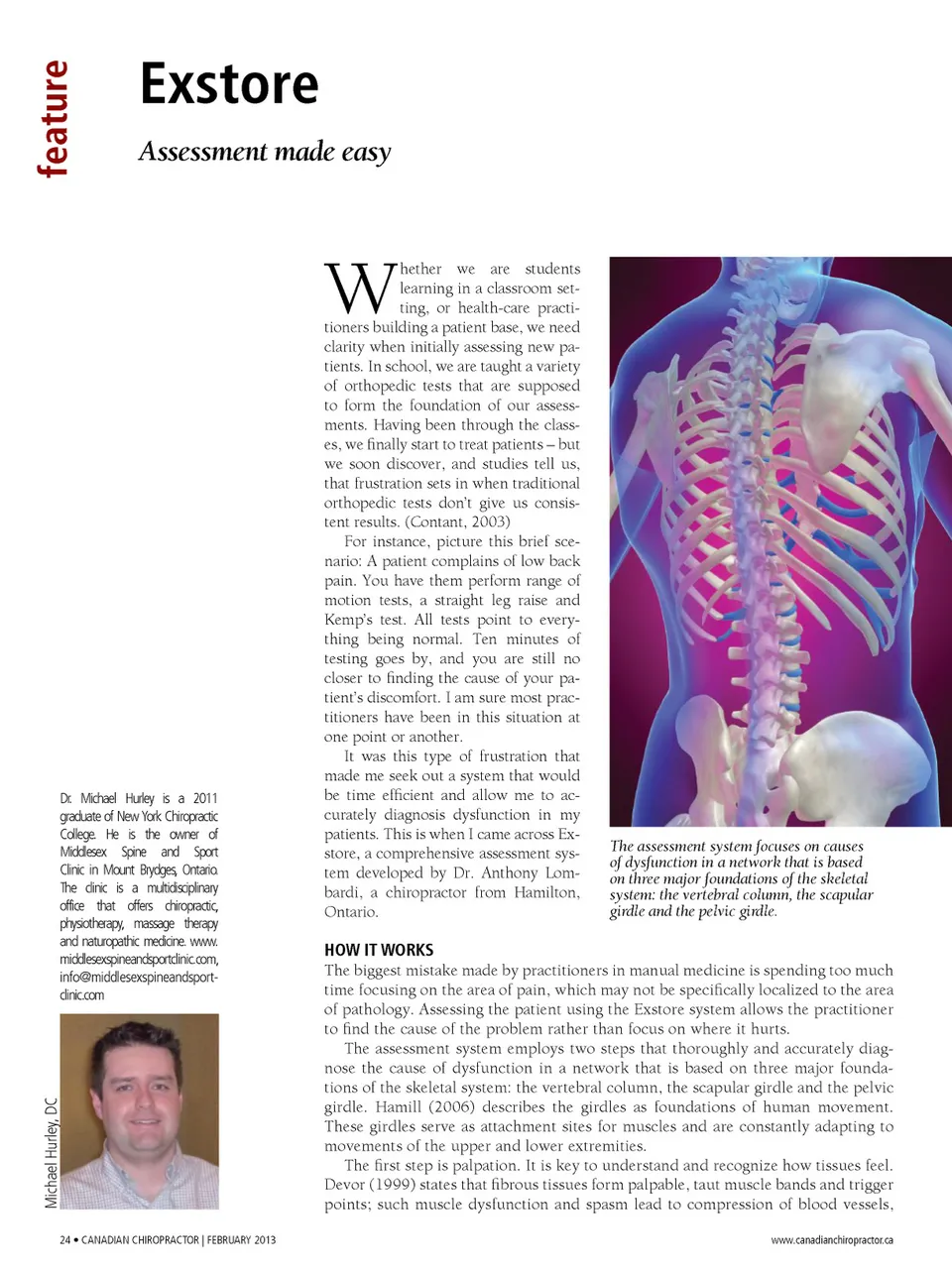
feature Exstore Assessment made easy W Dr. Michael Hurley is a 2011 graduate of New York Chiropractic College. He is the owner of Middlesex Spine and Sport Clinic in Mount Brydges, Ontario. The clinic is a multidisciplinary office that offers chiropractic, physiotherapy, massage therapy and naturopathic medicine. www. middlesexspineandsportclinic.com, [email protected] hether we are students learning in a classroom set-ting, or health-care practi-tioners building a patient base, we need clarity when initially assessing new pa-tients. In school, we are taught a variety of orthopedic tests that are supposed to form the foundation of our assess-ments. Having been through the class-es, we finally start to treat patients – but we soon discover, and studies tell us, that frustration sets in when traditional orthopedic tests don’t give us consis-tent results. (Contant, 2003) For instance, picture this brief sce-nario: A patient complains of low back pain. You have them perform range of motion tests, a straight leg raise and Kemp’s test. All tests point to every-thing being normal. Ten minutes of testing goes by, and you are still no closer to finding the cause of your pa-tient’s discomfort. I am sure most prac-titioners have been in this situation at one point or another. It was this type of frustration that made me seek out a system that would be time efficient and allow me to ac-curately diagnosis dysfunction in my patients. This is when I came across Ex-store, a comprehensive assessment sys-tem developed by Dr. Anthony Lom-bardi, a chiropractor from Hamilton, Ontario. The assessment system focuses on causes of dysfunction in a network that is based on three major foundations of the skeletal system: the vertebral column, the scapular girdle and the pelvic girdle. HOW IT WORKS The biggest mistake made by practitioners in manual medicine is spending too much time focusing on the area of pain, which may not be specifically localized to the area of pathology. Assessing the patient using the Exstore system allows the practitioner to find the cause of the problem rather than focus on where it hurts. The assessment system employs two steps that thoroughly and accurately diag-nose the cause of dysfunction in a network that is based on three major founda-tions of the skeletal system: the vertebral column, the scapular girdle and the pelvic girdle. Hamill (2006) describes the girdles as foundations of human movement. These girdles serve as attachment sites for muscles and are constantly adapting to movements of the upper and lower extremities. The first step is palpation. It is key to understand and recognize how tissues feel. Devor (1999) states that fibrous tissues form palpable, taut muscle bands and trigger points; such muscle dysfunction and spasm lead to compression of blood vessels, www.canadianchiropractor.ca Michael Hurley, DC 24 • CANADiAN CHiROPRACTOR | FEBRUARY 2013
Chiropractic + Naturopathic Doctor February 2013: Page 24