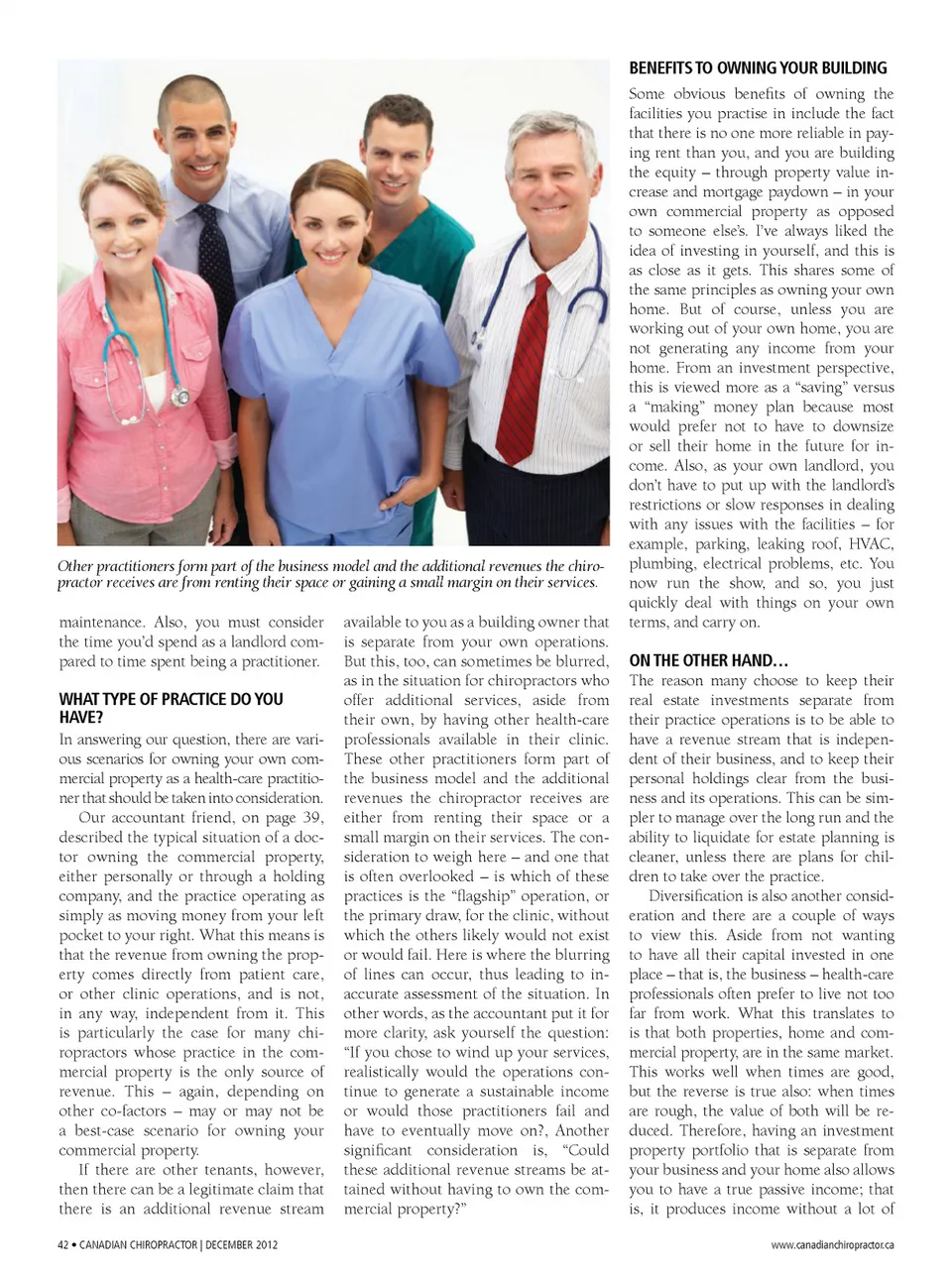
BENEFITS TO OWNING YOUR BUILDING Other practitioners form part of the business model and the additional revenues the chiro-practor receives are from renting their space or gaining a small margin on their services. maintenance. Also, you must consider the time you’d spend as a landlord com-pared to time spent being a practitioner. WHAT TYPE OF PRACTICE DO YOU HAVE? In answering our question, there are vari-ous scenarios for owning your own com-mercial property as a health-care practitio-ner that should be taken into consideration. Our accountant friend, on page 39, described the typical situation of a doc-tor owning the commercial property, either personally or through a holding company, and the practice operating as simply as moving money from your left pocket to your right. What this means is that the revenue from owning the prop-erty comes directly from patient care, or other clinic operations, and is not, in any way, independent from it. This is particularly the case for many chi-ropractors whose practice in the com-mercial property is the only source of revenue. This – again, depending on other co-factors – may or may not be a best-case scenario for owning your commercial property. If there are other tenants, however, then there can be a legitimate claim that there is an additional revenue stream 42 • CANADIAN CHIROPRACTOR | DECEMBER 2012 available to you as a building owner that is separate from your own operations. But this, too, can sometimes be blurred, as in the situation for chiropractors who offer additional services, aside from their own, by having other health-care professionals available in their clinic. These other practitioners form part of the business model and the additional revenues the chiropractor receives are either from renting their space or a small margin on their services. The con-sideration to weigh here – and one that is often overlooked – is which of these practices is the “flagship” operation, or the primary draw, for the clinic, without which the others likely would not exist or would fail. Here is where the blurring of lines can occur, thus leading to in-accurate assessment of the situation. In other words, as the accountant put it for more clarity, ask yourself the question: “If you chose to wind up your services, realistically would the operations con-tinue to generate a sustainable income or would those practitioners fail and have to eventually move on?, Another significant consideration is, “Could these additional revenue streams be at-tained without having to own the com-mercial property?” Some obvious benefits of owning the facilities you practise in include the fact that there is no one more reliable in pay-ing rent than you, and you are building the equity – through property value in-crease and mortgage paydown – in your own commercial property as opposed to someone else’s. I’ve always liked the idea of investing in yourself, and this is as close as it gets. This shares some of the same principles as owning your own home. But of course, unless you are working out of your own home, you are not generating any income from your home. From an investment perspective, this is viewed more as a “saving” versus a “making” money plan because most would prefer not to have to downsize or sell their home in the future for in-come. Also, as your own landlord, you don’t have to put up with the landlord’s restrictions or slow responses in dealing with any issues with the facilities – for example, parking, leaking roof, HVAC, plumbing, electrical problems, etc. You now run the show, and so, you just quickly deal with things on your own terms, and carry on. ON THE OTHER HAND… The reason many choose to keep their real estate investments separate from their practice operations is to be able to have a revenue stream that is indepen-dent of their business, and to keep their personal holdings clear from the busi-ness and its operations. This can be sim-pler to manage over the long run and the ability to liquidate for estate planning is cleaner, unless there are plans for chil-dren to take over the practice. Diversification is also another consid-eration and there are a couple of ways to view this. Aside from not wanting to have all their capital invested in one place – that is, the business – health-care professionals often prefer to live not too far from work. What this translates to is that both properties, home and com-mercial property, are in the same market. This works well when times are good, but the reverse is true also: when times are rough, the value of both will be re-duced. Therefore, having an investment property portfolio that is separate from your business and your home also allows you to have a true passive income; that is, it produces income without a lot of www.canadianchiropractor.ca
Chiropractic + Naturopathic Doctor December 2012: Page 42