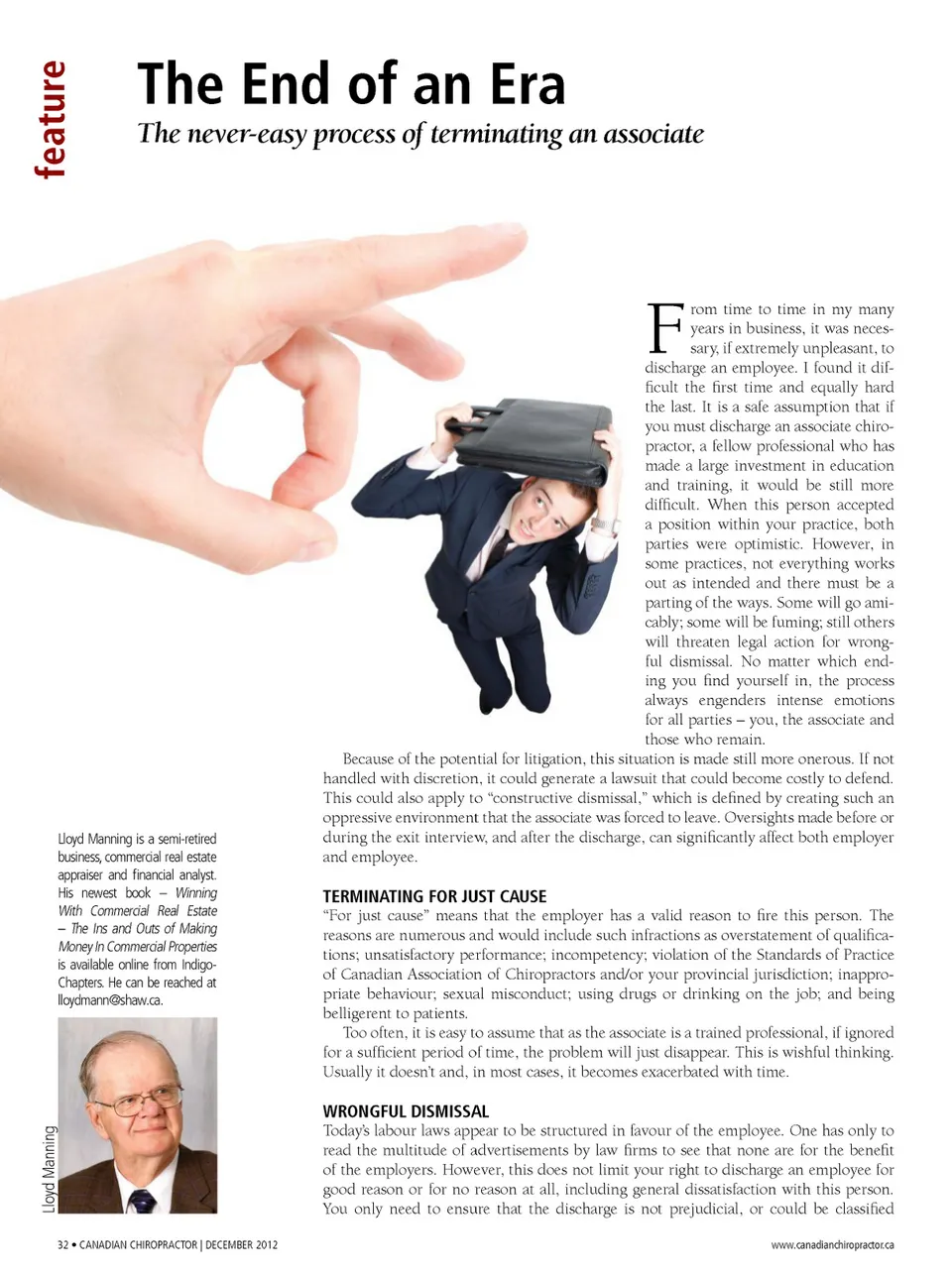
The End of an Era The never-easy process of terminating an associate F rom time to time in my many years in business, it was neces-sary, if extremely unpleasant, to discharge an employee. I found it dif-ficult the first time and equally hard the last. It is a safe assumption that if you must discharge an associate chiro-practor, a fellow professional who has made a large investment in education and training, it would be still more difficult. When this person accepted a position within your practice, both parties were optimistic. However, in some practices, not everything works out as intended and there must be a parting of the ways. Some will go ami-cably; some will be fuming; still others will threaten legal action for wrong-ful dismissal. No matter which end-ing you find yourself in, the process always engenders intense emotions for all parties – you, the associate and those who remain. Lloyd Manning is a semi-retired business, commercial real estate appraiser and financial analyst. His newest book – Winning With Commercial Real Estate – The Ins and Outs of Making Money In Commercial Properties is available online from Indigo-Chapters. He can be reached at [email protected]. Because of the potential for litigation, this situation is made still more onerous. If not handled with discretion, it could generate a lawsuit that could become costly to defend. This could also apply to “constructive dismissal,” which is defined by creating such an oppressive environment that the associate was forced to leave. Oversights made before or during the exit interview, and after the discharge, can significantly affect both employer and employee. TERMINATING FOR JUST CAUSE “For just cause” means that the employer has a valid reason to fire this person. The reasons are numerous and would include such infractions as overstatement of qualifica-tions; unsatisfactory performance; incompetency; violation of the Standards of Practice of Canadian Association of Chiropractors and/or your provincial jurisdiction; inappro-priate behaviour; sexual misconduct; using drugs or drinking on the job; and being belligerent to patients. Too often, it is easy to assume that as the associate is a trained professional, if ignored for a sufficient period of time, the problem will just disappear. This is wishful thinking. Usually it doesn’t and, in most cases, it becomes exacerbated with time. WRONGFUL DISMISSAL Today’s labour laws appear to be structured in favour of the employee. One has only to read the multitude of advertisements by law firms to see that none are for the benefit of the employers. However, this does not limit your right to discharge an employee for good reason or for no reason at all, including general dissatisfaction with this person. You only need to ensure that the discharge is not prejudicial, or could be classified 32 • CANADIAN CHIROPRACTOR | DECEMBER 2012 www.canadianchiropractor.ca Lloyd Manning feature
Chiropractic + Naturopathic Doctor December 2012: Page 32