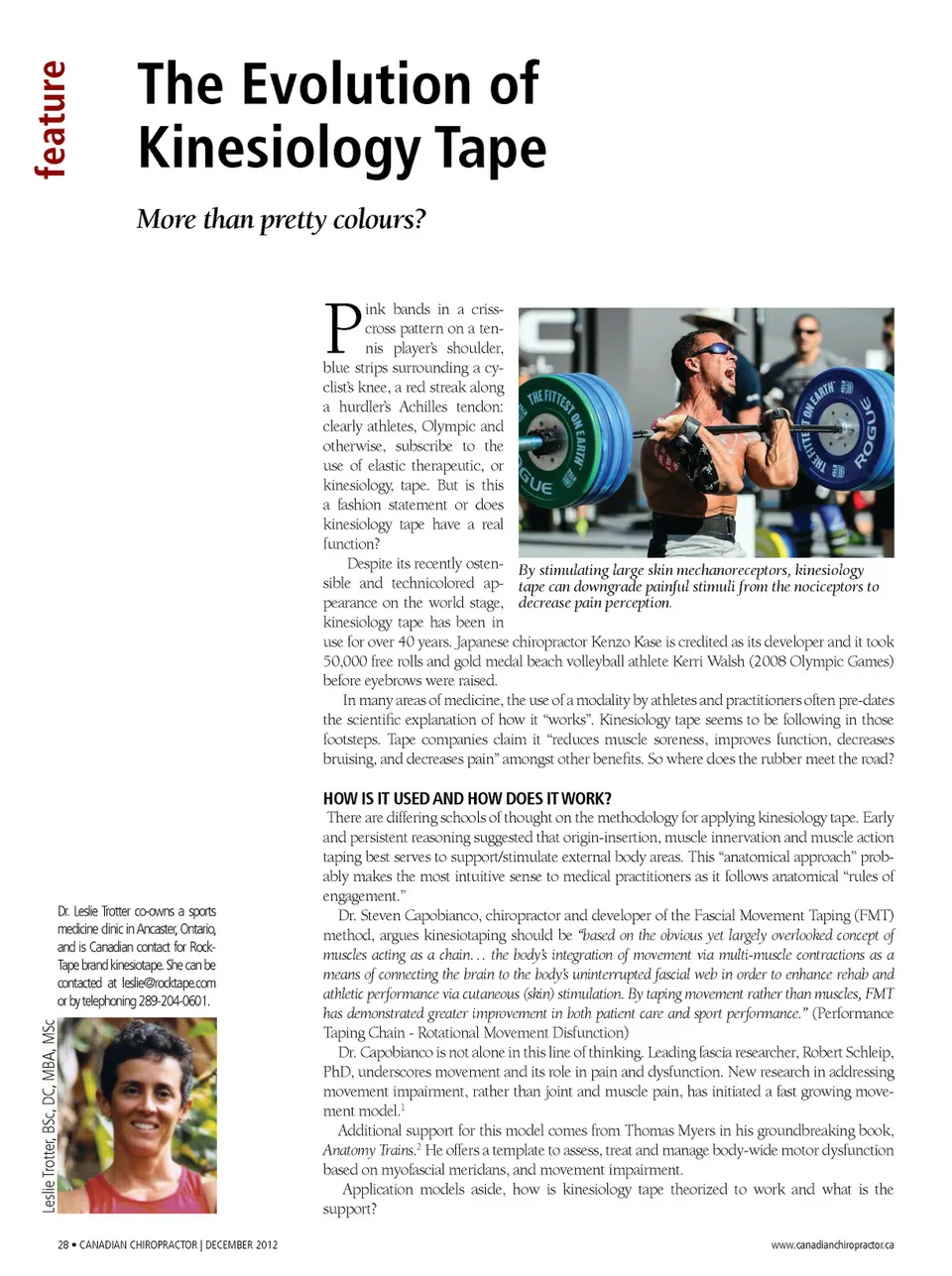
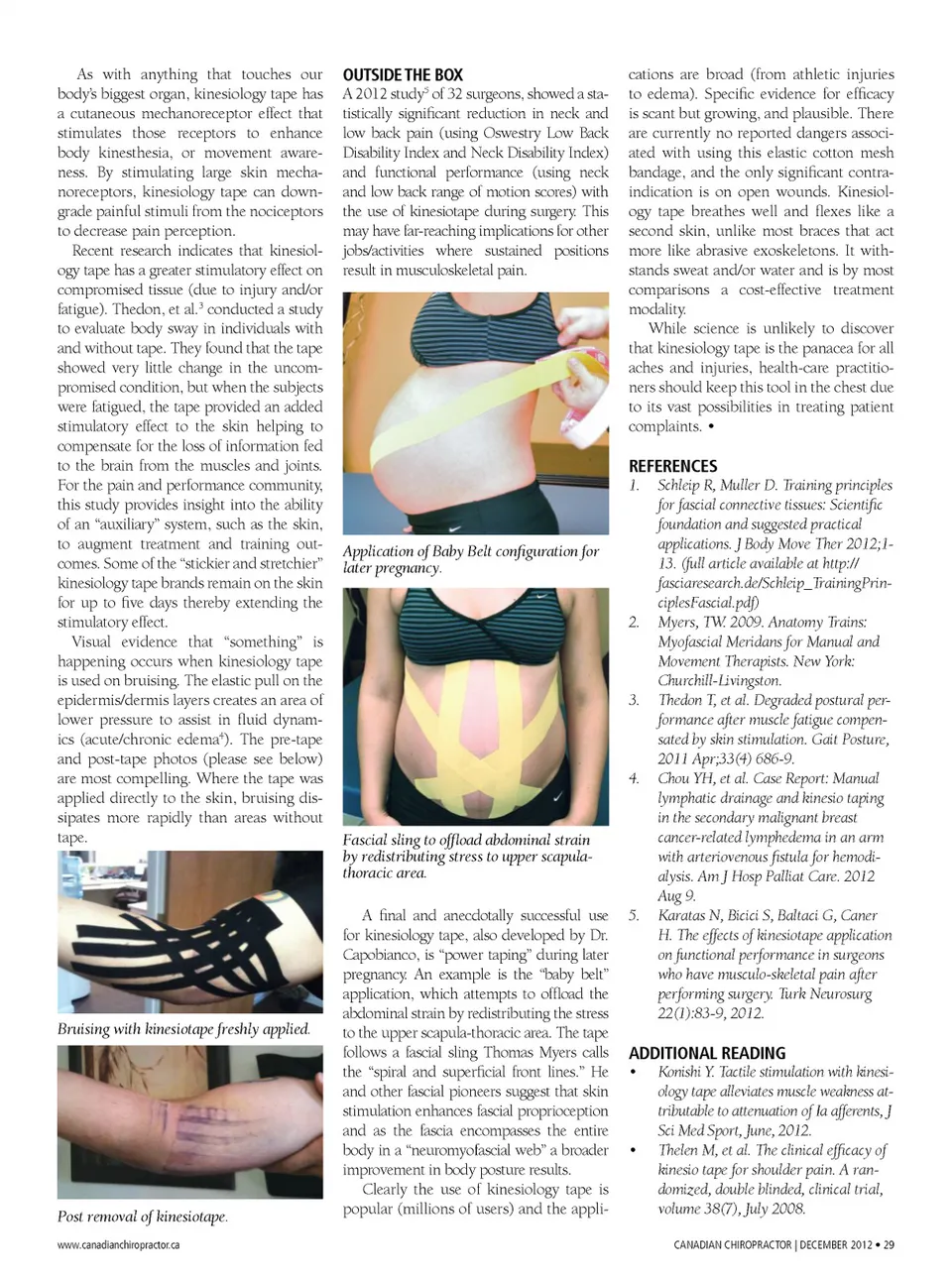
As with anything that touches our body’s biggest organ, kinesiology tape has a cutaneous mechanoreceptor effect that stimulates those receptors to enhance body kinesthesia, or movement aware-ness. By stimulating large skin mecha-noreceptors, kinesiology tape can down-grade painful stimuli from the nociceptors to decrease pain perception. Recent research indicates that kinesiol-ogy tape has a greater stimulatory effect on compromised tissue (due to injury and/or fatigue). Thedon, et al.3 conducted a study to evaluate body sway in individuals with and without tape. They found that the tape showed very little change in the uncom-promised condition, but when the subjects were fatigued, the tape provided an added stimulatory effect to the skin helping to compensate for the loss of information fed to the brain from the muscles and joints. For the pain and performance community, this study provides insight into the ability of an “auxiliary” system, such as the skin, to augment treatment and training out-comes. Some of the “stickier and stretchier” kinesiology tape brands remain on the skin for up to five days thereby extending the stimulatory effect. Visual evidence that “something” is happening occurs when kinesiology tape is used on bruising. The elastic pull on the epidermis/dermis layers creates an area of lower pressure to assist in fluid dynam-ics (acute/chronic edema4 ). The pre-tape and post-tape photos (please see below) are most compelling. Where the tape was applied directly to the skin, bruising dis-sipates more rapidly than areas without tape. OUTSIDE THE BOX A 2012 study5 of 32 surgeons, showed a sta-tistically significant reduction in neck and low back pain (using Oswestry Low Back Disability Index and Neck Disability Index) and functional performance (using neck and low back range of motion scores) with the use of kinesiotape during surgery. This may have far-reaching implications for other jobs/activities where sustained positions result in musculoskeletal pain. cations are broad (from athletic injuries to edema). Specific evidence for efficacy is scant but growing, and plausible. There are currently no reported dangers associ-ated with using this elastic cotton mesh bandage, and the only significant contra-indication is on open wounds. Kinesiol-ogy tape breathes well and flexes like a second skin, unlike most braces that act more like abrasive exoskeletons. It with-stands sweat and/or water and is by most comparisons a cost-effective treatment modality. While science is unlikely to discover that kinesiology tape is the panacea for all aches and injuries, health-care practitio-ners should keep this tool in the chest due to its vast possibilities in treating patient complaints. • Application of Baby Belt configuration for later pregnancy. REFERENCES 1. Schleip R, Muller D. Training principles for fascial connective tissues: Scientific foundation and suggested practical applications. J Body Move Ther 2012;1-13. (full article available at http:// fasciaresearch.de/Schleip_TrainingPrin-ciplesFascial.pdf) 2. Myers, TW. 2009. Anatomy Trains: Myofascial Meridans for Manual and Movement Therapists. New York: Churchill-Livingston. 3. Thedon T, et al. Degraded postural per-formance after muscle fatigue compen-sated by skin stimulation. Gait Posture, 2011 Apr;33(4) 686-9. Fascial sling to offload abdominal strain by redistributing stress to upper scapula-thoracic area. Bruising with kinesiotape freshly applied. Post removal of kinesiotape. www.canadianchiropractor.ca A final and anecdotally successful use for kinesiology tape, also developed by Dr. Capobianco, is “power taping” during later pregnancy. An example is the “baby belt” application, which attempts to offload the abdominal strain by redistributing the stress to the upper scapula-thoracic area. The tape follows a fascial sling Thomas Myers calls the “spiral and superficial front lines.” He and other fascial pioneers suggest that skin stimulation enhances fascial proprioception and as the fascia encompasses the entire body in a “neuromyofascial web” a broader improvement in body posture results. Clearly the use of kinesiology tape is popular (millions of users) and the appli-4. Chou YH, et al. Case Report: Manual lymphatic drainage and kinesio taping in the secondary malignant breast cancer-related lymphedema in an arm with arteriovenous fistula for hemodi-alysis. Am J Hosp Palliat Care. 2012 Aug 9. 5. Karatas N, Bicici S, Baltaci G, Caner H. The effects of kinesiotape application on functional performance in surgeons who have musculo-skeletal pain after performing surgery. Turk Neurosurg 22(1):83-9, 2012. ADDITIONAL READING • Konishi Y. Tactile stimulation with kinesi-ology tape alleviates muscle weakness at-tributable to attenuation of Ia afferents, J Sci Med Sport, June, 2012. • Thelen M, et al. The clinical efficacy of kinesio tape for shoulder pain. A ran-domized, double blinded, clinical trial, volume 38(7), July 2008. CANADIAN CHIROPRACTOR | DECEMBER 2012 • 29
Chiropractic + Naturopathic Doctor December 2012: Page 29