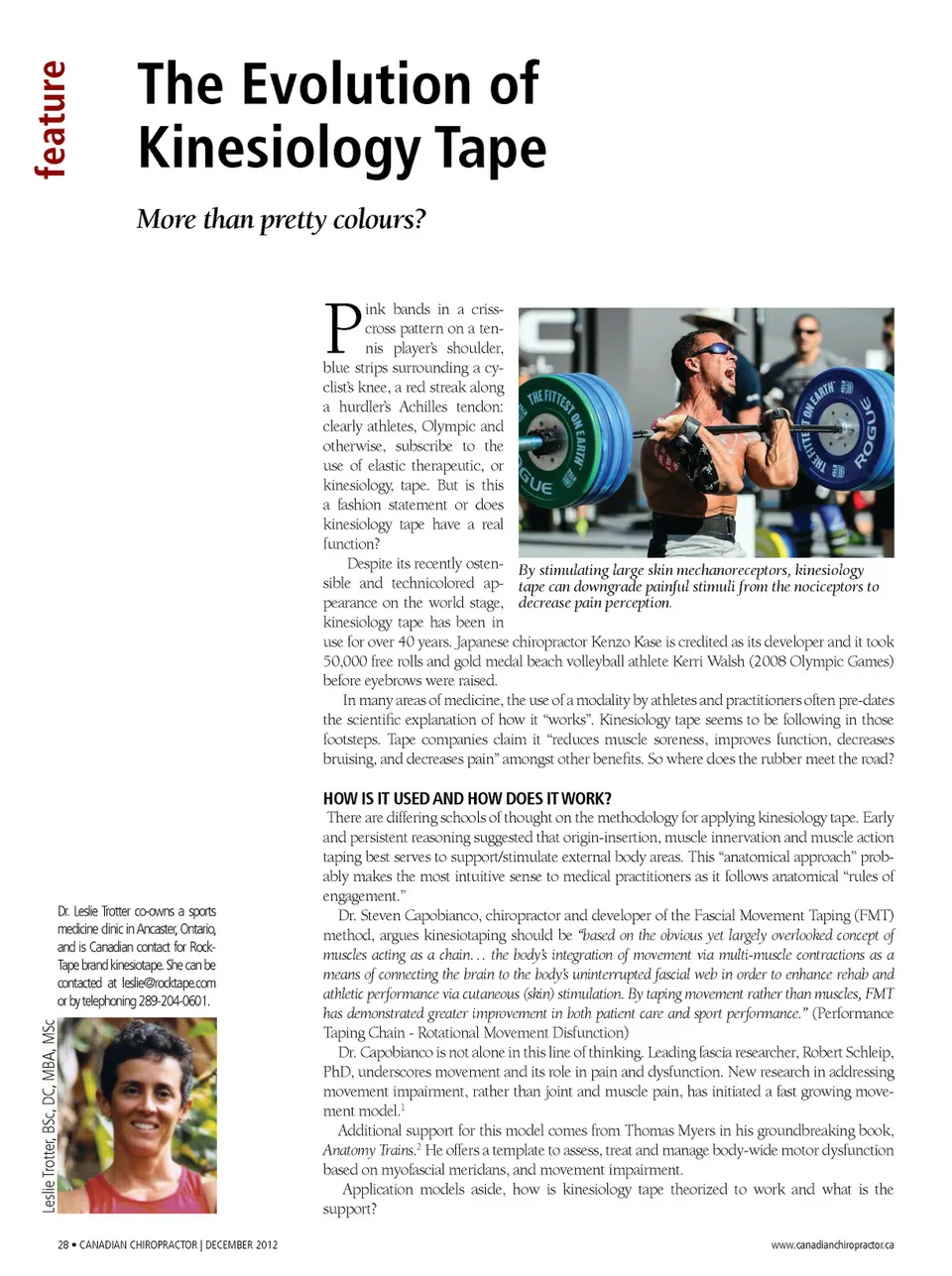
The Evolution of Kinesiology Tape More than pretty colours? P ink bands in a criss-cross pattern on a ten-nis player’s shoulder, blue strips surrounding a cy-clist’s knee, a red streak along a hurdler’s Achilles tendon: clearly athletes, Olympic and otherwise, subscribe to the use of elastic therapeutic, or kinesiology, tape. But is this a fashion statement or does kinesiology tape have a real function? Despite its recently osten-sible and technicolored ap-pearance on the world stage, kinesiology tape has been in use for over 40 years. Japanese chiropractor Kenzo Kase is credited as its developer and it took 50,000 free rolls and gold medal beach volleyball athlete Kerri Walsh (2008 Olympic Games) before eyebrows were raised. In many areas of medicine, the use of a modality by athletes and practitioners often pre-dates the scientific explanation of how it “works”. Kinesiology tape seems to be following in those footsteps. Tape companies claim it “reduces muscle soreness, improves function, decreases bruising, and decreases pain” amongst other benefits. So where does the rubber meet the road? By stimulating large skin mechanoreceptors, kinesiology tape can downgrade painful stimuli from the nociceptors to decrease pain perception. Dr. Leslie Trotter co-owns a sports medicine clinic in Ancaster, Ontario, and is Canadian contact for Rock-Tape brand kinesiotape.She can be contacted at [email protected] or by telephoning 289-204-0601. He offers a template to assess, treat and manage body-wide motor dysfunction based on myofascial meridans, and movement impairment. Application models aside, how is kinesiology tape theorized to work and what is the support? 28 • CANADIAN CHIROPRACTOR | DECEMBER 2012 www.canadianchiropractor.ca HOW IS IT USED AND HOW DOES IT WORK? There are differing schools of thought on the methodology for applying kinesiology tape. Early and persistent reasoning suggested that origin-insertion, muscle innervation and muscle action taping best serves to support/stimulate external body areas. This “anatomical approach” prob-ably makes the most intuitive sense to medical practitioners as it follows anatomical “rules of engagement.” Dr. Steven Capobianco, chiropractor and developer of the Fascial Movement Taping (FMT) method, argues kinesiotaping should be “based on the obvious yet largely overlooked concept of muscles acting as a chain… the body’s integration of movement via multi-muscle contractions as a means of connecting the brain to the body’s uninterrupted fascial web in order to enhance rehab and athletic performance via cutaneous (skin) stimulation. By taping movement rather than muscles, FMT has demonstrated greater improvement in both patient care and sport performance.” (Performance Taping Chain -Rotational Movement Disfunction) Dr. Capobianco is not alone in this line of thinking. Leading fascia researcher, Robert Schleip, PhD, underscores movement and its role in pain and dysfunction. New research in addressing movement impairment, rather than joint and muscle pain, has initiated a fast growing move-ment model.1 Additional support for this model comes from Thomas Myers in his groundbreaking book, Anatomy Trains.2 Leslie Trotter, BSc, DC, MBA, MSc feature
Chiropractic + Naturopathic Doctor December 2012: Page 28