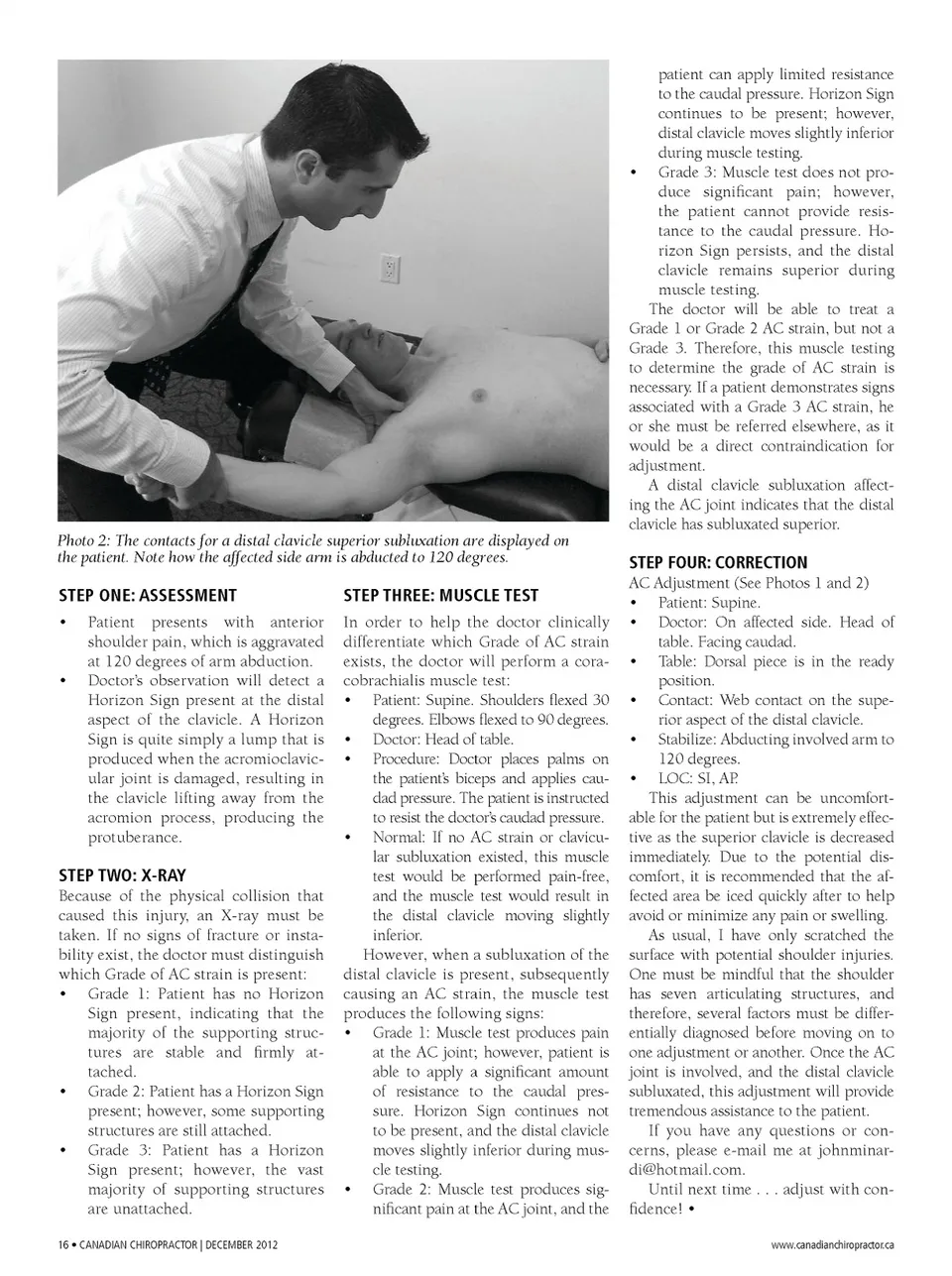
patient can apply limited resistance to the caudal pressure. Horizon Sign continues to be present; however, distal clavicle moves slightly inferior during muscle testing. • Grade 3: Muscle test does not pro-duce significant pain; however, the patient cannot provide resis-tance to the caudal pressure. Ho-rizon Sign persists, and the distal clavicle remains superior during muscle testing. The doctor will be able to treat a Grade 1 or Grade 2 AC strain, but not a Grade 3. Therefore, this muscle testing to determine the grade of AC strain is necessary. If a patient demonstrates signs associated with a Grade 3 AC strain, he or she must be referred elsewhere, as it would be a direct contraindication for adjustment. A distal clavicle subluxation affect-ing the AC joint indicates that the distal clavicle has subluxated superior. Photo 2: The contacts for a distal clavicle superior subluxation are displayed on the patient. Note how the affected side arm is abducted to 120 degrees. STEP ONE: ASSESSMENT • Patient presents with anterior shoulder pain, which is aggravated at 120 degrees of arm abduction. • Doctor’s observation will detect a Horizon Sign present at the distal aspect of the clavicle. A Horizon Sign is quite simply a lump that is produced when the acromioclavic-ular joint is damaged, resulting in the clavicle lifting away from the acromion process, producing the protuberance. STEP TWO: X-RAY Because of the physical collision that caused this injury, an X-ray must be taken. If no signs of fracture or insta-bility exist, the doctor must distinguish which Grade of AC strain is present: • Grade 1: Patient has no Horizon Sign present, indicating that the majority of the supporting struc-tures are stable and firmly at-tached. • Grade 2: Patient has a Horizon Sign present; however, some supporting structures are still attached. • Grade 3: Patient has a Horizon Sign present; however, the vast majority of supporting structures are unattached. 16 • CANADIAN CHIROPRACTOR | DECEMBER 2012 STEP THREE: MUSCLE TEST In order to help the doctor clinically differentiate which Grade of AC strain exists, the doctor will perform a cora-cobrachialis muscle test: • Patient: Supine. Shoulders flexed 30 degrees. Elbows flexed to 90 degrees. • Doctor: Head of table. • Procedure: Doctor places palms on the patient’s biceps and applies cau-dad pressure. The patient is instructed to resist the doctor’s caudad pressure. • Normal: If no AC strain or clavicu-lar subluxation existed, this muscle test would be performed pain-free, and the muscle test would result in the distal clavicle moving slightly inferior. However, when a subluxation of the distal clavicle is present, subsequently causing an AC strain, the muscle test produces the following signs: • Grade 1: Muscle test produces pain at the AC joint; however, patient is able to apply a significant amount of resistance to the caudal pres-sure. Horizon Sign continues not to be present, and the distal clavicle moves slightly inferior during mus-cle testing. • Grade 2: Muscle test produces sig-nificant pain at the AC joint, and the STEP FOUR: CORRECTION AC Adjustment (See Photos 1 and 2) • Patient: Supine. • Doctor: On affected side. Head of table. Facing caudad. • Table: Dorsal piece is in the ready position. • Contact: Web contact on the supe-rior aspect of the distal clavicle. • Stabilize: Abducting involved arm to 120 degrees. • LOC: SI, AP. This adjustment can be uncomfort-able for the patient but is extremely effec-tive as the superior clavicle is decreased immediately. Due to the potential dis-comfort, it is recommended that the af-fected area be iced quickly after to help avoid or minimize any pain or swelling. As usual, I have only scratched the surface with potential shoulder injuries. One must be mindful that the shoulder has seven articulating structures, and therefore, several factors must be differ-entially diagnosed before moving on to one adjustment or another. Once the AC joint is involved, and the distal clavicle subluxated, this adjustment will provide tremendous assistance to the patient. If you have any questions or con-cerns, please e-mail me at [email protected]. Until next time . . . adjust with con-fidence! • www.canadianchiropractor.ca
Chiropractic + Naturopathic Doctor December 2012: Page 16