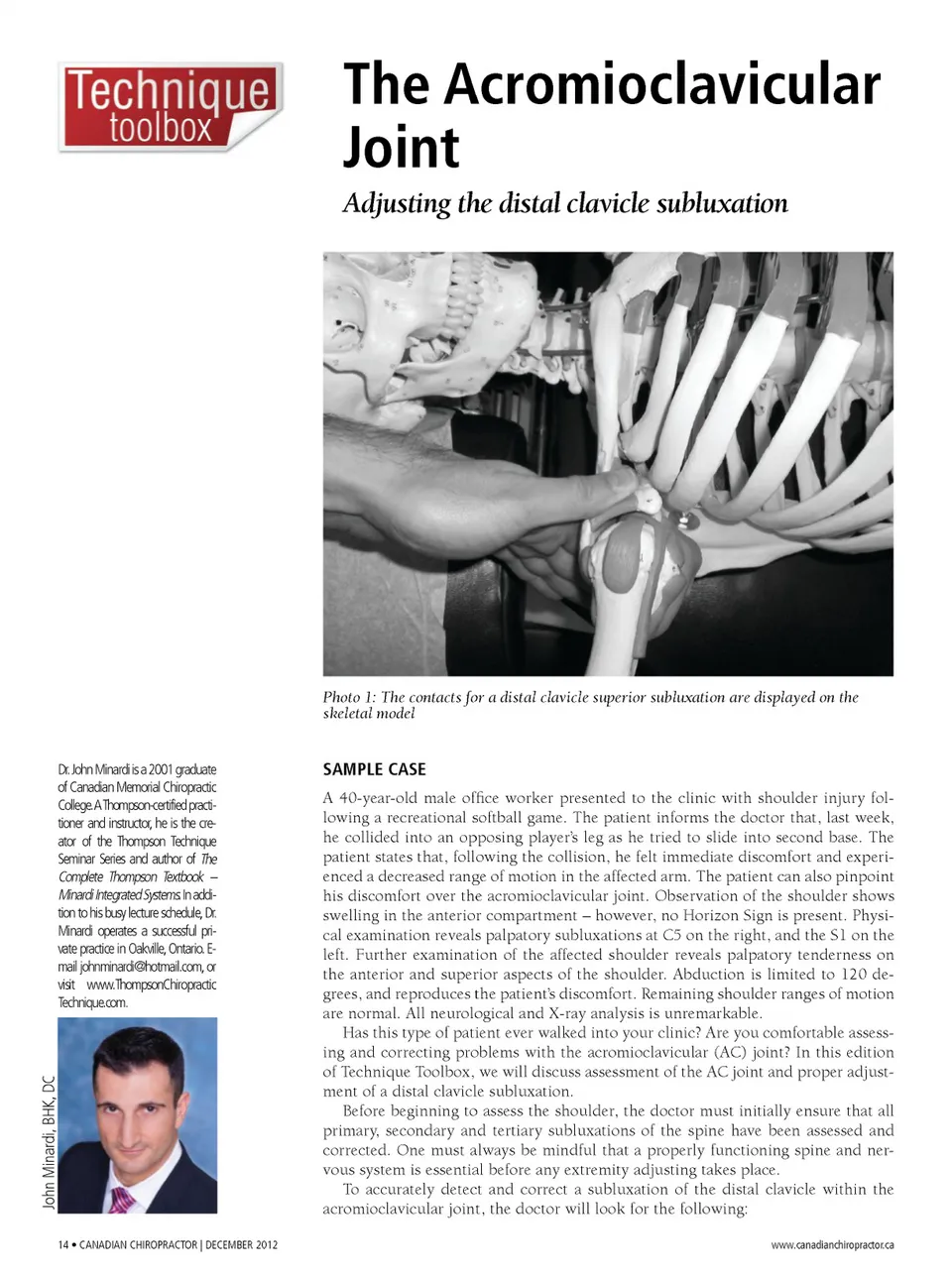
The Acromioclavicular Joint Adjusting the distal clavicle subluxation Photo 1: The contacts for a distal clavicle superior subluxation are displayed on the skeletal model Dr.John Minardi is a 2001 graduate of Canadian Memorial Chiropractic College.A Thompson-certified practi-tioner and instructor, he is the cre-ator of the Thompson Technique Seminar Series and author of The Complete Thompson Textbook – Minardi Integrated Systems. In addi-tion to his busy lecture schedule, Dr. Minardi operates a successful pri-vate practice in Oakville, Ontario. E-mail [email protected], or visit www.ThompsonChiropractic Technique.com. SAMPLE CASE A 40-year-old male office worker presented to the clinic with shoulder injury fol-lowing a recreational softball game. The patient informs the doctor that, last week, he collided into an opposing player’s leg as he tried to slide into second base. The patient states that, following the collision, he felt immediate discomfort and experi-enced a decreased range of motion in the affected arm. The patient can also pinpoint his discomfort over the acromioclavicular joint. Observation of the shoulder shows swelling in the anterior compartment – however, no Horizon Sign is present. Physi-cal examination reveals palpatory subluxations at C5 on the right, and the S1 on the left. Further examination of the affected shoulder reveals palpatory tenderness on the anterior and superior aspects of the shoulder. Abduction is limited to 120 de-grees, and reproduces the patient’s discomfort. Remaining shoulder ranges of motion are normal. All neurological and X-ray analysis is unremarkable. Has this type of patient ever walked into your clinic? Are you comfortable assess-ing and correcting problems with the acromioclavicular (AC) joint? In this edition of Technique Toolbox, we will discuss assessment of the AC joint and proper adjust-ment of a distal clavicle subluxation. Before beginning to assess the shoulder, the doctor must initially ensure that all primary, secondary and tertiary subluxations of the spine have been assessed and corrected. One must always be mindful that a properly functioning spine and ner-vous system is essential before any extremity adjusting takes place. To accurately detect and correct a subluxation of the distal clavicle within the acromioclavicular joint, the doctor will look for the following: 14 • CANADIAN CHIROPRACTOR | DECEMBER 2012 www.canadianchiropractor.ca John Minardi, BHK, DC
Chiropractic + Naturopathic Doctor December 2012: Page 14