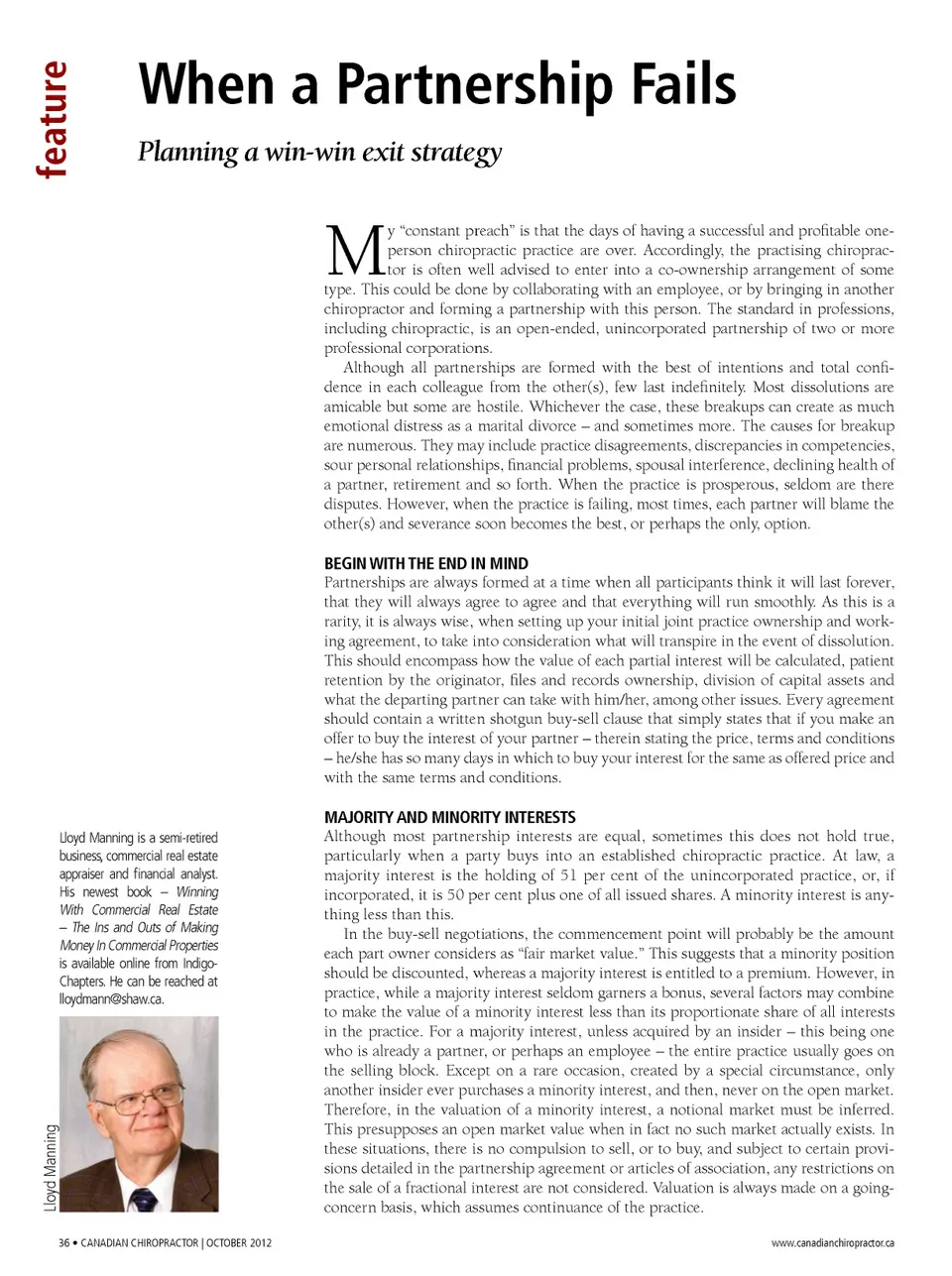
Dissolving a partnership is a negotiating process that should include give and take to achieve a win-win for all parties. VALUING THE PARTIAL INTERESTS Assuming unequal interests, the value of a majority or con-trolling interest can be equal to, more than, but never less than the pro rata percentage value of the minority interest. However, there are no definite rules, and few precedents, to establish a premium for that majority interest. Usually it is nil! In these situations, certain assumptions must be made. Any increase by including a bonus for a majority interest must be on account of subjective motives, or for some specific reason. It is not a fact of the market that can be interpreted by any prescribed set of rules, or by reference to legal precedents, few of which exist. Whether the value of a minority interest should be discount-ed is slightly more problematic. The courts, and the market, recognize that a lower value is attributable to a minority hold-ing, usually referring to a closely held corporation, yet deter-mining an appropriate discount is most often pure guesswork. When calculating the amount, or per cent, by which the value of the minority position should be discounted, or if it should be, further consideration should be given to the per cent of the practice being acquired. The greater the per cent owned, the lower the discount, with the value of a minute percentage greatly reduced. Most partnership breakups are amicable. Usually, valua-tion methods are agreed to, but if not, the shotgun clause of the buy-sell agreement is enforced. Although appraisers may suggest there should be a discount or perhaps a bonus, in actual practice, the sale of a fractional interest in professional practices is usually to an existing partner or employee at 100 per cent of value. This does not negate the fact that, since there is no open or secondary market, a notional market must be assumed. Thus, in day-to-day practice, dissolving a partnership becomes a negotiating process, and should include some give and some take to achieve a win-win for all parties. • www.canadianchiropractor.ca CANADIAN CHIROPRACTOR | OCTOBER 2012 • 37
Chiropractic + Naturopathic Doctor October 2012: Page 37