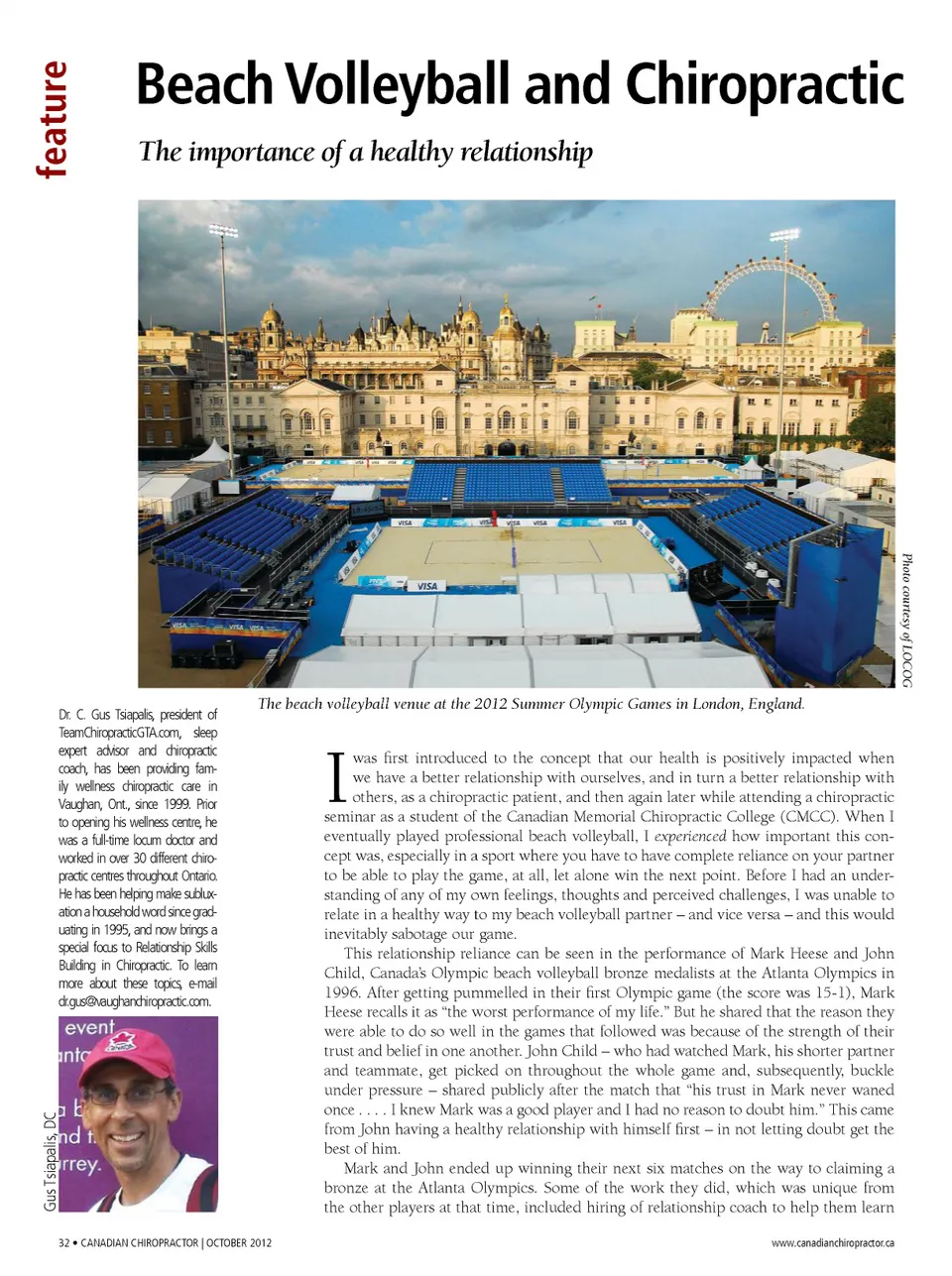
feature Beach Volleyball and Chiropractic The importance of a healthy relationship Photo courtesy of LOCOG Dr. C. Gus Tsiapalis, president of TeamChiropracticGTA.com, sleep expert advisor and chiropractic coach, has been providing fam-ily wellness chiropractic care in Vaughan, Ont., since 1999. Prior to opening his wellness centre, he was a full-time locum doctor and worked in over 30 different chiro-practic centres throughout Ontario. He has been helping make sublux-ation a household word since grad-uating in 1995, and now brings a special focus to Relationship Skills Building in Chiropractic. To learn more about these topics, e-mail [email protected]. The beach volleyball venue at the 2012 Summer Olympic Games in London, England. I was first introduced to the concept that our health is positively impacted when we have a better relationship with ourselves, and in turn a better relationship with others, as a chiropractic patient, and then again later while attending a chiropractic seminar as a student of the Canadian Memorial Chiropractic College (CMCC). When I eventually played professional beach volleyball, I experienced how important this con-cept was, especially in a sport where you have to have complete reliance on your partner to be able to play the game, at all, let alone win the next point. Before I had an under-standing of any of my own feelings, thoughts and perceived challenges, I was unable to relate in a healthy way to my beach volleyball partner – and vice versa – and this would inevitably sabotage our game. This relationship reliance can be seen in the performance of Mark Heese and John Child, Canada’s Olympic beach volleyball bronze medalists at the Atlanta Olympics in 1996. After getting pummelled in their first Olympic game (the score was 15-1), Mark Heese recalls it as “the worst performance of my life.” But he shared that the reason they were able to do so well in the games that followed was because of the strength of their trust and belief in one another. John Child – who had watched Mark, his shorter partner and teammate, get picked on throughout the whole game and, subsequently, buckle under pressure – shared publicly after the match that “his trust in Mark never waned once . . . . I knew Mark was a good player and I had no reason to doubt him.” This came from John having a healthy relationship with himself first – in not letting doubt get the best of him. Mark and John ended up winning their next six matches on the way to claiming a bronze at the Atlanta Olympics. Some of the work they did, which was unique from the other players at that time, included hiring of relationship coach to help them learn www.canadianchiropractor.ca Gus Tsiapalis, DC 32 • CANADIAN CHIROPRACTOR | OCTOBER 2012
Chiropractic + Naturopathic Doctor October 2012: Page 32