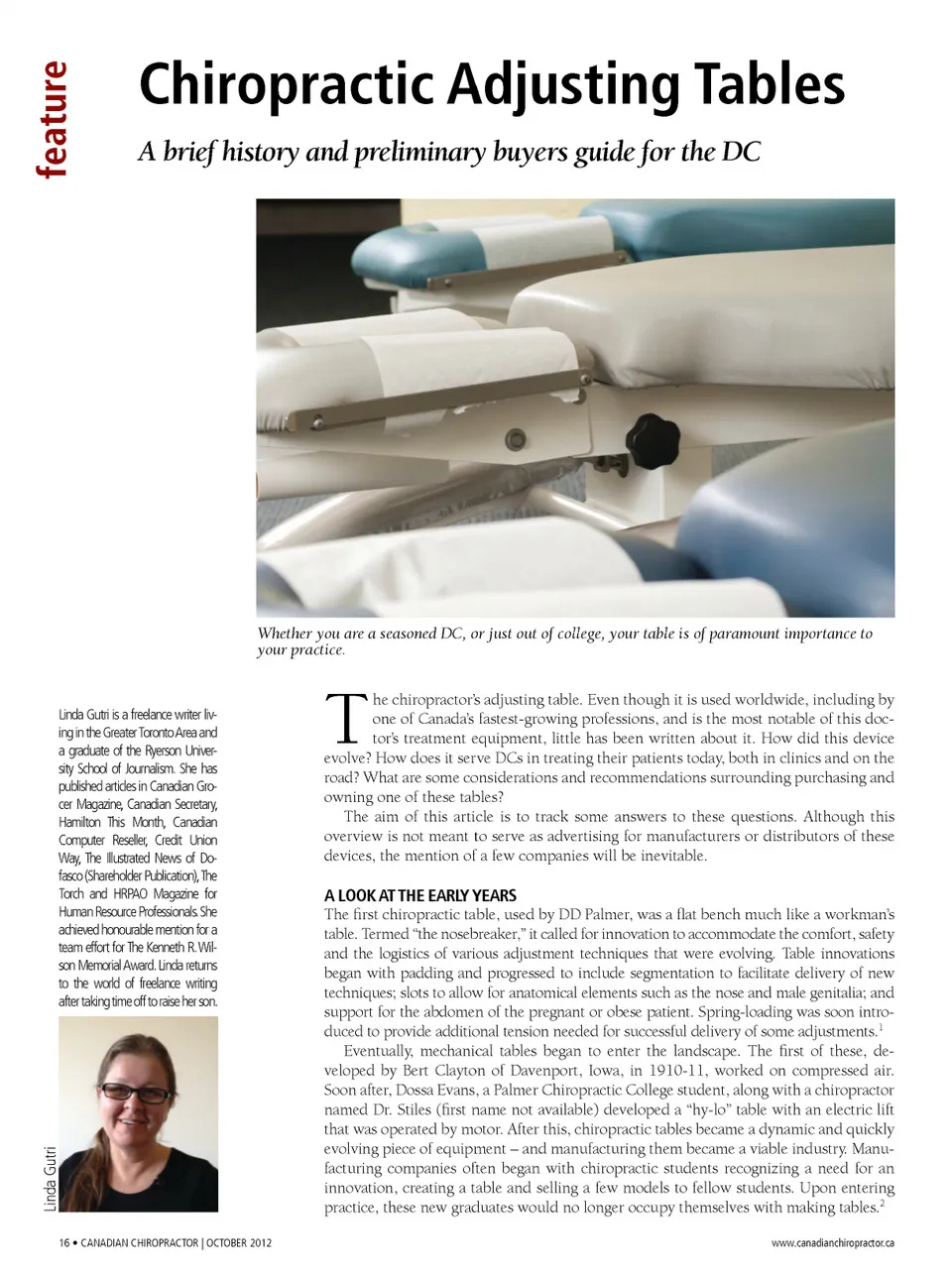
However, one of these students did not fade into chiropractic table obscurity. In 1963, Dr. Lloyd Steffensmeier, then a Palmer student, began his career as a reputable and successful table manu-facturer by filling the void for portable tables. 3 Following this, he also designed a chiropractic table for smaller patients and, before long, his table manufacturing setup, originally a hobby, mushroomed into a profitable company that is still in business today. For almost 50 years, Dr. Steffensmeier has produced innovations in table designs. Many of these have been at the request of clinicians who required a customized accommodation to a table for their practice. But the distinction of the oldest chi-ropractic table manufacturer still in busi-ness goes to the Williams Manufacturing Company. This venerable designer and purveyor of adjusting tables was started by William B. Williams, DC, in Moline, Illinois, in 1916. 4 “Tables of the earlier years started as garage projects, says John Triantos, presi-dent of Techniques Tables, a table design and manufacturing company located in Toronto. “The first ones had a flat bench and evolved from there.” to buy a table, and then purchase one that suits your needs.” DROPS HAVE IMPROVED Dr. Minardi specializes in the Thompson Technique, a technique requiring drop tables. For him and his practice needs, these are the most appropriate tables in which to invest. “Thanks to innovations in engineer-ing, the mechanical drops have improved to be just as good as the hydraulic drops,” he says. “That’s where most of the ingenu-ity has been put into by making the me-chanical elements as smooth as possible.” PRICING CHIROPRACTIC TABLES Drop table prices can range from $1,500 to $15,000. However, Dr. Minardi sug -gests that it may not be necessary, or even practical, to go for the luxury of a high-end table. He states, “You do not have to spend $15,000 to get a good quality table that will do everything you need. Depend-ing on the table manufacturer, you can get everything for the new chiropractic doc-tor for about $3,000. The only time you would pay more is when adding hydrau-lics, drops and electrical components, and you would only add these if they become relevant to your practice over time.” More savings can be realized by pur-chasing used or reconditioned tables. Depending on the features required by a chiropractor in his/her specific practice, refurbished tables may work just as well and assist in staying within budget. New or recent grads are advised to establish a price range before they visit a table distributor. At the Canadian Me-morial Chiropractic College (CMCC) Supply Centre and Bookstore, price lists with table features are provided for stu-dents and alumni so that they can learn about what is available to them and de-cide where they want to begin. With 10 years in the profession, John Triantos also counsels new grads: “Start with the least complex table – i.e., with drops or some kind of elevation – and add what you need over time.” PURCHASING A TABLE Whether you are a seasoned DC, or just out of college, your table is of paramount importance to your practice – and buying a table is always a major event! The growing number of manufacturers and the increas-ing variations in tables offer an opportunity to explore many designs, but can also be confusing and rife with the possibility of making a wrong, and costly, decision. “Some of the features of today’s tables are designed to enable access from all heights,” says Dr. John Minardi, who is a DC, writer and instructor of chiroprac-tic techniques. “As well, hydraulic tables are not necessarily the best way to go, yet may be marketed that way.” “However,” he continues, “clinics with five or six doctors are better off with a pump lift mechanism rather than the electrical lift because the electrical design has the greater propensity to break down over time.” Still, a chiropractor may have a preference – in other words, one table type or the other may not be better, but just better suited to that chiropractor and his/her practice. It is important to iden-tify what you need before venturing out www.canadianchiropractor.ca FINANCING YOUR TABLE Chiropractic adjusting tables, whether new or used, can be bought or leased, depending on which arrangement is best for you. Payments can be made up front, of course, but manufacturers/distributors may have financing programs that the chiropractor can tap into. Financial assistance is available for new graduates from Canadian banks such as the Royal Bank of Canada and Scotiabank. RBC offers graduates the Royal Credit Line for new graduates with a professional des-ignation. In this program, new grads can borrow between $40,000 and $150,000. Scotiabank’s program offers a Scotia Offi-cial Line of Student Credit to chiropractic program graduates. A COLOURFUL IDEA Traditionally, chiropractic tables were black. In recent years, however, colour CONSIDERATIONS WHEN PURCHASING A CHIROPRACTIC TABLE 1. 2. 3. 4. 5. 6. 7. 8. 9. What type of table will my practice require: portable versus stationary, electric versus hydraulic. What segments – drop pieces, etc. – will I need? Is colour a factor? Will the colour I choose complement the rest of my décor and be relaxing and therapeutic to patients and staff? Do I need to adjust for height between doctors? Will I be offering services to pediatric patients, pregnant patients or patients with disabilities? Will I need wider cushions or other elements for this? Is the safety of my table in line with, and authorized by, my jurisdiction’s regula-tory structure? What current costs am I looking at? Should I start simple and plan to add to my table in coming years? Should I buy or lease? Should the table be new or used? Is financing available? Do I require infrastructure – space, wiring, etc. – to accommodate my tables? What will be the future costs of table maintenance, parts, fabric and upholstery? replacements? 10. Who will handle my maintenance and repairs and where will they be done? CANADIAN CHIROPRACTOR | OCTOBER 2012 • 17
Chiropractic + Naturopathic Doctor October 2012: Page 17