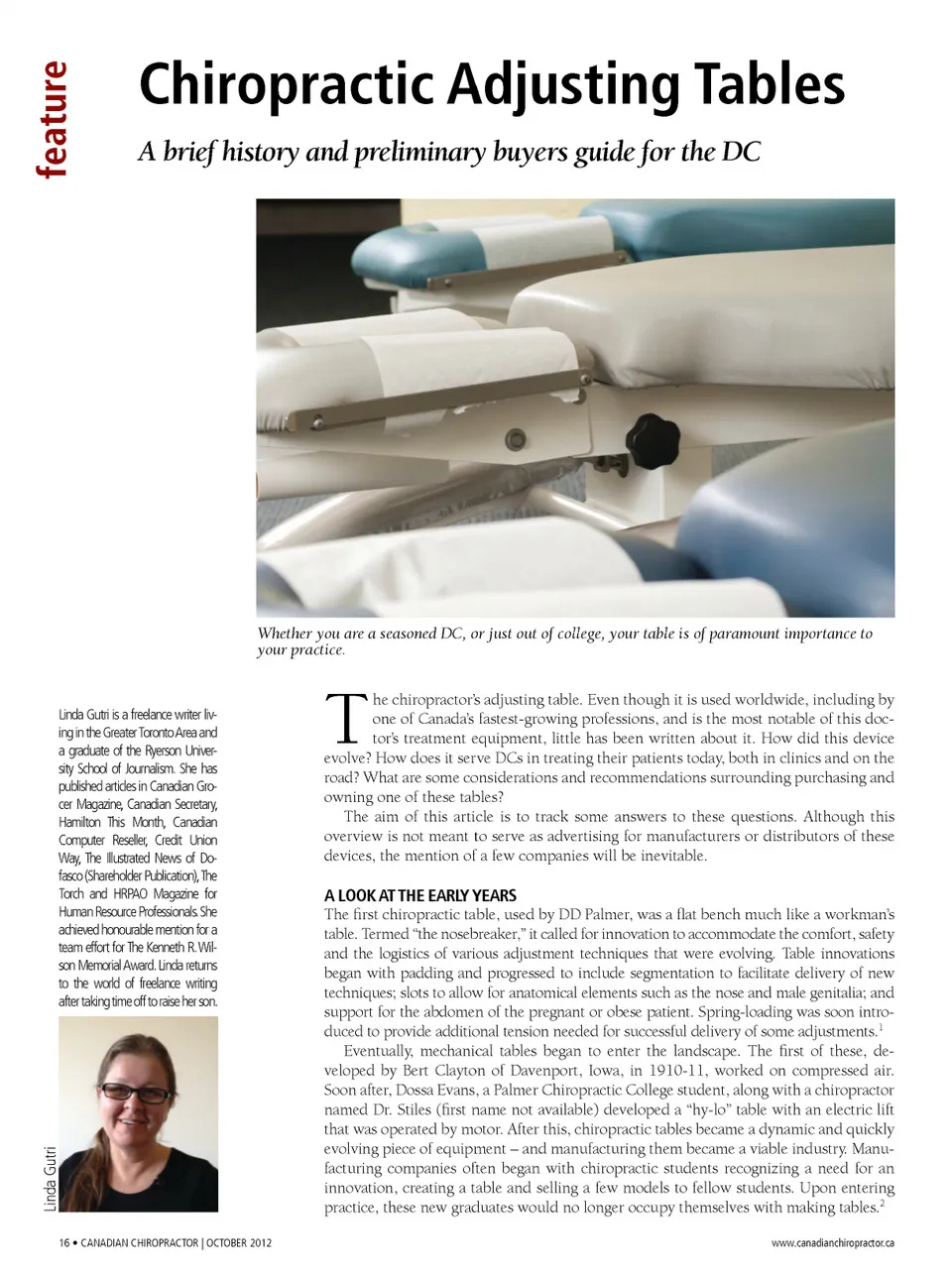
feature Chiropractic Adjusting Tables A brief history and preliminary buyers guide for the DC Whether you are a seasoned DC, or just out of college, your table is of paramount importance to your practice. Linda Gutri is a freelance writer liv-ing in the Greater Toronto Area and a graduate of the Ryerson Univer-sity School of Journalism. She has published articles in Canadian Gro-cer Magazine, Canadian Secretary, Hamilton This Month, Canadian Computer Reseller, Credit Union Way, The Illustrated News of Do-fasco (Shareholder Publication), The Torch and HRPAO Magazine for Human Resource Professionals. She achieved honourable mention for a team effort for The Kenneth R. Wil-son Memorial Award. Linda returns to the world of freelance writing after taking time off to raise her son. T he chiropractor’s adjusting table. Even though it is used worldwide, including by one of Canada’s fastest-growing professions, and is the most notable of this doc-tor’s treatment equipment, little has been written about it. How did this device evolve? How does it serve DCs in treating their patients today, both in clinics and on the road? What are some considerations and recommendations surrounding purchasing and owning one of these tables? The aim of this article is to track some answers to these questions. Although this overview is not meant to serve as advertising for manufacturers or distributors of these devices, the mention of a few companies will be inevitable. A LOOK AT THE EARLY YEARS The first chiropractic table, used by DD Palmer, was a flat bench much like a workman’s table. Termed “the nosebreaker,” it called for innovation to accommodate the comfort, safety and the logistics of various adjustment techniques that were evolving. Table innovations began with padding and progressed to include segmentation to facilitate delivery of new techniques; slots to allow for anatomical elements such as the nose and male genitalia; and support for the abdomen of the pregnant or obese patient. Spring-loading was soon intro-duced to provide additional tension needed for successful delivery of some adjustments. 1 Eventually, mechanical tables began to enter the landscape. The first of these, de-veloped by Bert Clayton of Davenport, Iowa, in 1910-11, worked on compressed air. Soon after, Dossa Evans, a Palmer Chiropractic College student, along with a chiropractor named Dr. Stiles (first name not available) developed a “hy-lo” table with an electric lift that was operated by motor. After this, chiropractic tables became a dynamic and quickly evolving piece of equipment – and manufacturing them became a viable industry. Manu-facturing companies often began with chiropractic students recognizing a need for an innovation, creating a table and selling a few models to fellow students. Upon entering practice, these new graduates would no longer occupy themselves with making tables. 2 www.canadianchiropractor.ca Linda Gutri 16 • CANADIAN CHIROPRACTOR | OCTOBER 2012
Chiropractic + Naturopathic Doctor October 2012: Page 16