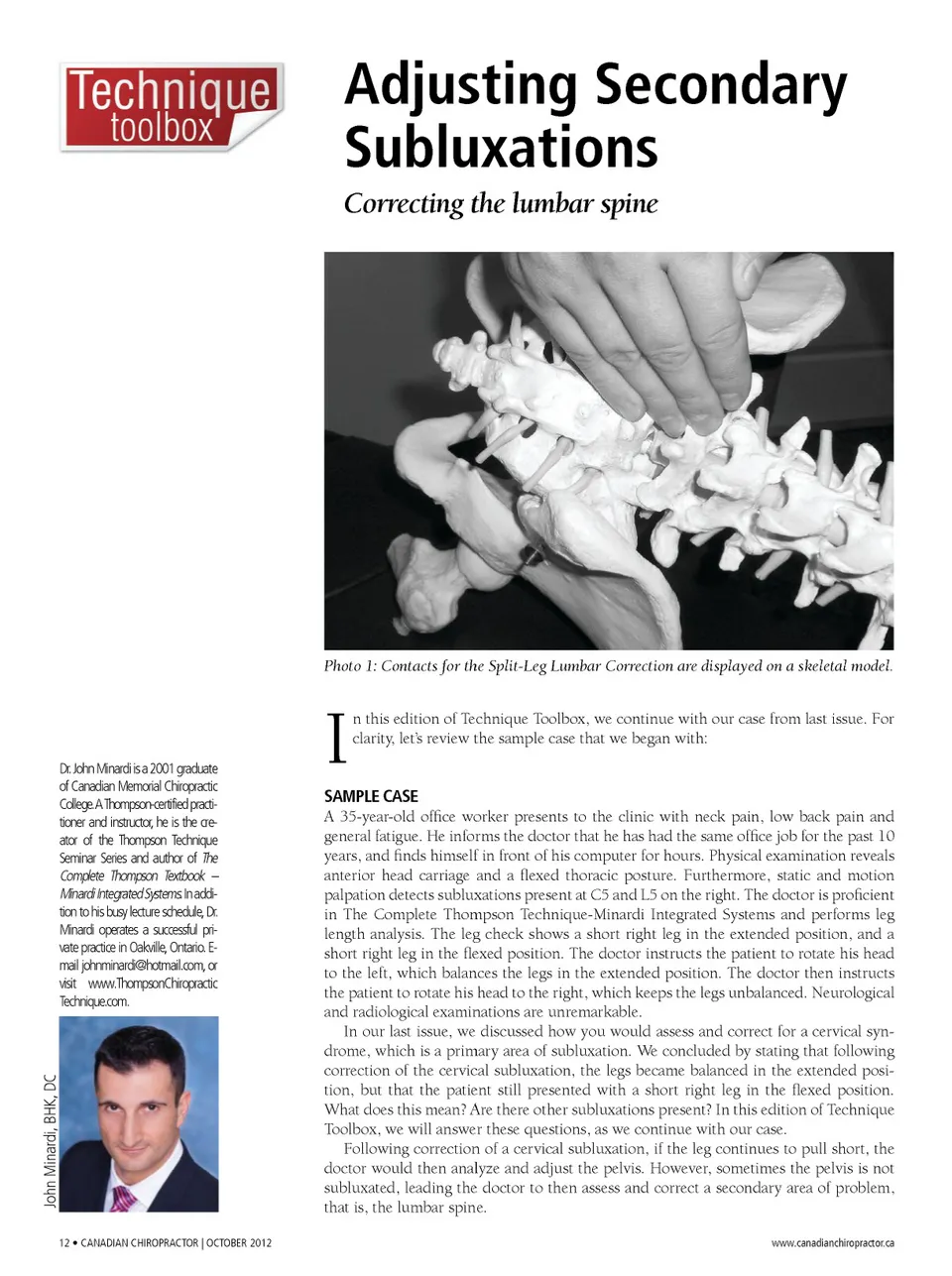
Adjusting Secondary Subluxations Correcting the lumbar spine Photo 1: Contacts for the Split-Leg Lumbar Correction are displayed on a skeletal model. Dr. John Minardi is a 2001 graduate of Canadian Memorial Chiropractic College. A Thompson-certified practi-tioner and instructor, he is the cre-ator of the Thompson Technique Seminar Series and author of The Complete Thompson Textbook – Minardi Integrated Systems. In addi-tion to his busy lecture schedule, Dr. Minardi operates a successful pri-vate practice in Oakville, Ontario. E-mail [email protected], or visit www.ThompsonChiropractic Technique.com. I n this edition of Technique Toolbox, we continue with our case from last issue. For clarity, let’s review the sample case that we began with: SAMPLE CASE A 35-year-old office worker presents to the clinic with neck pain, low back pain and general fatigue. He informs the doctor that he has had the same office job for the past 10 years, and finds himself in front of his computer for hours. Physical examination reveals anterior head carriage and a flexed thoracic posture. Furthermore, static and motion palpation detects subluxations present at C5 and L5 on the right. The doctor is proficient in The Complete Thompson Technique-Minardi Integrated Systems and performs leg length analysis. The leg check shows a short right leg in the extended position, and a short right leg in the flexed position. The doctor instructs the patient to rotate his head to the left, which balances the legs in the extended position. The doctor then instructs the patient to rotate his head to the right, which keeps the legs unbalanced. Neurological and radiological examinations are unremarkable. In our last issue, we discussed how you would assess and correct for a cervical syn-th Anniversar drome, which is a primary area of subluxation. We concluded by stating that following 0 6 correction of the cervical subluxation, the legs became balanced in the extended posi-tion, but that the patient still presented with a short right leg in the flexed position. What does this mean? Are there other subluxations present? In this edition of Technique Toolbox, we will answer these questions, as we continue with our case. Following correction of a cervical subluxation, if the leg continues to pull short, the doctor would then analyze and adjust the pelvis. However, sometimes the pelvis is not subluxated, leading the doctor to then assess and correct a secondary area of problem, that is, the lumbar spine. www.canadianchiropractor.ca John Minardi, BHK, DC 12 • CANADIAN CHIROPRACTOR | OCTOBER 2012
Chiropractic + Naturopathic Doctor October 2012: Page 12