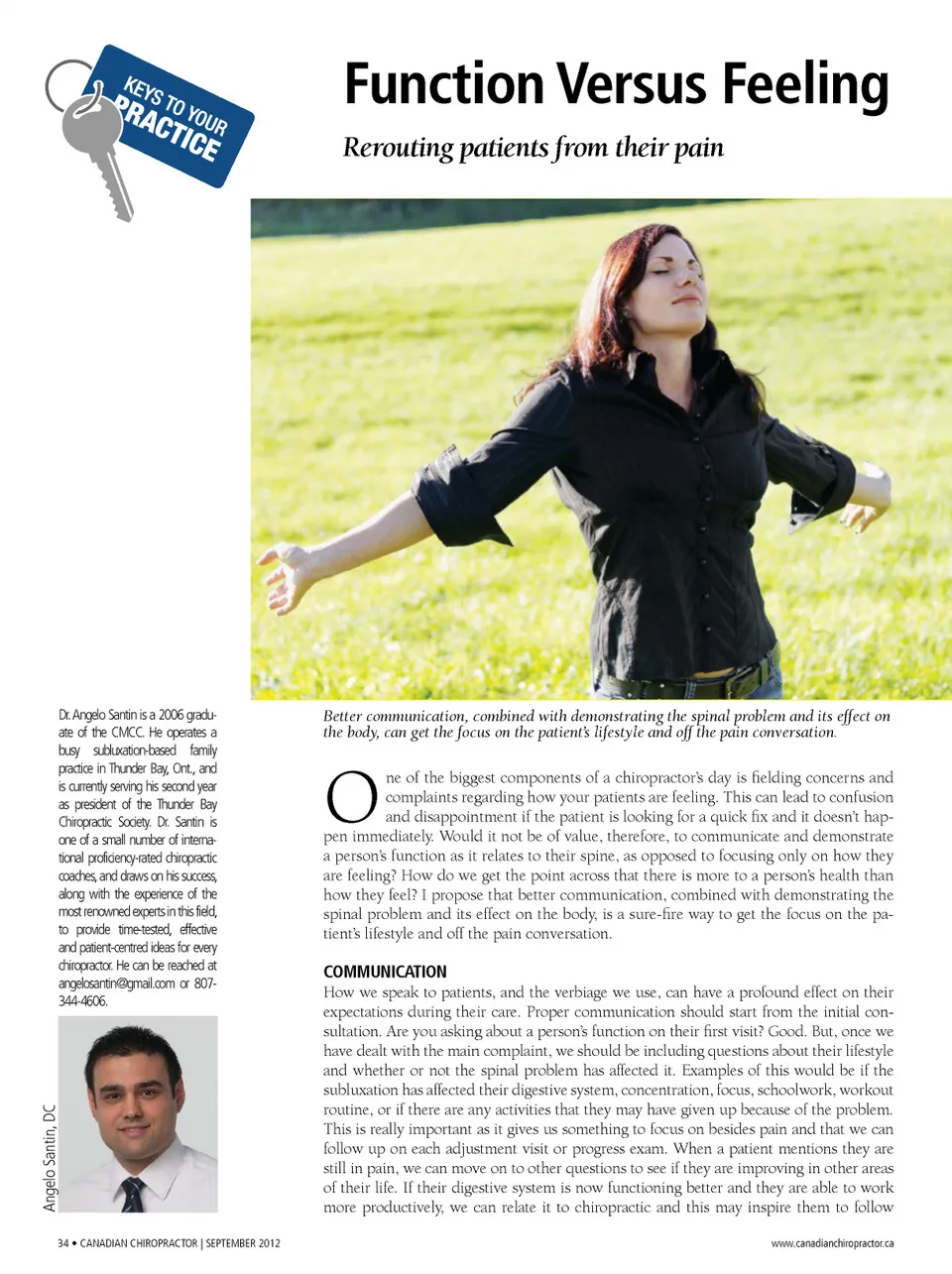
Function Versus Feeling Rerouting patients from their pain Dr. Angelo Santin is a 2006 gradu-ate of the CMCC. He operates a busy subluxation-based family practice in Thunder Bay, Ont., and is currently serving his second year as president of the Thunder Bay Chiropractic Society. Dr. Santin is one of a small number of interna-tional proficiency-rated chiropractic coaches, and draws on his success, along with the experience of the most renowned experts in this field, to provide time-tested, effective and patient-centred ideas for every chiropractor. He can be reached at [email protected] or 807-344-4606. Better communication, combined with demonstrating the spinal problem and its effect on the body, can get the focus on the patient’s lifestyle and off the pain conversation. O ne of the biggest components of a chiropractor’s day is fielding concerns and complaints regarding how your patients are feeling. This can lead to confusion and disappointment if the patient is looking for a quick fix and it doesn’t hap-pen immediately. Would it not be of value, therefore, to communicate and demonstrate a person’s function as it relates to their spine, as opposed to focusing only on how they are feeling? How do we get the point across that there is more to a person’s health than how they feel? I propose that better communication, combined with demonstrating the spinal problem and its effect on the body, is a sure-fire way to get the focus on the pa-tient’s lifestyle and off the pain conversation. COMMUNICATION How we speak to patients, and the verbiage we use, can have a profound effect on their expectations during their care. Proper communication should start from the initial con-sultation. Are you asking about a person’s function on their first visit? Good. But, once we have dealt with the main complaint, we should be including questions about their lifestyle and whether or not the spinal problem has affected it. Examples of this would be if the subluxation has affected their digestive system, concentration, focus, schoolwork, workout routine, or if there are any activities that they may have given up because of the problem. This is really important as it gives us something to focus on besides pain and that we can follow up on each adjustment visit or progress exam. When a patient mentions they are still in pain, we can move on to other questions to see if they are improving in other areas of their life. If their digestive system is now functioning better and they are able to work more productively, we can relate it to chiropractic and this may inspire them to follow www.canadianchiropractor.ca Angelo Santin, DC 34 • Canadian ChiropraCtor | SEptEMBEr 2012
Chiropractic + Naturopathic Doctor September 2012: Page 34