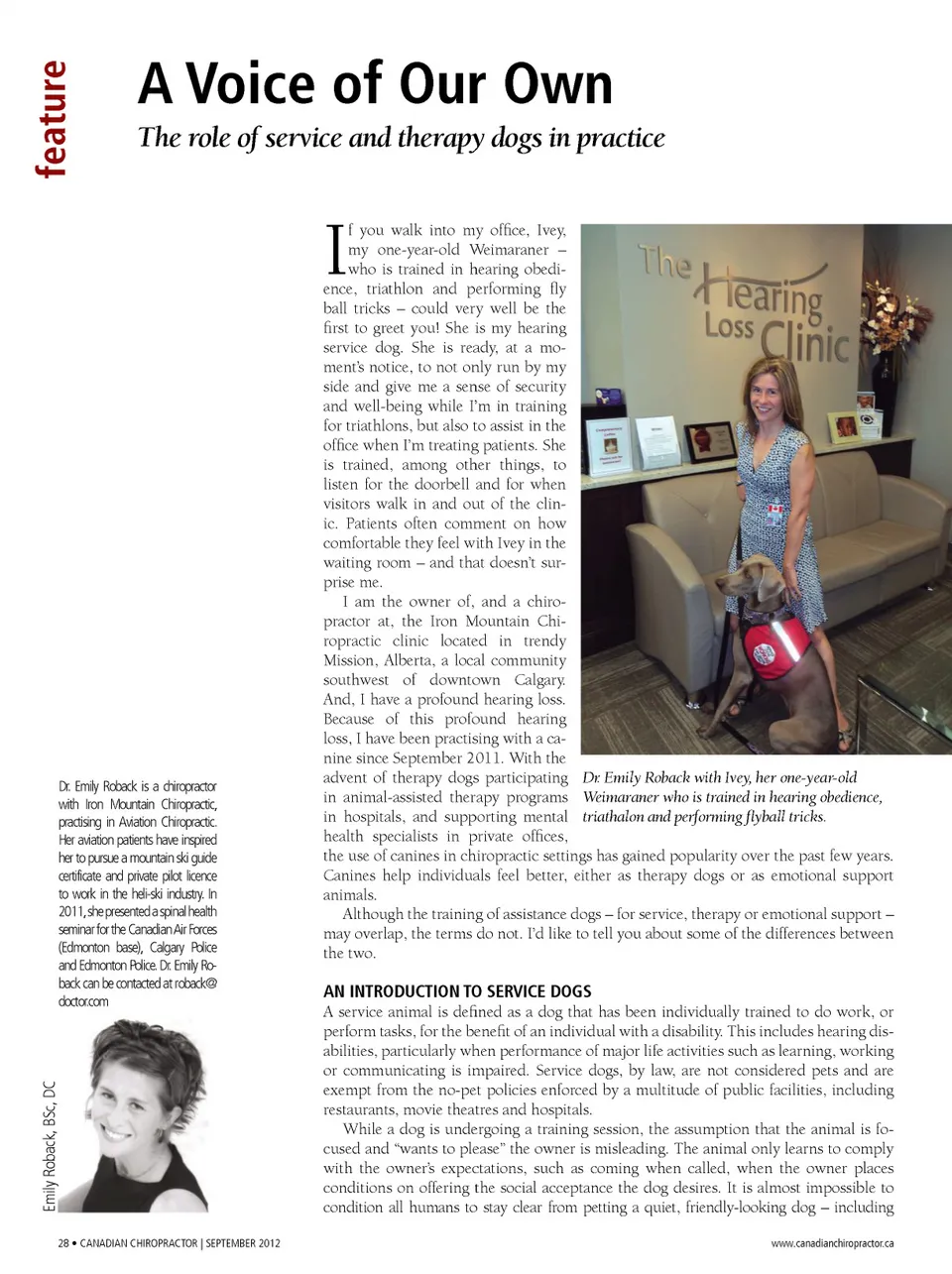
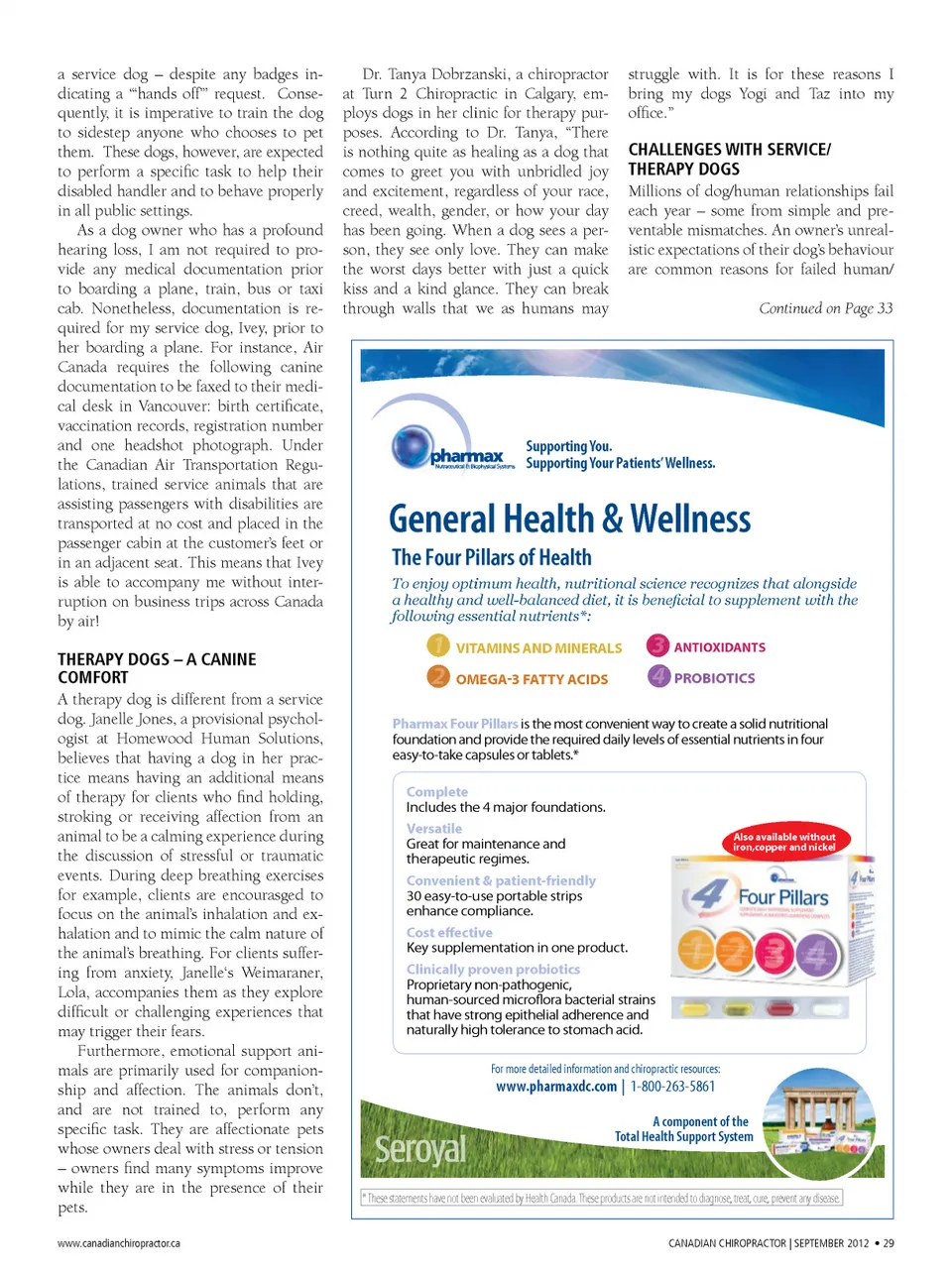
feature A Voice of Our Own The role of service and therapy dogs in practice I Dr. Emily Roback is a chiropractor with Iron Mountain Chiropractic, practising in Aviation Chiropractic. Her aviation patients have inspired her to pursue a mountain ski guide certificate and private pilot licence to work in the heli-ski industry. In 2011, she presented a spinal health seminar for the Canadian Air Forces (Edmonton base), Calgary Police and Edmonton Police. Dr. Emily Ro-back can be contacted at roback@ doctor.com f you walk into my office, Ivey, my one-year-old Weimaraner – who is trained in hearing obedi-ence, triathlon and performing fly ball tricks – could very well be the first to greet you! She is my hearing service dog. She is ready, at a mo-ment’s notice, to not only run by my side and give me a sense of security and well-being while I’m in training for triathlons, but also to assist in the office when I’m treating patients. She is trained, among other things, to listen for the doorbell and for when visitors walk in and out of the clin-ic. Patients often comment on how comfortable they feel with Ivey in the waiting room – and that doesn’t sur-prise me. I am the owner of, and a chiro-practor at, the Iron Mountain Chi-ropractic clinic located in trendy Mission, Alberta, a local community southwest of downtown Calgary. And, I have a profound hearing loss. Because of this profound hearing loss, I have been practising with a ca-nine since September 2011. With the advent of therapy dogs participating Dr. Emily Roback with Ivey, her one-year-old in animal-assisted therapy programs Weimaraner who is trained in hearing obedience, in hospitals, and supporting mental triathalon and performing flyball tricks. health specialists in private offices, the use of canines in chiropractic settings has gained popularity over the past few years. Canines help individuals feel better, either as therapy dogs or as emotional support animals. Although the training of assistance dogs – for service, therapy or emotional support – may overlap, the terms do not. I’d like to tell you about some of the differences between the two. AN INTRODUCTION TO SERVICE DOGS A service animal is defined as a dog that has been individually trained to do work, or perform tasks, for the benefit of an individual with a disability. This includes hearing dis-abilities, particularly when performance of major life activities such as learning, working or communicating is impaired. Service dogs, by law, are not considered pets and are exempt from the no-pet policies enforced by a multitude of public facilities, including restaurants, movie theatres and hospitals. While a dog is undergoing a training session, the assumption that the animal is fo-cused and “wants to please” the owner is misleading. The animal only learns to comply with the owner’s expectations, such as coming when called, when the owner places conditions on offering the social acceptance the dog desires. It is almost impossible to condition all humans to stay clear from petting a quiet, friendly-looking dog – including www.canadianchiropractor.ca Emily Roback, BSc, DC 28 • Canadian ChiropraCtor | SEptEMBEr 2012
Chiropractic + Naturopathic Doctor September 2012: Page 28