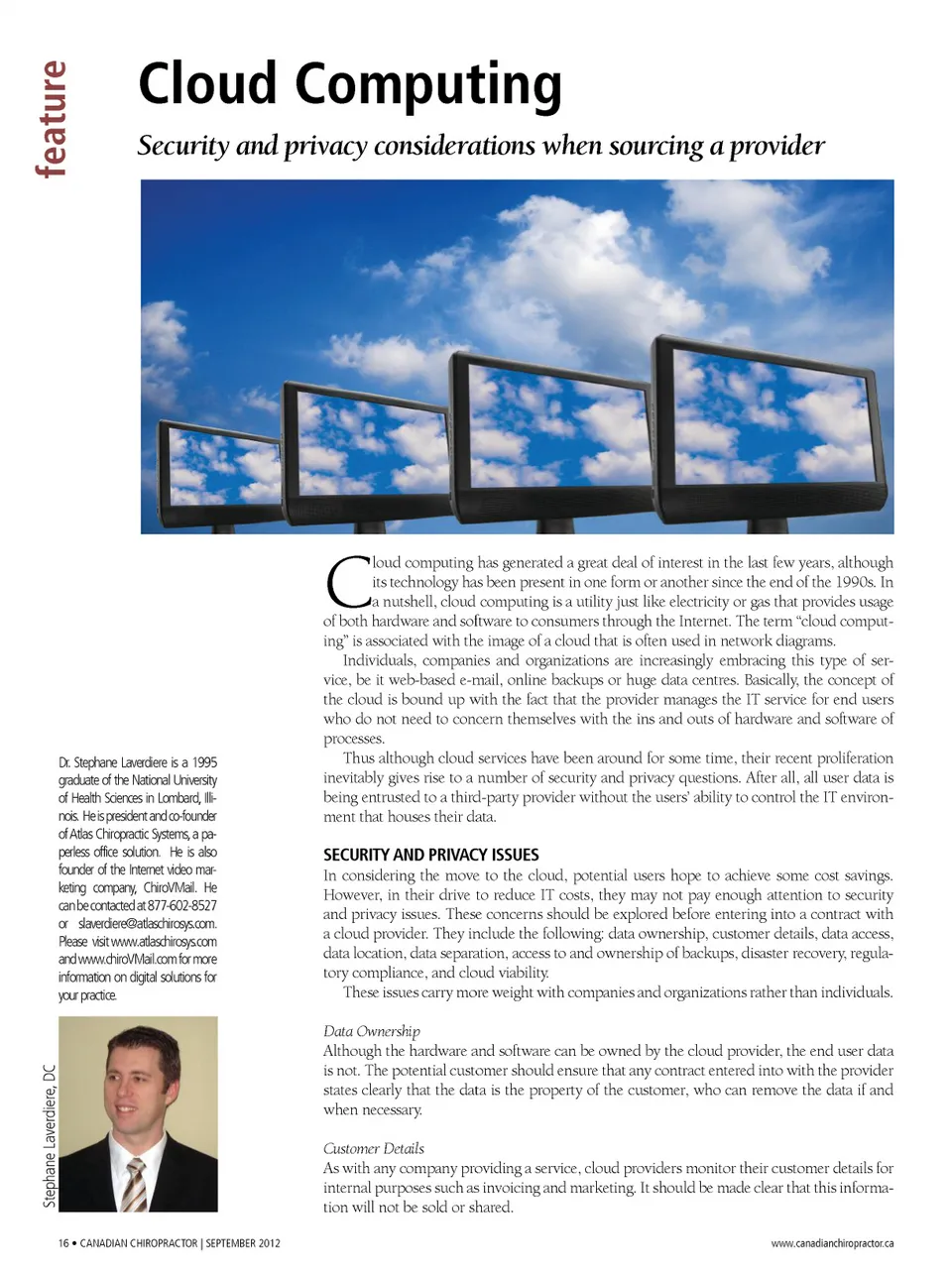
feature Cloud Computing Security and privacy considerations when sourcing a provider Dr. Stephane Laverdiere is a 1995 graduate of the National University of Health Sciences in Lombard, Illi-nois. He is president and co-founder of Atlas Chiropractic Systems, a pa-perless office solution. He is also founder of the Internet video mar-keting company, ChiroVMail. He can be contacted at 877-602-8527 or [email protected]. Please visit www.atlaschirosys.com and www.chiroVMail.com for more information on digital solutions for your practice. loud computing has generated a great deal of interest in the last few years, although its technology has been present in one form or another since the end of the 1990s. In a nutshell, cloud computing is a utility just like electricity or gas that provides usage of both hardware and software to consumers through the Internet. The term “cloud comput-ing” is associated with the image of a cloud that is often used in network diagrams. Individuals, companies and organizations are increasingly embracing this type of ser-vice, be it web-based e-mail, online backups or huge data centres. Basically, the concept of the cloud is bound up with the fact that the provider manages the IT service for end users who do not need to concern themselves with the ins and outs of hardware and software of processes. Thus although cloud services have been around for some time, their recent proliferation inevitably gives rise to a number of security and privacy questions. After all, all user data is being entrusted to a third-party provider without the users’ ability to control the IT environ-ment that houses their data. C SECURITY AND PRIVACY ISSUES In considering the move to the cloud, potential users hope to achieve some cost savings. However, in their drive to reduce IT costs, they may not pay enough attention to security and privacy issues. These concerns should be explored before entering into a contract with a cloud provider. They include the following: data ownership, customer details, data access, data location, data separation, access to and ownership of backups, disaster recovery, regula-tory compliance, and cloud viability. These issues carry more weight with companies and organizations rather than individuals. Stephane Laverdiere, DC Data Ownership h Anniversa Although the hardware and software can be owned by the cloud provider, the end user t data 0 is not. The potential customer should ensure that any contract entered into with the provider states clearly that the data is the property of the customer, who can remove the data if and when necessary. 6 Customer Details As with any company providing a service, cloud providers monitor their customer details for internal purposes such as invoicing and marketing. It should be made clear that this informa-tion will not be sold or shared. www.canadianchiropractor.ca 16 • Canadian ChiropraCtor | SEptEMBEr 2012
Chiropractic + Naturopathic Doctor September 2012: Page 16