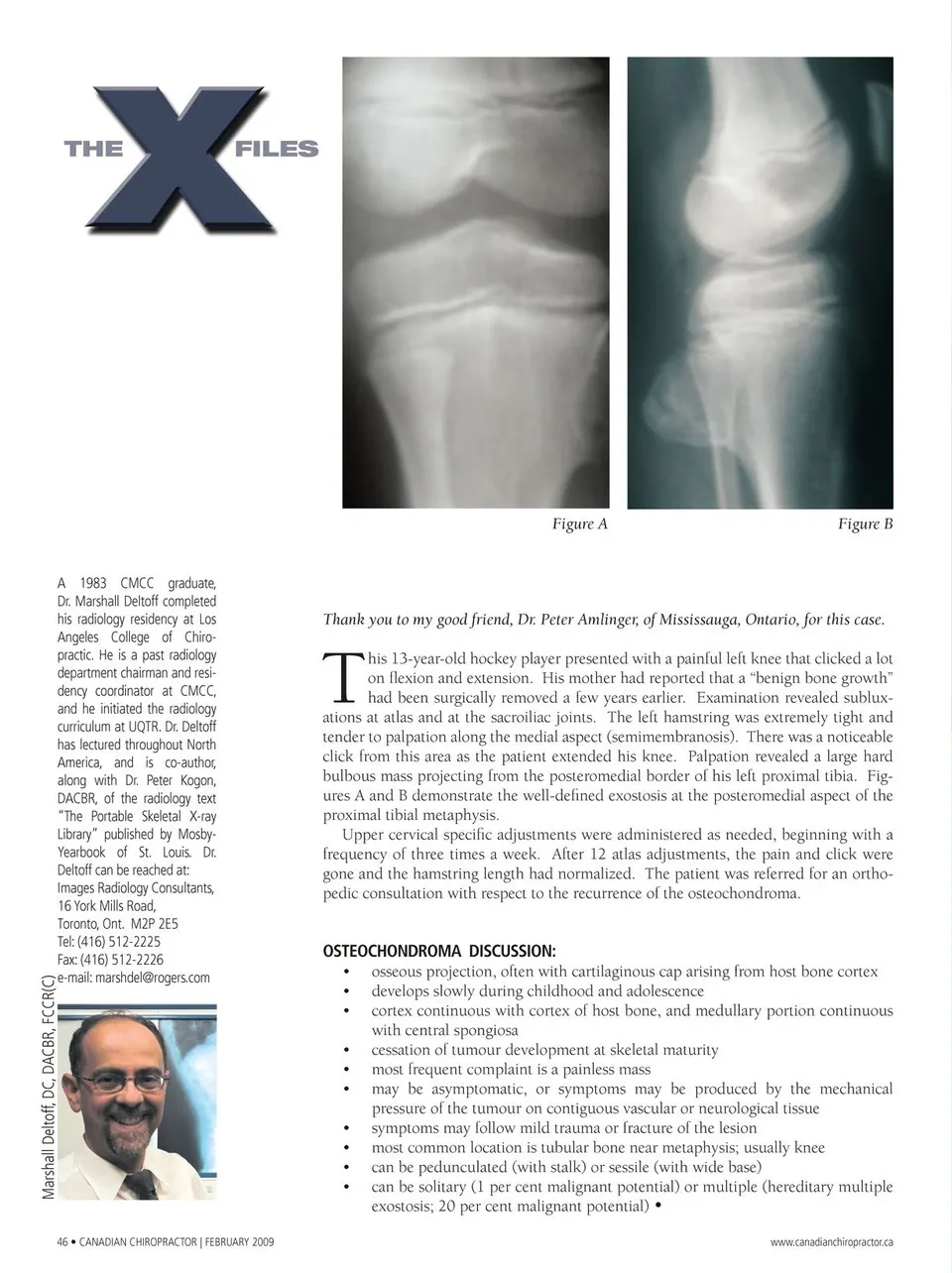
Figure A A 1983 CMCC graduate, Dr. Marshall Deltoff completed his radiology residency at Los Angeles College of Chiro- practic. He is a past radiology department chairman and resi- dency coordinator at CMCC, and he initiated the radiology curriculum at UQTR. Dr. Deltoff has lectured throughout North America, and is co-author, along with Dr. Peter Kogon, DACBR, of the radiology text “The Portable Skeletal X-ray Library” published by Mosby- Yearbook of St. Louis. Dr. Deltoff can be reached at: Images Radiology Consultants, 16 York Mills Road, Toronto, Ont. M2P 2E5 Tel: (416) 512-2225 Fax: (416) 512-2226 e-mail: [email protected] Figure B Thank you to my good friend, Dr. Peter Amlinger, of Mississauga, Ontario, for this case. T his 13-year-old hockey player presented with a painful left knee that clicked a lot on flexion and extension. His mother had reported that a “benign bone growth” had been surgically removed a few years earlier. Examination revealed sublux- ations at atlas and at the sacroiliac joints. The left hamstring was extremely tight and tender to palpation along the medial aspect (semimembranosis). There was a noticeable click from this area as the patient extended his knee. Palpation revealed a large hard bulbous mass projecting from the posteromedial border of his left proximal tibia. Fig- ures A and B demonstrate the well-defined exostosis at the posteromedial aspect of the proximal tibial metaphysis. Upper cervical specific adjustments were administered as needed, beginning with a frequency of three times a week. After 12 atlas adjustments, the pain and click were gone and the hamstring length had normalized. The patient was referred for an ortho- pedic consultation with respect to the recurrence of the osteochondroma. OSTEOCHONDROMA DISCUSSION: • osseous projection, often with cartilaginous cap arising from host bone cortex • develops slowly during childhood and adolescence • cortex continuous with cortex of host bone, and medullary portion continuous with central spongiosa • cessation of tumour development at skeletal maturity • most frequent complaint is a painless mass • may be asymptomatic, or symptoms may be produced by the mechanical pressure of the tumour on contiguous vascular or neurological tissue • symptoms may follow mild trauma or fracture of the lesion • most common location is tubular bone near metaphysis; usually knee • can be pedunculated (with stalk) or sessile (with wide base) • can be solitary (1 per cent malignant potential) or multiple (hereditary multiple exostosis; 20 per cent malignant potential) • 46 • CANADIAN CHIROPRACTOR | FEBRUARY 2009 www.canadianchiropractor.ca Marshall Deltoff, DC, DACBR, FCCR(C)
Chiropractic + Naturopathic Doctor Febuary 2009: Page 46