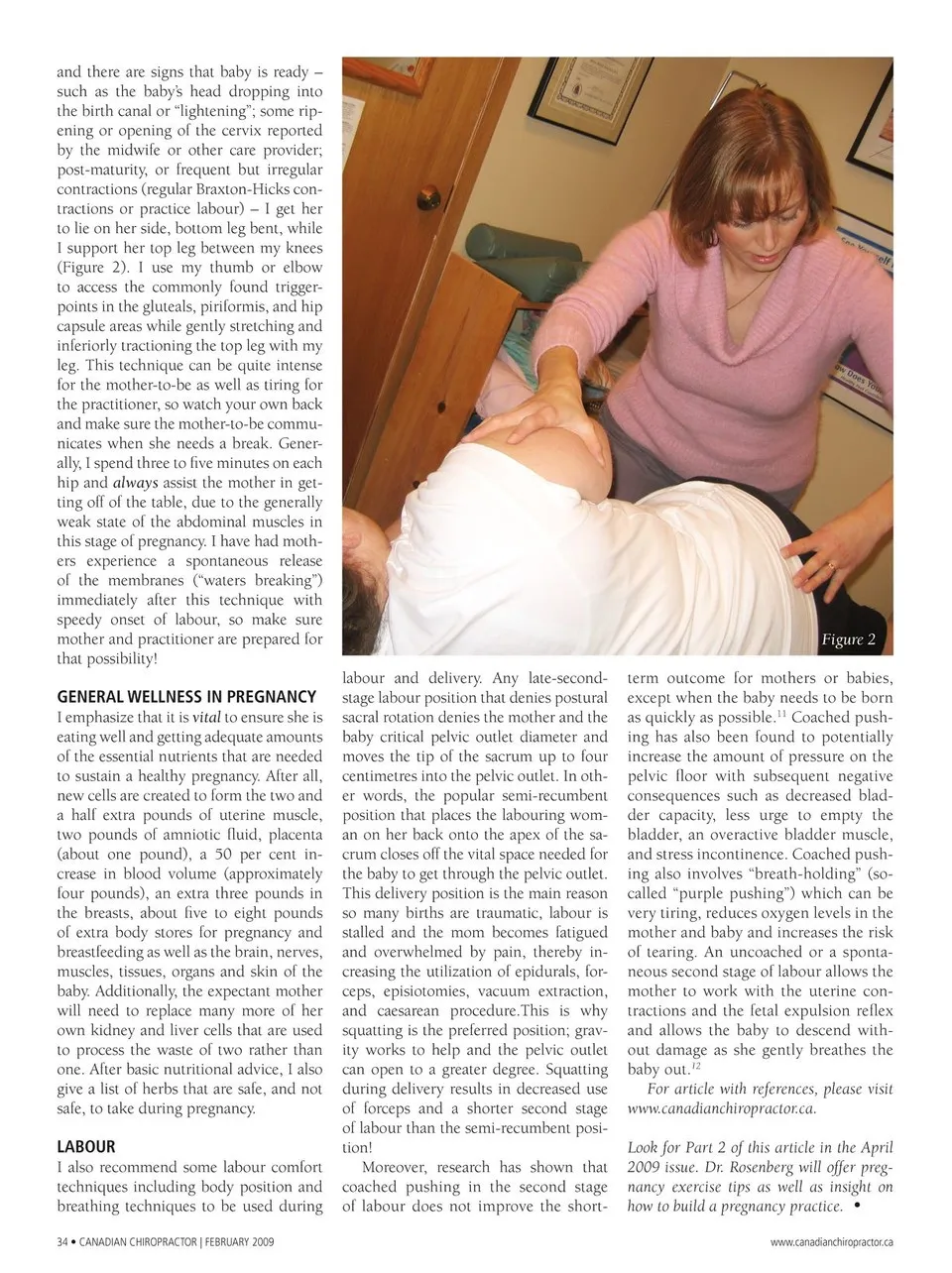
and there are signs that baby is ready – such as the baby’s head dropping into the birth canal or “lightening”; some rip- ening or opening of the cervix reported by the midwife or other care provider; post-maturity, or frequent but irregular contractions (regular Braxton-Hicks con- tractions or practice labour) – I get her to lie on her side, bottom leg bent, while I support her top leg between my knees (Figure 2). I use my thumb or elbow to access the commonly found trigger- points in the gluteals, piriformis, and hip capsule areas while gently stretching and inferiorly tractioning the top leg with my leg. This technique can be quite intense for the mother-to-be as well as tiring for the practitioner, so watch your own back and make sure the mother-to-be commu- nicates when she needs a break. Gener- ally, I spend three to five minutes on each hip and always assist the mother in get- ting off of the table, due to the generally weak state of the abdominal muscles in this stage of pregnancy. I have had moth- ers experience a spontaneous release of the membranes (“waters breaking”) immediately after this technique with speedy onset of labour, so make sure mother and practitioner are prepared for that possibility! GENERAL WELLNESS IN pREGNANCy I emphasize that it is vital to ensure she is eating well and getting adequate amounts of the essential nutrients that are needed to sustain a healthy pregnancy. After all, new cells are created to form the two and a half extra pounds of uterine muscle, two pounds of amniotic fluid, placenta (about one pound), a 50 per cent in- crease in blood volume (approximately four pounds), an extra three pounds in the breasts, about five to eight pounds of extra body stores for pregnancy and breastfeeding as well as the brain, nerves, muscles, tissues, organs and skin of the baby. Additionally, the expectant mother will need to replace many more of her own kidney and liver cells that are used to process the waste of two rather than one. After basic nutritional advice, I also give a list of herbs that are safe, and not safe, to take during pregnancy. LABOUR I also recommend some labour comfort techniques including body position and breathing techniques to be used during 34 • CANADIAN CHIROPRACTOR | FEBRUARY 2009 labour and delivery. Any late-second- stage labour position that denies postural sacral rotation denies the mother and the baby critical pelvic outlet diameter and moves the tip of the sacrum up to four centimetres into the pelvic outlet. In oth- er words, the popular semi-recumbent position that places the labouring wom- an on her back onto the apex of the sa- crum closes off the vital space needed for the baby to get through the pelvic outlet. This delivery position is the main reason so many births are traumatic, labour is stalled and the mom becomes fatigued and overwhelmed by pain, thereby in- creasing the utilization of epidurals, for- ceps, episiotomies, vacuum extraction, and caesarean procedure.This is why squatting is the preferred position; grav- ity works to help and the pelvic outlet can open to a greater degree. Squatting during delivery results in decreased use of forceps and a shorter second stage of labour than the semi-recumbent posi- tion! Moreover, research has shown that coached pushing in the second stage of labour does not improve the short- Figure 2 term outcome for mothers or babies, except when the baby needs to be born as quickly as possible.11 Coached push- ing has also been found to potentially increase the amount of pressure on the pelvic floor with subsequent negative consequences such as decreased blad- der capacity, less urge to empty the bladder, an overactive bladder muscle, and stress incontinence. Coached push- ing also involves “breath-holding” (so- called “purple pushing”) which can be very tiring, reduces oxygen levels in the mother and baby and increases the risk of tearing. An uncoached or a sponta- neous second stage of labour allows the mother to work with the uterine con- tractions and the fetal expulsion reflex and allows the baby to descend with- out damage as she gently breathes the baby out.12 For article with references, please visit www.canadianchiropractor.ca. Look for Part 2 of this article in the April 2009 issue. Dr. Rosenberg will offer preg- nancy exercise tips as well as insight on how to build a pregnancy practice. • www.canadianchiropractor.ca
Chiropractic + Naturopathic Doctor Febuary 2009: Page 34