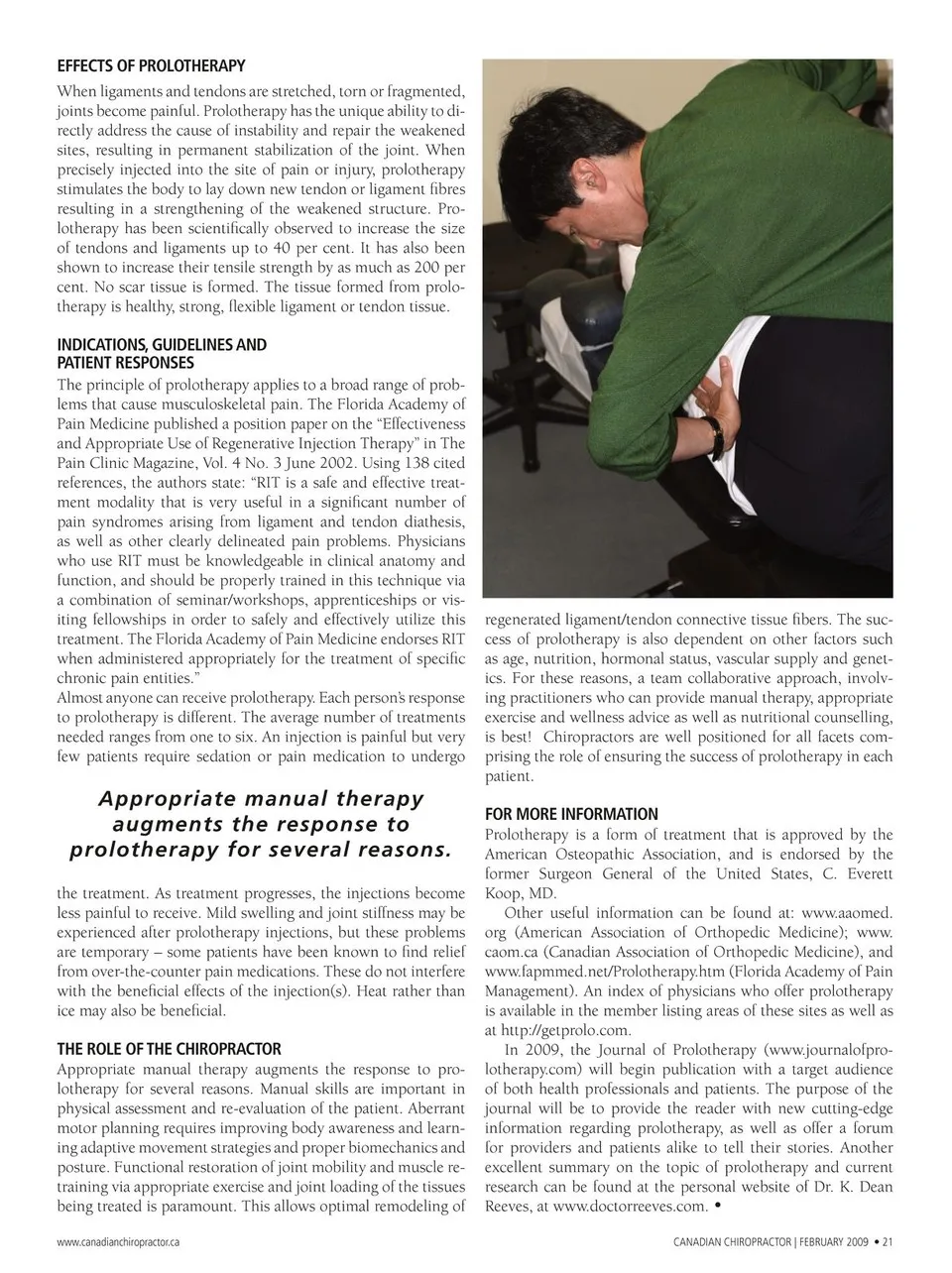
EffECTS Of pROLOTHERApy When ligaments and tendons are stretched, torn or fragmented, joints become painful. Prolotherapy has the unique ability to di- rectly address the cause of instability and repair the weakened sites, resulting in permanent stabilization of the joint. When precisely injected into the site of pain or injury, prolotherapy stimulates the body to lay down new tendon or ligament fibres resulting in a strengthening of the weakened structure. Pro- lotherapy has been scientifically observed to increase the size of tendons and ligaments up to 40 per cent. It has also been shown to increase their tensile strength by as much as 200 per cent. No scar tissue is formed. The tissue formed from prolo- therapy is healthy, strong, flexible ligament or tendon tissue. INDICATIONS, GUIDELINES AND pATIENT RESpONSES The principle of prolotherapy applies to a broad range of prob- lems that cause musculoskeletal pain. The Florida Academy of Pain Medicine published a position paper on the “Effectiveness and Appropriate Use of Regenerative Injection Therapy” in The Pain Clinic Magazine, Vol. 4 No. 3 June 2002. Using 138 cited references, the authors state: “RIT is a safe and effective treat- ment modality that is very useful in a significant number of pain syndromes arising from ligament and tendon diathesis, as well as other clearly delineated pain problems. Physicians who use RIT must be knowledgeable in clinical anatomy and function, and should be properly trained in this technique via a combination of seminar/workshops, apprenticeships or vis- iting fellowships in order to safely and effectively utilize this treatment. The Florida Academy of Pain Medicine endorses RIT when administered appropriately for the treatment of specific chronic pain entities.” Almost anyone can receive prolotherapy. Each person’s response to prolotherapy is different. The average number of treatments needed ranges from one to six. An injection is painful but very few patients require sedation or pain medication to undergo Appropriate manual therapy augments the response to prolotherapy for several reasons. the treatment. As treatment progresses, the injections become less painful to receive. Mild swelling and joint stiffness may be experienced after prolotherapy injections, but these problems are temporary – some patients have been known to find relief from over-the-counter pain medications. These do not interfere with the beneficial effects of the injection(s). Heat rather than ice may also be beneficial. THE ROLE Of THE CHIROpRACTOR Appropriate manual therapy augments the response to pro- lotherapy for several reasons. Manual skills are important in physical assessment and re-evaluation of the patient. Aberrant motor planning requires improving body awareness and learn- ing adaptive movement strategies and proper biomechanics and posture. Functional restoration of joint mobility and muscle re- training via appropriate exercise and joint loading of the tissues being treated is paramount. This allows optimal remodeling of www.canadianchiropractor.ca regenerated ligament/tendon connective tissue fibers. The suc- cess of prolotherapy is also dependent on other factors such as age, nutrition, hormonal status, vascular supply and genet- ics. For these reasons, a team collaborative approach, involv- ing practitioners who can provide manual therapy, appropriate exercise and wellness advice as well as nutritional counselling, is best! Chiropractors are well positioned for all facets com- prising the role of ensuring the success of prolotherapy in each patient. fOR MORE INfORMATION Prolotherapy is a form of treatment that is approved by the American Osteopathic Association, and is endorsed by the former Surgeon General of the United States, C. Everett Koop, MD. Other useful information can be found at: www.aaomed. org (American Association of Orthopedic Medicine); www. caom.ca (Canadian Association of Orthopedic Medicine), and www.fapmmed.net/Prolotherapy.htm (Florida Academy of Pain Management). An index of physicians who offer prolotherapy is available in the member listing areas of these sites as well as at http://getprolo.com. In 2009, the Journal of Prolotherapy (www.journalofpro- lotherapy.com) will begin publication with a target audience of both health professionals and patients. The purpose of the journal will be to provide the reader with new cutting-edge information regarding prolotherapy, as well as offer a forum for providers and patients alike to tell their stories. Another excellent summary on the topic of prolotherapy and current research can be found at the personal website of Dr. K. Dean Reeves, at www.doctorreeves.com. • CANADIAN CHIROPRACTOR | FEBRUARY 2009 • 21
Chiropractic + Naturopathic Doctor Febuary 2009: Page 21