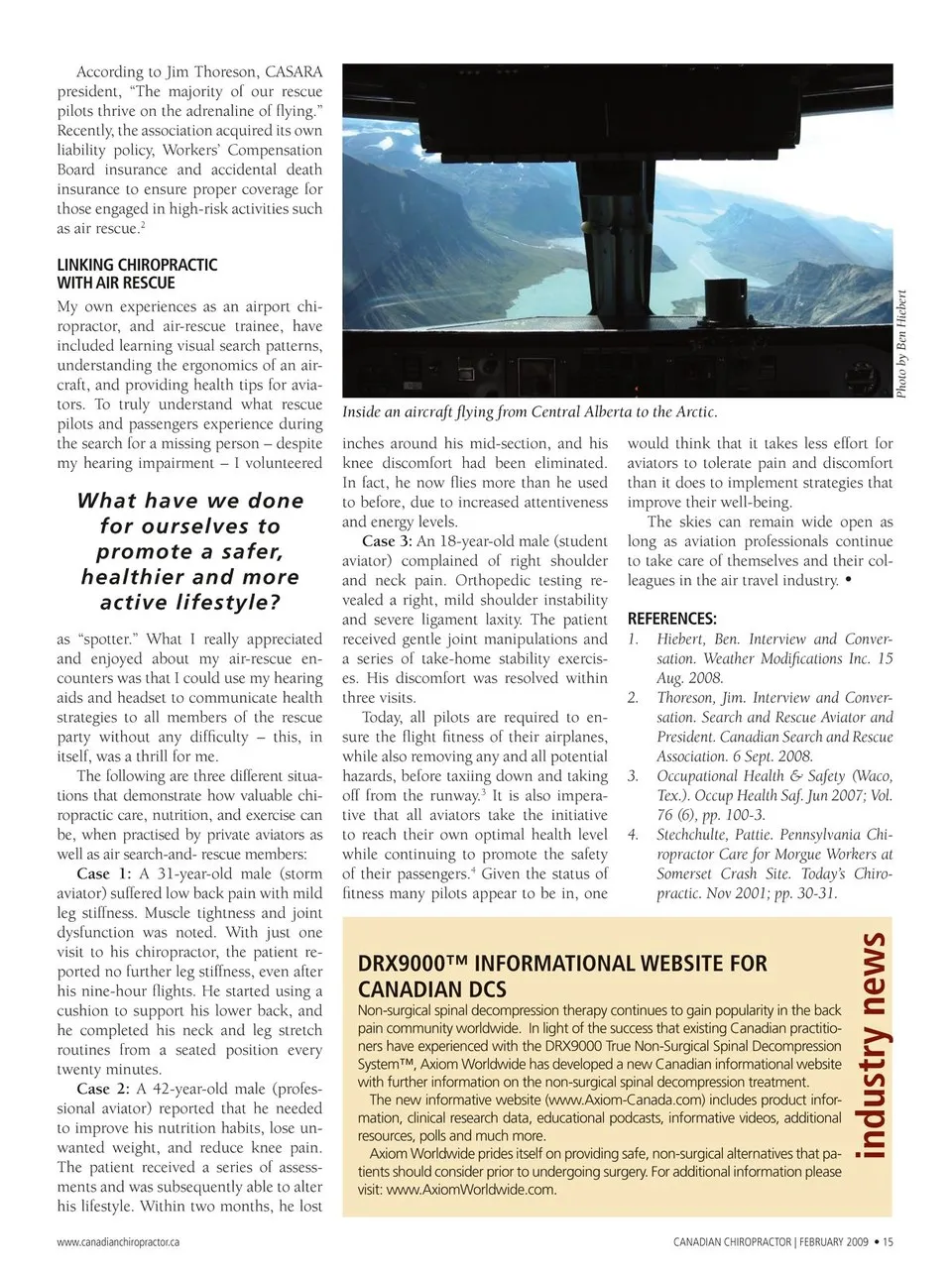
According to Jim Thoreson, CASARA president, “The majority of our rescue pilots thrive on the adrenaline of flying.” Recently, the association acquired its own liability policy, Workers’ Compensation Board insurance and accidental death insurance to ensure proper coverage for those engaged in high-risk activities such as air rescue.2 LINKING CHIROpRACTIC WITH AIR RESCUE My own experiences as an airport chi- ropractor, and air-rescue trainee, have included learning visual search patterns, understanding the ergonomics of an air- craft, and providing health tips for avia- tors. To truly understand what rescue pilots and passengers experience during the search for a missing person – despite my hearing impairment – I volunteered What have we done for ourselves to promote a safer, healthier and more active lifestyle? as “spotter.” What I really appreciated and enjoyed about my air-rescue en- counters was that I could use my hearing aids and headset to communicate health strategies to all members of the rescue party without any difficulty – this, in itself, was a thrill for me. The following are three different situa- tions that demonstrate how valuable chi- ropractic care, nutrition, and exercise can be, when practised by private aviators as well as air search-and- rescue members: Case 1: A 31-year-old male (storm aviator) suffered low back pain with mild leg stiffness. Muscle tightness and joint dysfunction was noted. With just one visit to his chiropractor, the patient re- ported no further leg stiffness, even after his nine-hour flights. He started using a cushion to support his lower back, and he completed his neck and leg stretch routines from a seated position every twenty minutes. Case 2: A 42-year-old male (profes- sional aviator) reported that he needed to improve his nutrition habits, lose un- wanted weight, and reduce knee pain. The patient received a series of assess- ments and was subsequently able to alter his lifestyle. Within two months, he lost www.canadianchiropractor.ca Inside an aircraft flying from Central Alberta to the Arctic. inches around his mid-section, and his knee discomfort had been eliminated. In fact, he now flies more than he used to before, due to increased attentiveness and energy levels. Case 3: An 18-year-old male (student aviator) complained of right shoulder and neck pain. Orthopedic testing re- vealed a right, mild shoulder instability and severe ligament laxity. The patient received gentle joint manipulations and a series of take-home stability exercis- es. His discomfort was resolved within three visits. Today, all pilots are required to en- sure the flight fitness of their airplanes, while also removing any and all potential hazards, before taxiing down and taking off from the runway.3 It is also impera- tive that all aviators take the initiative to reach their own optimal health level while continuing to promote the safety of their passengers.4 Given the status of fitness many pilots appear to be in, one would think that it takes less effort for aviators to tolerate pain and discomfort than it does to implement strategies that improve their well-being. The skies can remain wide open as long as aviation professionals continue to take care of themselves and their col- leagues in the air travel industry. • REfERENCES: 1. Hiebert, Ben. Interview and Conver- sation. Weather Modifications Inc. 15 Aug. 2008. 2. Thoreson, Jim. Interview and Conver- sation. Search and Rescue Aviator and President. Canadian Search and Rescue Association. 6 Sept. 2008. 3. Occupational Health & Safety (Waco, Tex.). Occup Health Saf. Jun 2007; Vol. 76 (6), pp. 100-3. 4. Stechchulte, Pattie. Pennsylvania Chi- ropractor Care for Morgue Workers at Somerset Crash Site. Today’s Chiro- practic. Nov 2001; pp. 30-31. DRX9000™ INfORMATIONAL WEBSITE fOR CANADIAN DCS Non-surgical spinal decompression therapy continues to gain popularity in the back pain community worldwide. In light of the success that existing Canadian practitio- ners have experienced with the DRX9000 True Non-Surgical Spinal Decompression System™, Axiom Worldwide has developed a new Canadian informational website with further information on the non-surgical spinal decompression treatment. The new informative website (www.Axiom-Canada.com) includes product infor- mation, clinical research data, educational podcasts, informative videos, additional resources, polls and much more. Axiom Worldwide prides itself on providing safe, non-surgical alternatives that pa- tients should consider prior to undergoing surgery. For additional information please visit: www.AxiomWorldwide.com. CANADIAN CHIROPRACTOR | FEBRUARY 2009 • 15 industry news Photo by Ben Hiebert
Chiropractic + Naturopathic Doctor Febuary 2009: Page 15