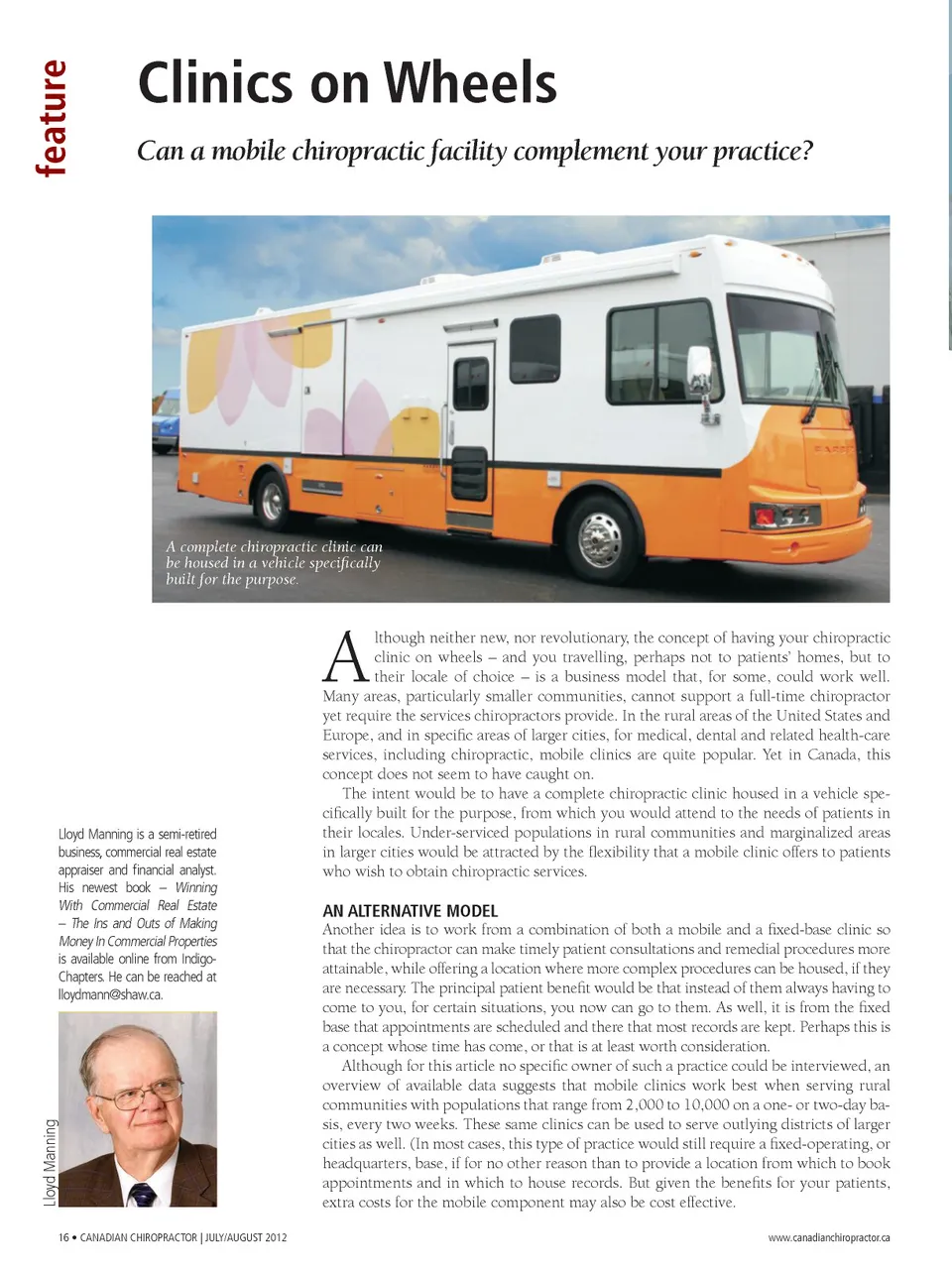
feature Clinics on Wheels Can a mobile chiropractic facility complement your practice? A complete chiropractic clinic can be housed in a vehicle specifically built for the purpose. A Lloyd Manning is a semi-retired business, commercial real estate appraiser and financial analyst. His newest book – Winning With Commercial Real Estate – The Ins and Outs of Making Money In Commercial Properties is available online from Indigo-Chapters. He can be reached at [email protected]. lthough neither new, nor revolutionary, the concept of having your chiropractic clinic on wheels – and you travelling, perhaps not to patients’ homes, but to their locale of choice – is a business model that, for some, could work well. Many areas, particularly smaller communities, cannot support a full-time chiropractor yet require the services chiropractors provide. In the rural areas of the United States and Europe, and in specific areas of larger cities, for medical, dental and related health-care services, including chiropractic, mobile clinics are quite popular. Yet in Canada, this concept does not seem to have caught on. The intent would be to have a complete chiropractic clinic housed in a vehicle spe-cifically built for the purpose, from which you would attend to the needs of patients in their locales. Under-serviced populations in rural communities and marginalized areas in larger cities would be attracted by the flexibility that a mobile clinic offers to patients who wish to obtain chiropractic services. AN ALTERNATIVE MODEL Another idea is to work from a combination of both a mobile and a fixed-base clinic so that the chiropractor can make timely patient consultations and remedial procedures more attainable, while offering a location where more complex procedures can be housed, if they are necessary. The principal patient benefit would be that instead of them always having to come to you, for certain situations, you now can go to them. As well, it is from the fixed base that appointments are scheduled and there that most records are kept. Perhaps this is a concept whose time has come, or that is at least worth consideration. Although for this article no specific owner of such a practice could be interviewed, an overview of available data suggests that mobile clinics work best when serving rural communities with populations that range from 2,000 to 10,000 on a one-or two-day ba-sis, every two weeks. These same clinics can be used to serve outlying districts of larger cities as well. (In most cases, this type of practice would still require a fixed-operating, or headquarters, base, if for no other reason than to provide a location from which to book appointments and in which to house records. But given the benefits for your patients, extra costs for the mobile component may also be cost effective. www.canadianchiropractor.ca Lloyd Manning s CANADIAN CHIROPRACTOR | JULY/AUGUST 2012
Chiropractic + Naturopathic Doctor July/August 2012: Page 16