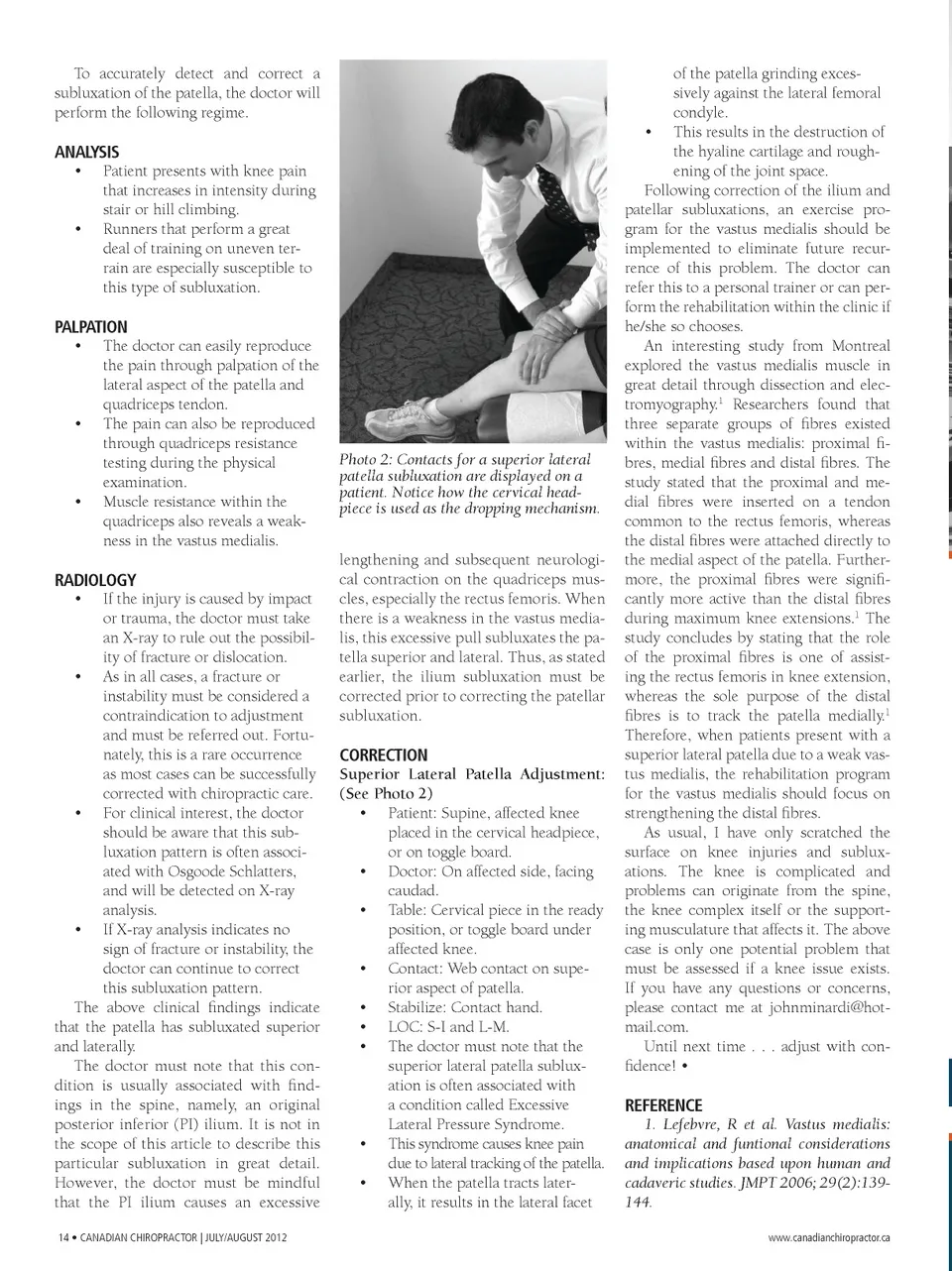
To accurately detect and correct a subluxation of the patella, the doctor will perform the following regime. ANALYSIS UÊ Patient presents with knee pain that increases in intensity during stair or hill climbing. UÊ Runners that perform a great deal of training on uneven ter-rain are especially susceptible to this type of subluxation. PALPATION UÊ The doctor can easily reproduce the pain through palpation of the lateral aspect of the patella and quadriceps tendon. UÊ The pain can also be reproduced through quadriceps resistance testing during the physical examination. UÊ Muscle resistance within the quadriceps also reveals a weak-ness in the vastus medialis. RADIOLOGY UÊ If the injury is caused by impact or trauma, the doctor must take an X-ray to rule out the possibil-ity of fracture or dislocation. UÊ As in all cases, a fracture or instability must be considered a contraindication to adjustment and must be referred out. Fortu-nately, this is a rare occurrence as most cases can be successfully corrected with chiropractic care. UÊ For clinical interest, the doctor should be aware that this sub-luxation pattern is often associ-ated with Osgoode Schlatters, and will be detected on X-ray analysis. UÊ If X-ray analysis indicates no sign of fracture or instability, the doctor can continue to correct this subluxation pattern. The above clinical findings indicate that the patella has subluxated superior and laterally. The doctor must note that this con-dition is usually associated with find-ings in the spine, namely, an original posterior inferior (PI) ilium. It is not in the scope of this article to describe this particular subluxation in great detail. However, the doctor must be mindful that the PI ilium causes an excessive s CANADIAN CHIROPRACTOR | JULY/AUGUST 2012 Photo 2: Contacts for a superior lateral patella subluxation are displayed on a patient. Notice how the cervical head-piece is used as the dropping mechanism. lengthening and subsequent neurologi-cal contraction on the quadriceps mus-cles, especially the rectus femoris. When there is a weakness in the vastus media-lis, this excessive pull subluxates the pa-tella superior and lateral. Thus, as stated earlier, the ilium subluxation must be corrected prior to correcting the patellar subluxation. CORRECTION Superior Lateral Patella Adjustment: (See Photo 2) UÊ Patient: Supine, affected knee placed in the cervical headpiece, or on toggle board. UÊ Doctor: On affected side, facing caudad. UÊ Table: Cervical piece in the ready position, or toggle board under affected knee. UÊ Contact: Web contact on supe-rior aspect of patella. UÊ Stabilize: Contact hand. UÊ LOC: S-I and L-M. UÊ The doctor must note that the superior lateral patella sublux-ation is often associated with a condition called Excessive Lateral Pressure Syndrome. UÊ This syndrome causes knee pain due to lateral tracking of the patella. UÊ When the patella tracts later-ally, it results in the lateral facet of the patella grinding exces-sively against the lateral femoral condyle. UÊ This results in the destruction of the hyaline cartilage and rough-ening of the joint space. Following correction of the ilium and patellar subluxations, an exercise pro-gram for the vastus medialis should be implemented to eliminate future recur-rence of this problem. The doctor can refer this to a personal trainer or can per-form the rehabilitation within the clinic if he/she so chooses. An interesting study from Montreal explored the vastus medialis muscle in great detail through dissection and elec-tromyography. 1 Researchers found that three separate groups of fibres existed within the vastus medialis: proximal fi-bres, medial fibres and distal fibres. The study stated that the proximal and me-dial fibres were inserted on a tendon common to the rectus femoris, whereas the distal fibres were attached directly to the medial aspect of the patella. Further-more, the proximal fibres were signifi-cantly more active than the distal fibres during maximum knee extensions. 1 The study concludes by stating that the role of the proximal fibres is one of assist-ing the rectus femoris in knee extension, whereas the sole purpose of the distal fibres is to track the patella medially. 1 Therefore, when patients present with a superior lateral patella due to a weak vas-tus medialis, the rehabilitation program for the vastus medialis should focus on strengthening the distal fibres. As usual, I have only scratched the surface on knee injuries and sublux-ations. The knee is complicated and problems can originate from the spine, the knee complex itself or the support-ing musculature that affects it. The above case is only one potential problem that must be assessed if a knee issue exists. If you have any questions or concerns, please contact me at [email protected]. Until next time . . . adjust with con-w`iVitÊU REFERENCE 1. Lefebvre, R et al. Vastus medialis: anatomical and funtional considerations and implications based upon human and cadaveric studies. JMPT 2006; 29(2):139-144. www.canadianchiropractor.ca
Chiropractic + Naturopathic Doctor July/August 2012: Page 14