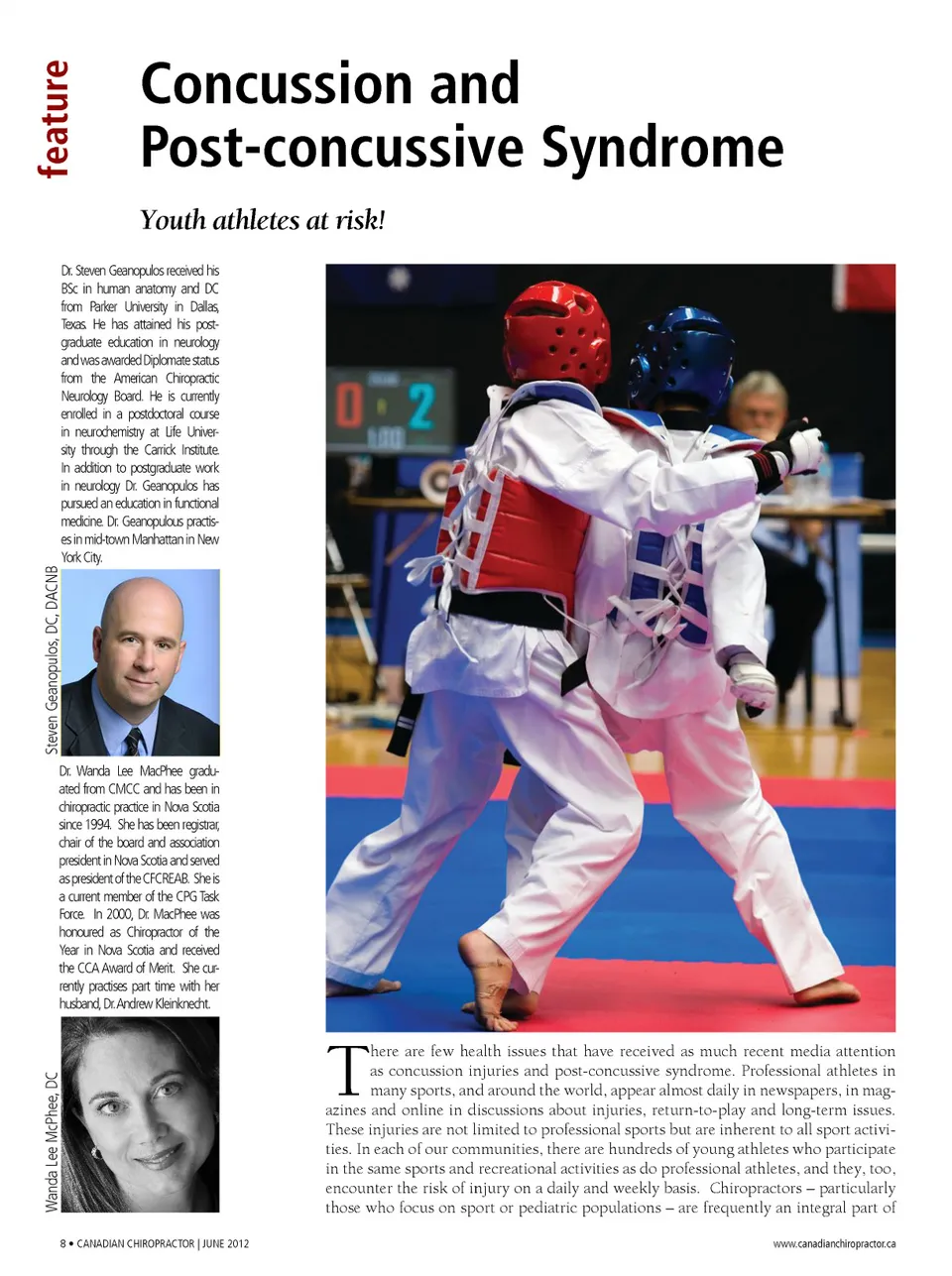
the health-care team in monitoring, assessing and caring for young players recovering from a concussion injury. At St. Margaret’s Bay Chiropractic Centre in Nova Scotia, we have created a special niche in screening and subsequently co-treating young athletes at risk of or following concussion injuries. With our own children involved in hockey and rin-gette as well as a practice focused on children and families, we have been consistently involved in helping children already in our practice with concussion recovery. This has transformed into an opportunity to serve the greater community on a larger scale. ’KeeP your Head in tHe Game’ SCreeninG ProGram We developed “Keep Your Head in the Game” concussion screening protocols based on the most current science of the day combined with the practicality of performing screenings in arenas, fields and community centres. To date we have screened hundreds of young athletes in our community, pro-viding them with baseline records that have proven valuable when later injuries occur and they present to the local pedi-atric hospital. Chiropractic offices in the United States, Can-ada and Australia have used our protocols to develop these programs with teams in their areas as well. The consistent baseline and post-injury testing used allows for a common language among all professionals on the health-care team and provides co-ordination of diagnosis, treatment and fol-lowup. Working together with emergency room physicians, family doctors, pediatric neurologists and chiropractic neu-rology diplomates has been a learning experience for us, and for them as well, that results in optimal care of these children and adolescents. Each year more than 300,000 sport-related mild-to-mod -erate traumatic brain injuries occur in the United States. 1 Overall, hockey and rugby have the highest incidence of con-cussion, and soccer has one of the lowest incidence rates. 2 Male boxers and female taekwondo participants have the highest concussion frequency in recreational activities. 2 Un-fortunately, these statistics are most likely lower than the true incidence as many athletes still do not recognize or report concussion injuries. 2,3 Equally unfortunate is that parents do not fully understand the significance of a diagnosis of concus-sion. Several studies have shown that when given a diagnosis of concussion, families are less likely to consider it a brain injury than a temporary and/or less serious condition. 3 Par-ents, and even some health-care providers, may use the term to imply a transient condition with no significant health con-sequences. 3 The reality is that concussion is a mild traumatic brain injury and although many cases resolve fully, 2 there are potential consequences that parents and clinicians must take seriously. 4,5 WHat iS a ConCuSSion? Definitions for concussion are not always consistent in the lit-erature but recent attention and discussion is helping to cre-ate better agreement on what constitutes a concussion injury. The Canadian Paediatric Society describes concussion as “a complex pathophysiological process that affects the brain, induced by traumatic biomechanical forces resulting in the rapid onset of short-lived impairment of neurologic function www.canadianchiropractor.ca that resolves spontaneously. Concussion may be sustained by a direct blow to the head, face, or neck or by a blow to somewhere else on the body that transmits an impulsive force to the head. Most concussions do not cause a LOC [loss of consciousness] or cause only a transient (i.e., lasting seconds) LOC.” 6 Concussion diagnosis and treatment is never easy. De-spite great advancements in standardizing and documenting testing and symptoms, young athletes are at particular risk for misdiagnosis and potentially serious long-term effects. Standard testing such as Sport Concussion Assessment Tool (SCAT) and SCAT 2 are excellent examination tools for adults as we can safely assume that a healthy, normal adult can per-form the tests without significant challenge, but that is not the case for child and adolescent patients! Concussion is generally diagnosed using a thorough his-tory and symptom profile and measured in severity with vari-ous neurological and neuro-behavioural activities. Most sport participants who sustain a concussive injury do not lose con-sciousness – and loss of consciousness in isolation is a rela-tively weak predictor of neuro-behavioural outcomes. 2 For those of you who would like further reading, one of the most comprehensive sources is the consensus document generated from the Third International Conference on Concussion in Sport. 7 Children and adolescents are still developing the neuro-logical integrity that tests of memory, balance and concentra-tion seek to measure. Even within the same age group, there can be significant variation in test scores among healthy pa-tients, which creates a diagnostic challenge for the clinician testing children and adolescents post-injury. How much has been lost or changed in the scores if we don’t know what the scores were prior to injury? Relying on post-injury test scores only, there is no doubt that more than half of the hundreds of athletes we have tested would be unable to return to play, as they were originally unable to perform the testing activities at an adequate level, even without a concussion injury! In developing a screening protocol for local athletes, and in screening hundreds of athletes ages eight to 17, the need for pre-injury baseline testing has become apparent. Knowing the pre-incident condition is crucial for making appropriate diagnosis of concussion, ranking the severity of the injury, determining treatment protocols, measuring recovery rates and determining back-to-play status. 8 There is substantial variation in responses to concussion injury. 2 Most experts note that the initial grading of concussion is less relevant to recovery post-concussion than systematic tracking of each athlete’s recovery over time. 2 As a parent, knowing that we can be as specific and measured as possible with a challenging entity like concussion injury or post-concussive syndrome al-lows for: better decision-making and understanding of when a child athlete should be removed from the game; better rec-ognition of when it is unsafe to return to play; and the reas-surance that returning to the game is appropriate. reaSonS PeoPle reSPond So differently to Care after a ConCuSSion It seems that, while one athlete may have a concussion and recover without prolonged symptoms and return to normal CANADIAN CHIROPRACTOR | JUNE 2012 • 9
Chiropractic + Naturopathic Doctor June 2012: Page 9