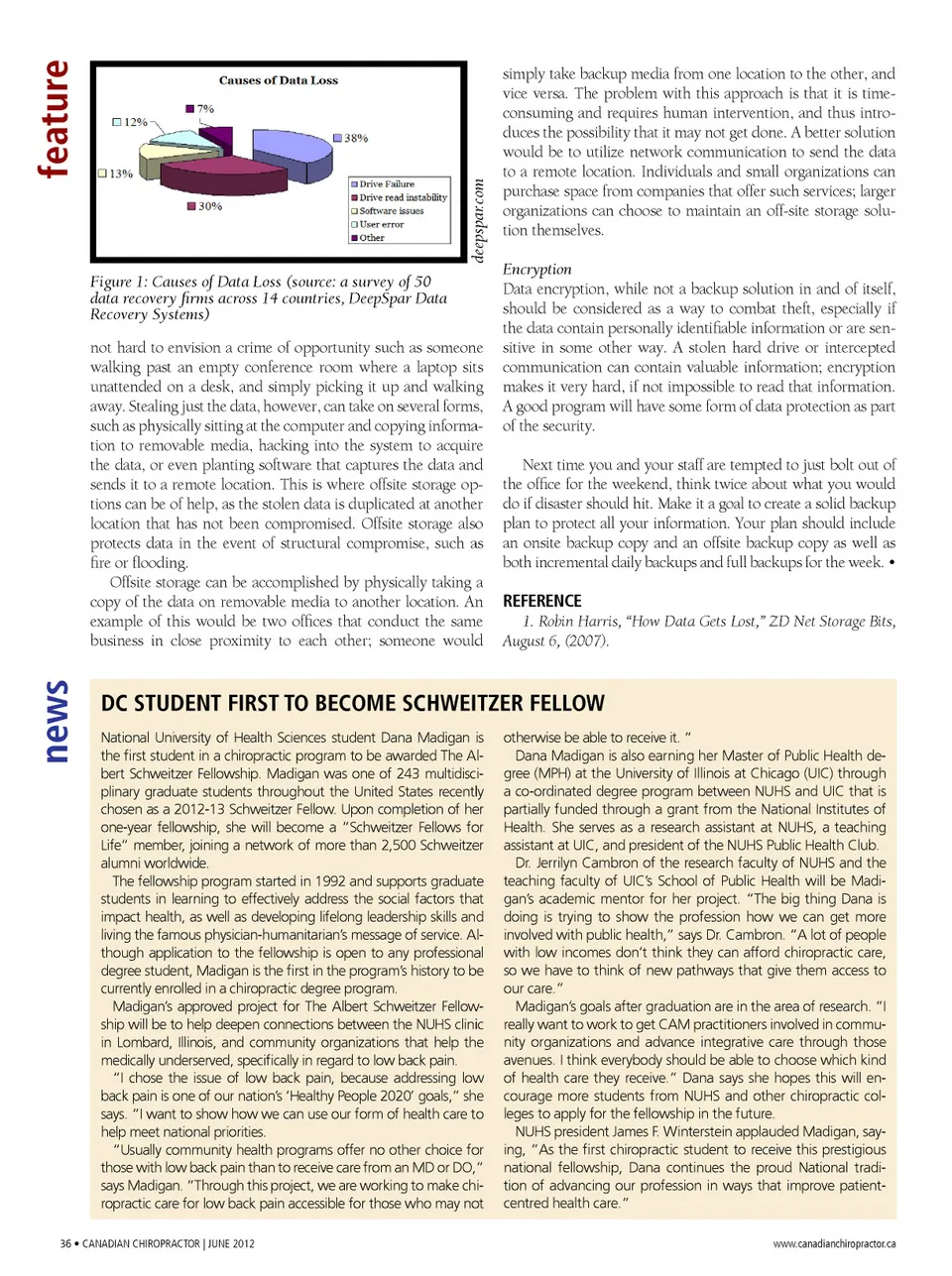
feature deepspar.com simply take backup media from one location to the other, and vice versa. The problem with this approach is that it is time-consuming and requires human intervention, and thus intro-duces the possibility that it may not get done. A better solution would be to utilize network communication to send the data to a remote location. Individuals and small organizations can purchase space from companies that offer such services; larger organizations can choose to maintain an off-site storage solu-tion themselves. Encryption Data encryption, while not a backup solution in and of itself, should be considered as a way to combat theft, especially if the data contain personally identifiable information or are sen-sitive in some other way. A stolen hard drive or intercepted communication can contain valuable information; encryption makes it very hard, if not impossible to read that information. A good program will have some form of data protection as part of the security. Next time you and your staff are tempted to just bolt out of the office for the weekend, think twice about what you would do if disaster should hit. Make it a goal to create a solid backup plan to protect all your information. Your plan should include an onsite backup copy and an offsite backup copy as well as both incremental daily backups and full backups for the week. • Figure 1: Causes of Data Loss (source: a survey of 50 data recovery firms across 14 countries, DeepSpar Data Recovery Systems) not hard to envision a crime of opportunity such as someone walking past an empty conference room where a laptop sits unattended on a desk, and simply picking it up and walking away. Stealing just the data, however, can take on several forms, such as physically sitting at the computer and copying informa-tion to removable media, hacking into the system to acquire the data, or even planting software that captures the data and sends it to a remote location. This is where offsite storage op-tions can be of help, as the stolen data is duplicated at another location that has not been compromised. Offsite storage also protects data in the event of structural compromise, such as fire or flooding. Offsite storage can be accomplished by physically taking a copy of the data on removable media to another location. An example of this would be two offices that conduct the same business in close proximity to each other; someone would referenCe 1. Robin Harris, “How Data Gets Lost,” ZD Net Storage Bits, August 6, (2007). news dC Student firSt to beCome SCHWeitZer felloW National University of Health Sciences student Dana Madigan is the first student in a chiropractic program to be awarded The Al-bert Schweitzer Fellowship. Madigan was one of 243 multidisci-plinary graduate students throughout the United States recently chosen as a 2012-13 Schweitzer Fellow. Upon completion of her one-year fellowship, she will become a “Schweitzer Fellows for Life” member, joining a network of more than 2,500 Schweitzer alumni worldwide. The fellowship program started in 1992 and supports graduate students in learning to effectively address the social factors that impact health, as well as developing lifelong leadership skills and living the famous physician-humanitarian’s message of service. Al-though application to the fellowship is open to any professional degree student, Madigan is the first in the program’s history to be currently enrolled in a chiropractic degree program. Madigan’s approved project for The Albert Schweitzer Fellow-ship will be to help deepen connections between the NUHS clinic in Lombard, Illinois, and community organizations that help the medically underserved, specifically in regard to low back pain. “I chose the issue of low back pain, because addressing low back pain is one of our nation’s ‘Healthy People 2020’ goals,” she says. “I want to show how we can use our form of health care to help meet national priorities. “Usually community health programs offer no other choice for those with low back pain than to receive care from an MD or DO,” says Madigan. “Through this project, we are working to make chi-ropractic care for low back pain accessible for those who may not otherwise be able to receive it. “ Dana Madigan is also earning her Master of Public Health de-gree (MPH) at the University of Illinois at Chicago (UIC) through a co-ordinated degree program between NUHS and UIC that is partially funded through a grant from the National Institutes of Health. She serves as a research assistant at NUHS, a teaching assistant at UIC, and president of the NUHS Public Health Club. Dr. Jerrilyn Cambron of the research faculty of NUHS and the teaching faculty of UIC’s School of Public Health will be Madi-gan’s academic mentor for her project. “The big thing Dana is doing is trying to show the profession how we can get more involved with public health,” says Dr. Cambron. “A lot of people with low incomes don’t think they can afford chiropractic care, so we have to think of new pathways that give them access to our care.” Madigan’s goals after graduation are in the area of research. “I really want to work to get CAM practitioners involved in commu-nity organizations and advance integrative care through those avenues. I think everybody should be able to choose which kind of health care they receive.” Dana says she hopes this will en-courage more students from NUHS and other chiropractic col-leges to apply for the fellowship in the future. NUHS president James F. Winterstein applauded Madigan, say-ing, “As the first chiropractic student to receive this prestigious national fellowship, Dana continues the proud National tradi-tion of advancing our profession in ways that improve patient-centred health care.” www.canadianchiropractor.ca 36 • CANADIAN CHIROPRACTOR | JUNE 2012
Chiropractic + Naturopathic Doctor June 2012: Page 36