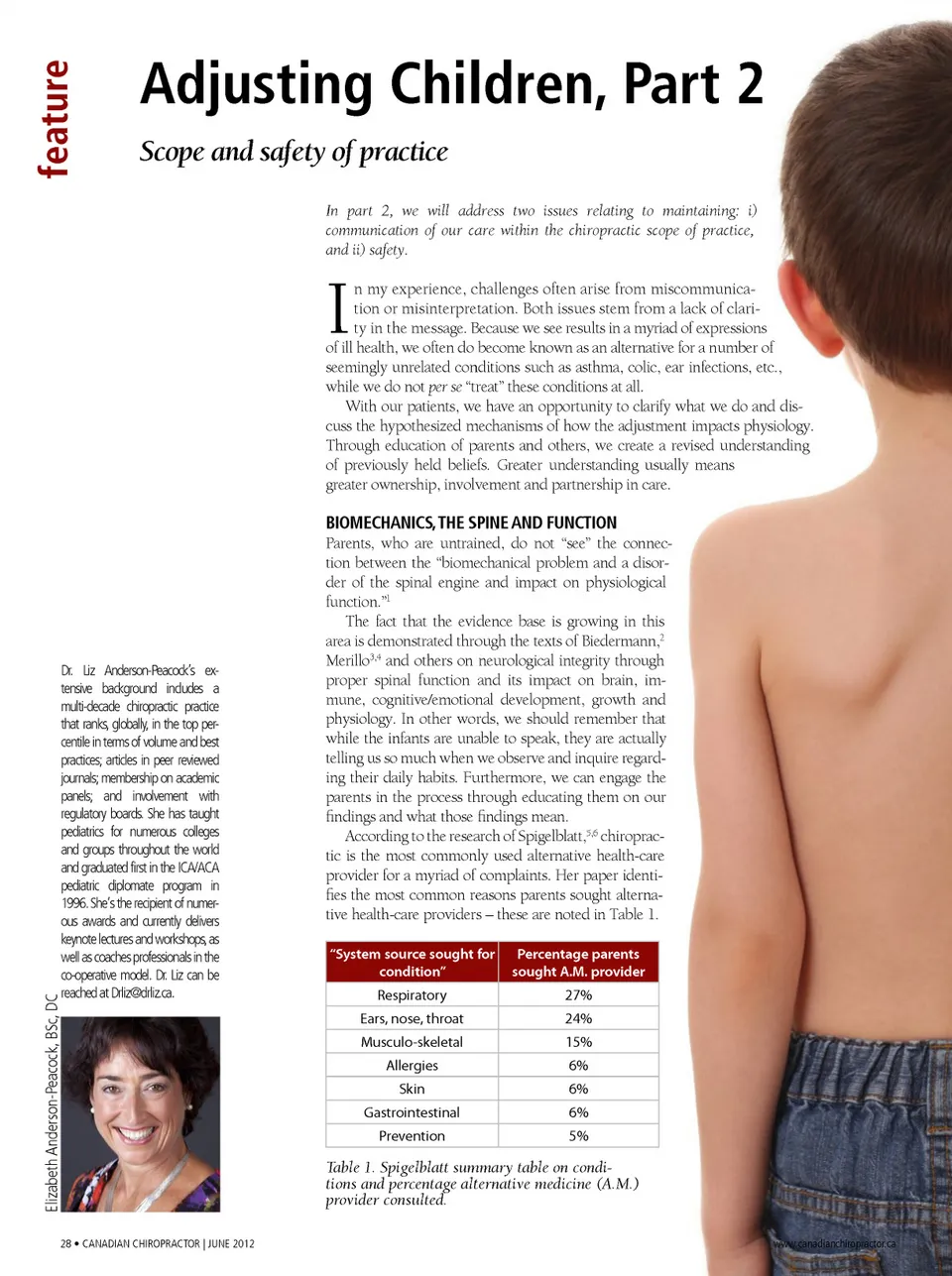
WHat doeS our SCoPe of PraCtiCe tell uS to do? Depending on the province you practise in, the wording might vary, but the scope of chiropractic is similar. In Ontario, the Chiro-practic Act of 1991 states that “the assess-ment of conditions re-lated to the spine, ner-vous system and joints and the diagnosis, pre-vention and treatment, primarily by adjustment of …” 7 With our scope in mind we may evaluate children with vari-ous expressions of poor allosta-sis and “dis-ease” but there is an ongoing need to keep educating parents that we are not treating “x” condi-tion but a spinal-muscular-neurological prob-lem impacting function in a way that is within our scope. To illustrate: Case Study #1: A child with a medically diagnosed recurrent otitis media While we are not treating the otitis me-dia, if findings indicate aberrant function in the motion of the spine – most often, of the upper cervical spine – we may encounter effects of vertebral subluxation complex patterns with muscle hypertonicity, loss in range of motion, specific chiropractic sub-luxation, and other elements of soft tissue congestion such as heat, swelling or lymph nodes. Those findings bring caring for that child into the chiropractic scope. Through-out the child’s program of care, some chi-ropractors may choose to observe the tym-panum, pre-and post-care, by way of otic examination – or refer to audiologists to monitor tympanum flexibility – to docu-ment the possibility of impact in physiol-ogy from the adjustments. But, while we are seeing many successful cases and combined reports where adjusting the child for neu-romusculoskeletal findings appears to cor-relate to improvement of the otitis as well, we must be clear that we are not treating the otitis itself. Case Study #2: A child with medically diagnosed asthma Chiropractic care calls for “the assess-ment of conditions related to the spine, nervous system and joints and the diagno-sis, prevention and treatment, primarily by adjustment of …” 7 However, while we do not treat asthma, we do find that many of these children pres-ent with subluxation patterns, muscular hypertonitities, congestion in soft tissues, costochondral/costovertebral dysfunctions that we can address through adjustments as well as challenges in their environments that are amenable to altered diets, and life-style recommendations that we can make that may have positive impacts on their asthma. When we are clear about what we are dealing with, there is less confusion as to the “why” we are doing what we do. iS adjuStinG KidS Safe? The last point I would like to touch on is safety. When we find ourselves being ques-tioned regarding the issue of safety in chiro-practic, we can rest assured that there is an www.canadianchiropractor.ca exceptional record of care. However, there exists literature that may suggest chiropractic for children is not safe. It is important for the profession to be fa-miliar with, and examine, these works for any inconsistencies that may help us ad-dress questions and clarify our position. For instance, in Vohra’s 8 Systematic Review of 2006 (published also online in 2007), a search involving 104 years, and including many disciplines of practitioners who “manipulate” was undertaken – in this review, 10 cases involving chiropractic care were identified. From the findings in this paper – a seminal document in the assessment of the safety of manipulations in children – a few challenges arise for chiropractic. But, these challenges can, and should, be easily ad-dressed by us, in the profession. 1) It is important to re-iterate that a number of disciplines that provide “spinal-manipulation” were included and no differ-entiation was made between spinal adjust-ment and manipulation. 2) The paper doesn’t actually come out to acknowledge that it cannot establish a link for causation or incidence of adverse events, whereas it does acknowledge that more work is necessary. 3) There is some confusion with respect to the application of parameters in the au-thors’ own definition of search inclusion as reports were included if they were observa-tional studies, controlled trials, surveys and only if adverse events were reported. In one case however, an inclusion was made from testimony at trial. 4) The paper mentions that it excluded over 30 articles where there were no side-effects mentioned. Even as an aside, it would actually have been important to, in-stead, emphasize that a number of papers had been published where no side-effects were identified. 5) The paper involved “misdiagno-sis” and “delayed diagnosis” as an adverse effect of spinal manipulation. This is like saying one side-effect of a dentist doing root canals was that (s)he didn’t realize the patient had a brain tumour, and that it is, therefore, the dentist’s fault that the brain tumour wasn’t diagnosed earlier. 6) When speaking about the lack of education in those groups who perform pediatric manipulation, the authors lump DOs in with DCs as though they were equally deficient in pediatric train-ing opportunities. In fact, as we discussed CANADIAN CHIROPRACTOR | JUNE 2012 • 29
Chiropractic + Naturopathic Doctor June 2012: Page 29