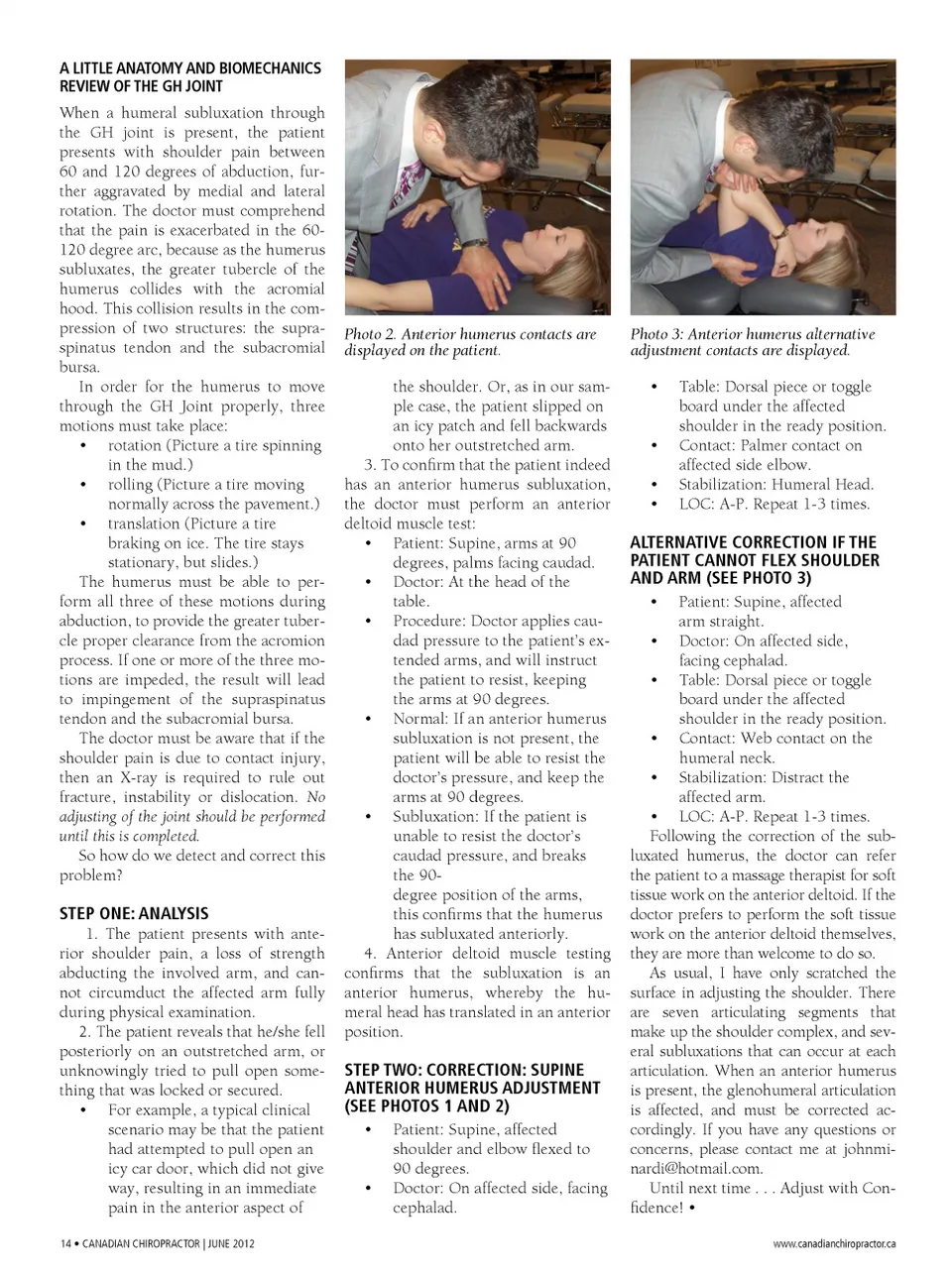
a little anatomy and biomeCHaniCS revieW of tHe GH joint When a humeral subluxation through the GH joint is present, the patient presents with shoulder pain between 60 and 120 degrees of abduction, fur-ther aggravated by medial and lateral rotation. The doctor must comprehend that the pain is exacerbated in the 60-120 degree arc, because as the humerus subluxates, the greater tubercle of the humerus collides with the acromial hood. This collision results in the com-pression of two structures: the supra-spinatus tendon and the subacromial bursa. In order for the humerus to move through the GH Joint properly, three motions must take place: • rotation (Picture a tire spinning in the mud.) • rolling (Picture a tire moving normally across the pavement.) • translation (Picture a tire braking on ice. The tire stays stationary, but slides.) The humerus must be able to per-form all three of these motions during abduction, to provide the greater tuber-cle proper clearance from the acromion process. If one or more of the three mo-tions are impeded, the result will lead to impingement of the supraspinatus tendon and the subacromial bursa. The doctor must be aware that if the shoulder pain is due to contact injury, then an X-ray is required to rule out fracture, instability or dislocation. No adjusting of the joint should be performed until this is completed. So how do we detect and correct this problem? Photo 2. Anterior humerus contacts are displayed on the patient. the shoulder. Or, as in our sam-ple case, the patient slipped on an icy patch and fell backwards onto her outstretched arm. 3. To confirm that the patient indeed has an anterior humerus subluxation, the doctor must perform an anterior deltoid muscle test: • Patient: Supine, arms at 90 degrees, palms facing caudad. • Doctor: At the head of the table. • Procedure: Doctor applies cau-dad pressure to the patient’s ex-tended arms, and will instruct the patient to resist, keeping the arms at 90 degrees. • Normal: If an anterior humerus subluxation is not present, the patient will be able to resist the doctor’s pressure, and keep the arms at 90 degrees. • Subluxation: If the patient is unable to resist the doctor’s caudad pressure, and breaks the 90-degree position of the arms, this confirms that the humerus has subluxated anteriorly. 4. Anterior deltoid muscle testing confirms that the subluxation is an anterior humerus, whereby the hu-meral head has translated in an anterior position. Photo 3: Anterior humerus alternative adjustment contacts are displayed. • Table: Dorsal piece or toggle board under the affected shoulder in the ready position. Contact: Palmer contact on affected side elbow. Stabilization: Humeral Head. LOC: A-P. Repeat 1-3 times. • • • SteP one: analySiS 1. The patient presents with ante-rior shoulder pain, a loss of strength abducting the involved arm, and can-not circumduct the affected arm fully during physical examination. 2. The patient reveals that he/she fell posteriorly on an outstretched arm, or unknowingly tried to pull open some-thing that was locked or secured. • For example, a typical clinical scenario may be that the patient had attempted to pull open an icy car door, which did not give way, resulting in an immediate pain in the anterior aspect of 14 • CANADIAN CHIROPRACTOR | JUNE 2012 SteP tWo: CorreCtion: SuPine anterior HumeruS adjuStment (See PHotoS 1 and 2) • Patient: Supine, affected shoulder and elbow flexed to 90 degrees. • Doctor: On affected side, facing cephalad. alternative CorreCtion if tHe Patient Cannot fleX SHoulder and arm (See PHoto 3) • Patient: Supine, affected arm straight. • Doctor: On affected side, facing cephalad. • Table: Dorsal piece or toggle board under the affected shoulder in the ready position. • Contact: Web contact on the humeral neck. • Stabilization: Distract the affected arm. • LOC: A-P. Repeat 1-3 times. Following the correction of the sub-luxated humerus, the doctor can refer the patient to a massage therapist for soft tissue work on the anterior deltoid. If the doctor prefers to perform the soft tissue work on the anterior deltoid themselves, they are more than welcome to do so. As usual, I have only scratched the surface in adjusting the shoulder. There are seven articulating segments that make up the shoulder complex, and sev-eral subluxations that can occur at each articulation. When an anterior humerus is present, the glenohumeral articulation is affected, and must be corrected ac-cordingly. If you have any questions or concerns, please contact me at [email protected]. Until next time . . . Adjust with Con-fidence! • www.canadianchiropractor.ca
Chiropractic + Naturopathic Doctor June 2012: Page 14