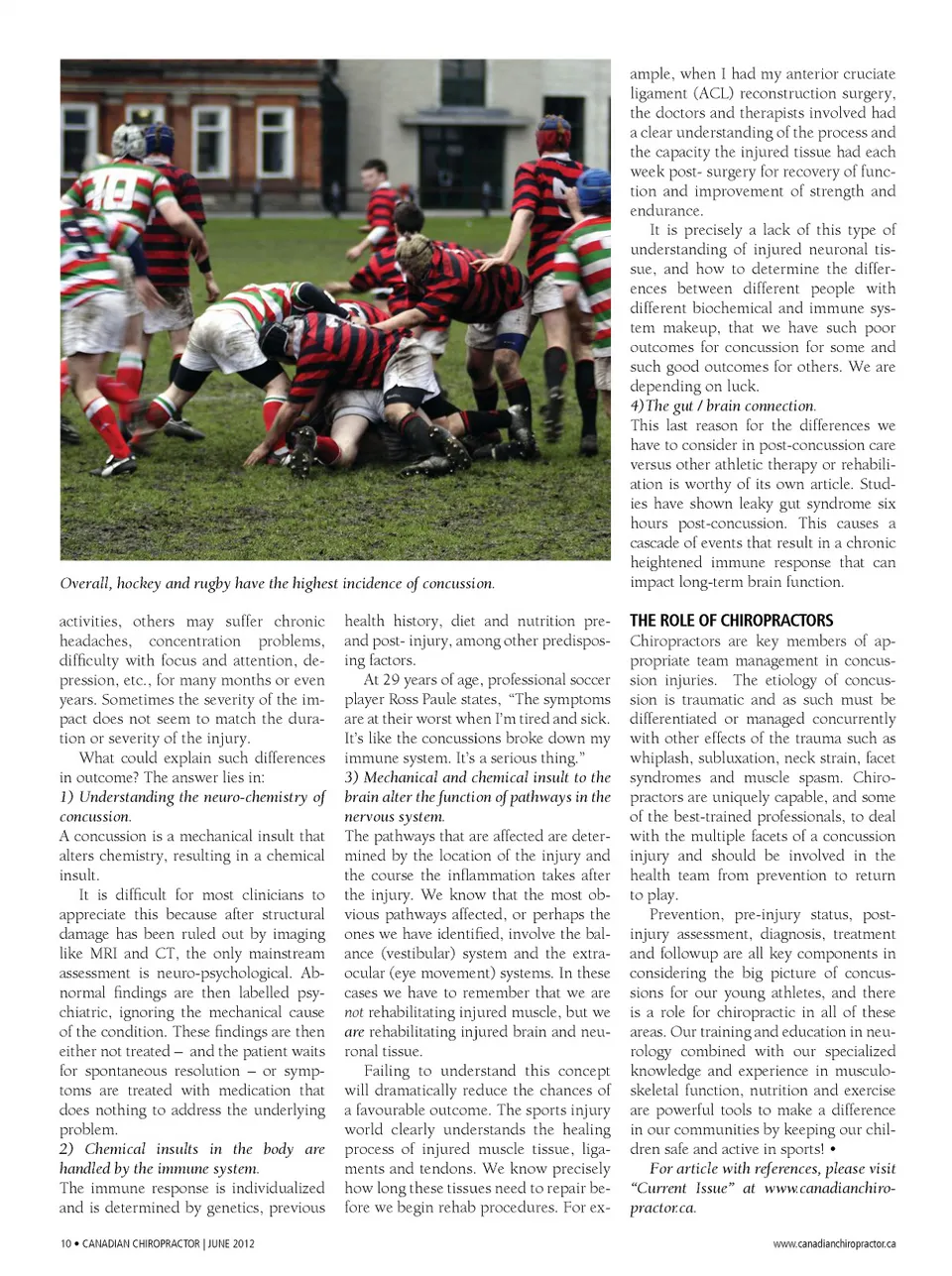
Overall, hockey and rugby have the highest incidence of concussion. activities, others may suffer chronic headaches, concentration problems, difficulty with focus and attention, de-pression, etc., for many months or even years. Sometimes the severity of the im-pact does not seem to match the dura-tion or severity of the injury. What could explain such differences in outcome? The answer lies in: 1) Understanding the neuro-chemistry of concussion. A concussion is a mechanical insult that alters chemistry, resulting in a chemical insult. It is difficult for most clinicians to appreciate this because after structural damage has been ruled out by imaging like MRI and CT, the only mainstream assessment is neuro-psychological. Ab-normal findings are then labelled psy-chiatric, ignoring the mechanical cause of the condition. These findings are then either not treated – and the patient waits for spontaneous resolution – or symp-toms are treated with medication that does nothing to address the underlying problem. 2) Chemical insults in the body are handled by the immune system. The immune response is individualized and is determined by genetics, previous 10 • CANADIAN CHIROPRACTOR | JUNE 2012 ample, when I had my anterior cruciate ligament (ACL) reconstruction surgery, the doctors and therapists involved had a clear understanding of the process and the capacity the injured tissue had each week post-surgery for recovery of func-tion and improvement of strength and endurance. It is precisely a lack of this type of understanding of injured neuronal tis-sue, and how to determine the differ-ences between different people with different biochemical and immune sys-tem makeup, that we have such poor outcomes for concussion for some and such good outcomes for others. We are depending on luck. 4)The gut / brain connection. This last reason for the differences we have to consider in post-concussion care versus other athletic therapy or rehabili-ation is worthy of its own article. Stud-ies have shown leaky gut syndrome six hours post-concussion. This causes a cascade of events that result in a chronic heightened immune response that can impact long-term brain function. health history, diet and nutrition pre-and post-injury, among other predispos-ing factors. At 29 years of age, professional soccer player Ross Paule states, “The symptoms are at their worst when I’m tired and sick. It’s like the concussions broke down my immune system. It’s a serious thing.” 3) Mechanical and chemical insult to the brain alter the function of pathways in the nervous system. The pathways that are affected are deter-mined by the location of the injury and the course the inflammation takes after the injury. We know that the most ob-vious pathways affected, or perhaps the ones we have identified, involve the bal-ance (vestibular) system and the extra-ocular (eye movement) systems. In these cases we have to remember that we are not rehabilitating injured muscle, but we are rehabilitating injured brain and neu-ronal tissue. Failing to understand this concept will dramatically reduce the chances of a favourable outcome. The sports injury world clearly understands the healing process of injured muscle tissue, liga-ments and tendons. We know precisely how long these tissues need to repair be-fore we begin rehab procedures. For ex-tHe role of CHiroPraCtorS Chiropractors are key members of ap-propriate team management in concus-sion injuries. The etiology of concus-sion is traumatic and as such must be differentiated or managed concurrently with other effects of the trauma such as whiplash, subluxation, neck strain, facet syndromes and muscle spasm. Chiro-practors are uniquely capable, and some of the best-trained professionals, to deal with the multiple facets of a concussion injury and should be involved in the health team from prevention to return to play. Prevention, pre-injury status, post-injury assessment, diagnosis, treatment and followup are all key components in considering the big picture of concus-sions for our young athletes, and there is a role for chiropractic in all of these areas. Our training and education in neu-th Anniversar rology combined with our specialized 0 6 knowledge and experience in musculo-skeletal function, nutrition and exercise are powerful tools to make a difference in our communities by keeping our chil-dren safe and active in sports! • For article with references, please visit “Current Issue” at www.canadianchiro-practor.ca. www.canadianchiropractor.ca
Chiropractic + Naturopathic Doctor June 2012: Page 10