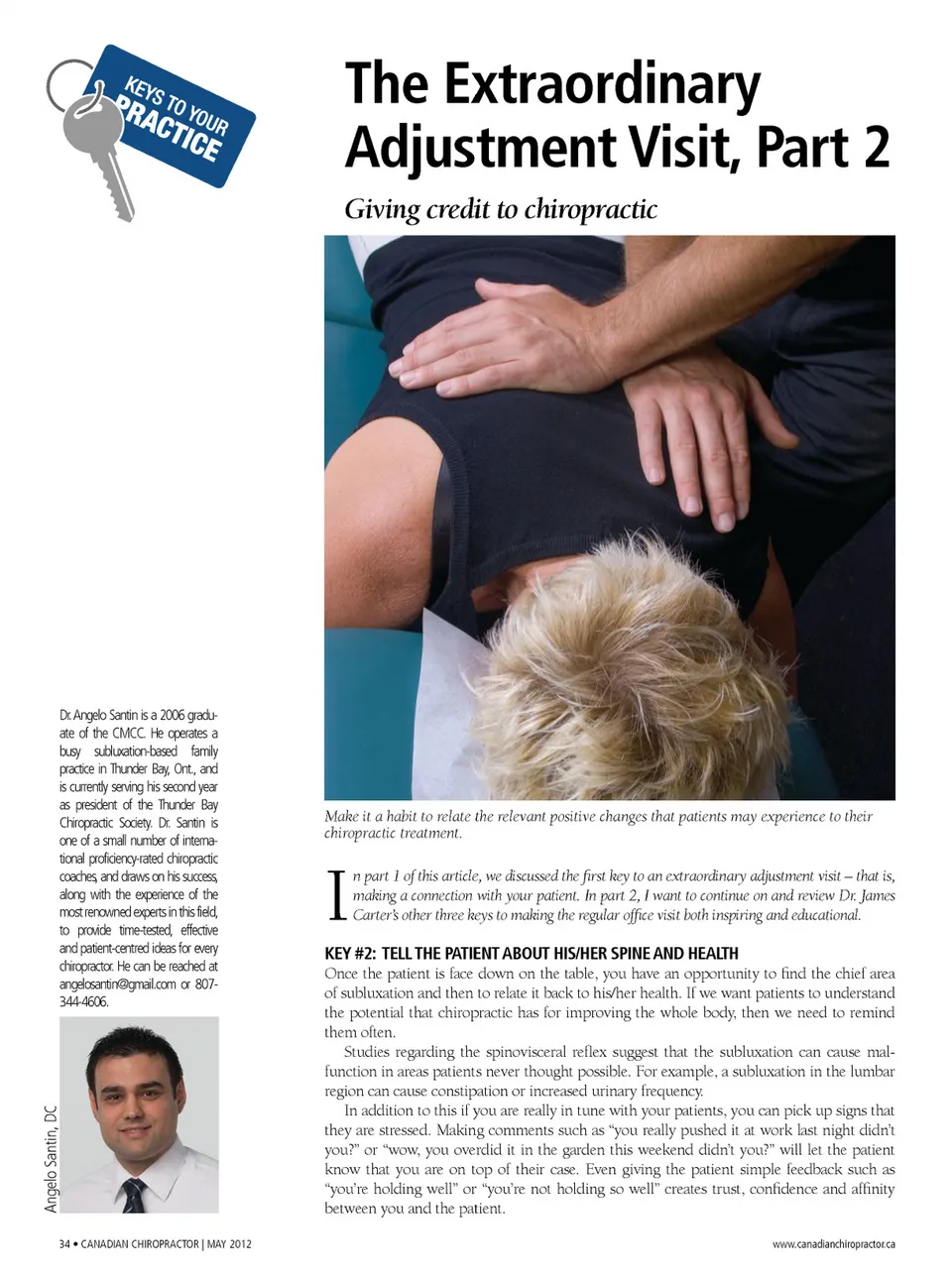
The Extraordinary Adjustment Visit, Part 2 Giving credit to chiropractic Dr. Angelo Santin is a 2006 gradu-ate of the CMCC. He operates a busy subluxation-based family practice in Thunder Bay, Ont., and is currently serving his second year as president of the Thunder Bay Chiropractic Society. Dr. Santin is one of a small number of interna-tional proficiency-rated chiropractic coaches, and draws on his success, along with the experience of the most renowned experts in this field, to provide time-tested, effective and patient-centred ideas for every chiropractor. He can be reached at [email protected] or 807-344-4606. Make it a habit to relate the relevant positive changes that patients may experience to their chiropractic treatment. I n part 1 of this article, we discussed the first key to an extraordinary adjustment visit – that is, making a connection with your patient. In part 2, I want to continue on and review Dr. James Carter’s other three keys to making the regular office visit both inspiring and educational. kEY #2: TEll THE PATIENT ABOUT HIS/HER SPINE AND HEAlTH Once the patient is face down on the table, you have an opportunity to find the chief area of subluxation and then to relate it back to his/her health. If we want patients to understand the potential that chiropractic has for improving the whole body, then we need to remind them often. Studies regarding the spinovisceral reflex suggest that the subluxation can cause mal-function in areas patients never thought possible. For example, a subluxation in the lumbar region can cause constipation or increased urinary frequency. In addition to this if you are really in tune with your patients, you can pick up signs that they are stressed. Making comments such as “you really pushed it at work last night didn’t you?” or “wow, you overdid it in the garden this weekend didn’t you?” will let the patient know that you are on top of their case. Even giving the patient simple feedback such as “you’re holding well” or “you’re not holding so well” creates trust, confidence and affinity between you and the patient. www.canadianchiropractor.ca Angelo Santin, DC 34 • CANADIAN CHIROPRACTOR | MAY 2012
Chiropractic + Naturopathic Doctor May 2012: Page 34